
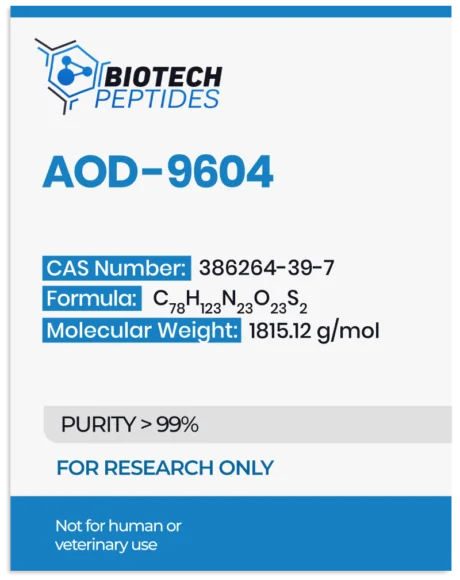
AOD 9604 (5mg)
$44.00
AOD 9604 peptides are synthesised and lyophilised in the USA.
Research Overview: Peptide Science and What Researchers Should Know
AOD 9604 (5mg) is a synthetic peptide that has attracted considerable interest within peptide research and biotechnology. Originally developed as an experimental approach to studying aspects of fat metabolism, AOD 9604 is derived from a specific portion of human growth hormone rather than being full-length growth hormone itself.
Today, AOD 9604 continues to appear in scientific discussions surrounding peptide chemistry, metabolic research, and experimental biotechnology. For researchers interested in peptide science, understanding the structure, history, research background, and regulatory status of AOD 9604 is important before evaluating any research material.
What Is AOD 9604?
AOD 9604 is a synthetic 16-amino-acid peptide fragment derived from the C-terminal region of human growth hormone. It was developed with the objective of investigating metabolic effects associated with this portion of the growth hormone molecule while avoiding some of the broader biological actions associated with full-length growth hormone.
Unlike human growth hormone, AOD 9604 was specifically investigated as an isolated peptide fragment. Early research explored whether this fragment could influence lipid metabolism without producing the same effects on IGF-1 and glucose metabolism associated with growth hormone.
This distinction is important when discussing AOD 9604 because it should not be described simply as “growth hormone.” Its chemical structure and biological research profile are different.
AOD 9604 and Peptide Research
AOD 9604 became particularly interesting to researchers because of its proposed relationship with lipid metabolism. Preclinical research investigated mechanisms involving fat oxidation and lipolysis, leading to interest in its potential applications in metabolic research.
Human clinical studies were subsequently conducted to evaluate safety, tolerability, and potential metabolic effects.
A published review summarised six randomised, double-blind, placebo-controlled clinical trials involving AOD 9604. The studies included approximately 893 participants and investigated different administration routes and dosage ranges. The researchers reported that AOD 9604 did not significantly increase IGF-1 and did not demonstrate the glucose-related effects associated with full-length growth hormone.
However, safety observations should not be interpreted as proof that AOD 9604 is effective for treating obesity or other medical conditions.
What Does the 5mg Specification Mean?
When a product is described as AOD 9604 (5mg), the “5mg” refers to the stated quantity of AOD 9604 in the product.
The amount of material contained in a research product should not be confused with a medically established dosage. There is currently no FDA-approved prescribing label establishing an approved therapeutic dose for AOD 9604.
For this reason, product specifications such as 5mg should be treated as information about the quantity of research material rather than as a recommendation for human administration.
Research on AOD 9604
The development history of AOD 9604 includes both laboratory research and human clinical investigation.
Researchers originally explored the peptide as a potential obesity-related therapeutic candidate. Clinical studies evaluated its safety and tolerability and examined whether the compound could produce meaningful metabolic effects.
Importantly, the FDA’s December 2024 evaluation materials state that AOD 9604 was originally developed for obesity treatment but did not demonstrate a clinically meaningful weight-loss outcome across the trial population.
This is an important distinction for anyone researching AOD 9604. The existence of clinical research does not mean that the compound is an approved weight-loss treatment.
AOD 9604 Safety Research
Published human research has examined the tolerability of AOD 9604. In the reviewed clinical trials, researchers reported no treatment-related serious adverse events or clinically significant changes in several monitored safety parameters. The studies also investigated IGF-1, glucose metabolism, and anti-AOD 9604 antibodies.
Some adverse events were reported during the studies, including headache and gastrointestinal symptoms. The available research therefore should not be interpreted as demonstrating that AOD 9604 is universally safe.
More importantly, research performed under controlled clinical conditions does not automatically establish the safety, purity, identity, or quality of every AOD 9604 product available commercially.
Is AOD 9604 FDA Approved?
No. AOD 9604 is not an FDA-approved drug for any therapeutic indication.
The FDA reviewed AOD 9604 and AOD 9604 acetate in connection with the agency’s evaluation of substances proposed for inclusion on the Section 503A bulk drug substances list. FDA materials identified concerns including limited evidence relevant to safety and effectiveness and questions regarding peptide impurities and characterisation.
Therefore, AOD 9604 should not be marketed as an FDA-approved medication or represented as an established treatment for obesity, weight loss, or other medical conditions.
Why Researchers Are Interested in AOD 9604
AOD 9604 remains scientifically interesting because it provides an example of how researchers can isolate and study specific regions of larger biological molecules.
Its development demonstrates several important principles in peptide science:
- Structure can influence biological activity.
- Small peptide fragments can behave differently from larger proteins.
- Synthetic peptides can be investigated for specific biological mechanisms.
- Clinical research is necessary to determine whether promising laboratory observations translate into meaningful human outcomes.
These principles make AOD 9604 a useful subject for discussions surrounding peptide chemistry and biotechnology.
AOD 9604 for Research Use
Research peptides require careful consideration of identity, purity, storage, handling, and analytical documentation.
Researchers evaluating AOD 9604 should consider documentation such as:
- Product identity
- Stated peptide quantity
- Purity information
- Lot or batch identification
- Analytical testing documentation
- Storage information
- Manufacturer or supplier information
These details can help researchers evaluate whether a research material is appropriate for their intended laboratory work.
AOD 9604 at Limitless Biotech
Limitless Biotech provides peptide-related research materials for customers interested in biotechnology and scientific research.
Our approach emphasises clear product information and responsible communication. AOD 9604 (5mg) should be understood as a research material and not as an FDA-approved medication or a substitute for professional medical treatment.
Researchers should review applicable laws, regulations, institutional requirements, and laboratory protocols before purchasing or handling research materials.
Frequently Asked Questions About AOD 9604 (5mg)
What is AOD 9604?
AOD 9604 is a synthetic peptide fragment derived from the C-terminal portion of human growth hormone. It was developed and investigated in connection with metabolic and obesity-related research.
What does AOD 9604 5mg mean?
The 5mg specification indicates the stated quantity of AOD 9604 contained in the research product. It does not represent an established medical dosage.
Is AOD 9604 the same as human growth hormone?
No. AOD 9604 is a peptide fragment derived from part of the human growth hormone sequence. It is not full-length human growth hormone.
Is AOD 9604 FDA approved?
No. AOD 9604 does not have FDA approval as a therapeutic drug. FDA materials have also raised questions concerning its suitability for inclusion as a bulk substance for compounding.
Has AOD 9604 been studied in humans?
Yes. Multiple randomised clinical studies investigated AOD 9604, including studies examining safety, tolerability, glucose-related parameters, and IGF-1.
Is AOD 9604 proven to cause weight loss?
No. Although AOD 9604 was investigated as an obesity treatment candidate, the FDA’s review notes that it did not produce a clinically meaningful weight-loss outcome across the trial population.
Where can researchers learn more about AOD 9604?
Researchers can consult peer-reviewed scientific literature, regulatory documents, and reputable scientific databases for information about AOD 9604.
Conclusion
AOD 9604 (5mg) represents an interesting chapter in modern peptide research. Its development illustrates how scientists investigate specific peptide fragments and explore their potential biological properties through laboratory and clinical research.
At the same time, responsible peptide education requires a clear distinction between research findings and established medical applications. AOD 9604 is not an FDA-approved therapeutic drug, and existing clinical evidence does not establish it as a proven weight-loss treatment.
For researchers and biotechnology enthusiasts, understanding the chemistry, development history, clinical evidence, and regulatory environment surrounding AOD 9604 provides a more informed foundation for evaluating this research peptide.
Research Use Notice: AOD 9604 products should be treated only as research materials where legally permitted. They are not intended to diagnose, treat, cure, or prevent any disease or medical condition. This content is provided for educational and research information and is not medical advice.
Brand
Biotech Peptides
Be the first to review “AOD 9604 (5mg)”
Related products
PEPTIDES
PEPTIDES
PEPTIDES
PEPTIDES
PEPTIDES
PEPTIDES

PEPTIDES
PEPTIDES
Reviews
There are no reviews yet.