
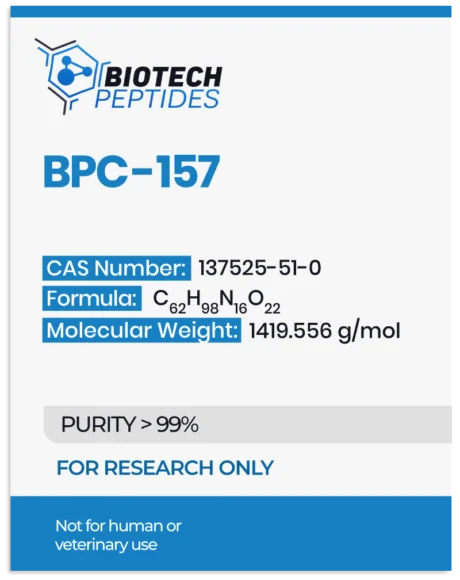
BPC-157 (5mg & 10mg)
Price range: $50.00 through $90.00
BPC-157 peptides are synthesised and lyophilised in the USA.
Research Overview, Peptide Science and Key Facts
BPC-157 (5mg & 10mg) is an experimental peptide that has attracted significant attention in biotechnology, peptide research, and studies involving tissue repair and gastrointestinal biology. BPC-157 is a synthetic peptide derived from a sequence associated with the body protection compound, a peptide originally identified in gastric juice.
Researchers have investigated BPC-157 in a variety of experimental models, particularly those examining tissue healing, vascular responses, gastrointestinal function, and cellular signalling. At the same time, it is important to distinguish preclinical research from established human medical evidence.
For researchers interested in peptide science, understanding the structure, research history, proposed mechanisms, and limitations of BPC-157 (5mg & 10mg) provides a useful foundation for evaluating this experimental compound.
What Is BPC-157?
BPC-157 is a synthetic peptide consisting of 15 amino acids. It has been investigated extensively in preclinical research, with studies exploring its potential effects on several biological processes.
The peptide has generated particular interest because experimental research has examined its relationship with tissue regeneration, angiogenesis, gastrointestinal function, and inflammatory pathways.
The name BPC is commonly associated with “body protection compound,” reflecting the peptide’s connection to research involving gastric protective mechanisms.
However, the existence of promising laboratory findings does not establish BPC-157 as an approved medical treatment.
What Does BPC-157 (5mg & 10mg) Mean?
The terms BPC-157 5mg and BPC-157 10mg refer to research products containing stated quantities of the peptide.
The 5mg and 10mg specifications describe the amount of research material supplied. They should not be interpreted as recommended human doses or treatment protocols.
Researchers evaluating BPC-157 should review product documentation, including peptide identity, purity, batch information, analytical testing, storage requirements, and available certificates of analysis.
BPC-157 and Tissue Research
One of the most widely investigated areas involving BPC-157 is tissue repair.
Preclinical studies have examined the peptide in different experimental models involving soft tissue, muscle, tendon, ligament, and other biological structures.
Researchers have proposed several mechanisms that could potentially contribute to observed effects, including interactions involving vascular signalling and tissue remodelling.
These findings have made BPC-157 a popular subject within experimental regenerative biology.
However, results observed in laboratory and animal studies cannot automatically be translated into equivalent outcomes in humans. Well-controlled clinical research is necessary to establish efficacy and safety.
BPC-157 and Angiogenesis Research
Angiogenesis refers to the formation of new blood vessels.
Blood vessel development is an important part of tissue repair because newly formed vessels can contribute to oxygen and nutrient delivery during regeneration.
Experimental research involving BPC-157 has investigated pathways associated with angiogenesis and vascular function. These studies have helped researchers explore how the peptide might interact with processes involved in tissue recovery.
The vascular research surrounding BPC-157 is one reason the compound continues to attract interest in regenerative medicine research.
BPC-157 and Gastrointestinal Research
Another important area of BPC-157 research involves the gastrointestinal system.
The peptide’s history is connected to gastric research, and experimental studies have investigated its potential relationship with gastrointestinal protection and intestinal function.
Researchers have examined BPC-157 in various experimental models involving gastrointestinal injury and inflammation.
This area of research is particularly interesting because it connects the peptide’s origins with broader investigations into cellular protection and tissue integrity.
Again, experimental results should not be interpreted as proof that BPC-157 can treat gastrointestinal diseases in humans.
BPC-157 and Inflammation Research
Inflammation is a complex biological response involving numerous signalling pathways and immune mechanisms.
Researchers have investigated BPC-157 in experimental models involving inflammatory responses, tissue injury, and recovery.
Some studies have reported changes in inflammatory and vascular markers following exposure to the peptide.
These findings have contributed to interest in BPC-157 as a research compound for studying the relationship between inflammation, vascular biology, and tissue remodelling.
Further research is required to determine whether these experimental observations have meaningful clinical implications.
Why Is BPC-157 Interesting to Researchers?
BPC-157 is scientifically interesting because research surrounding the peptide crosses several areas of biology.
Research has explored:
- Tissue regeneration
- Vascular biology
- Angiogenesis
- Gastrointestinal function
- Inflammatory signaling
- Cellular protection
- Wound healing
- Tendon and ligament research
- Muscle research
- Peptide chemistry
This broad research profile makes BPC-157 an interesting compound for laboratories investigating interactions between peptides and biological repair mechanisms.
BPC-157 and Regenerative Research
Regenerative biology focuses on understanding how tissues respond to injury and how cellular and molecular processes contribute to recovery.
BPC-157 has been investigated within this field primarily through preclinical studies.
Researchers have explored whether the peptide may influence cellular signalling, blood vessel formation, fibroblast activity, and other processes involved in tissue remodelling.
These studies provide hypotheses for further investigation but do not establish BPC-157 as a clinically proven regenerative therapy.
BPC-157 Product Quality and Research Considerations
When evaluating BPC-157 (5mg & 10mg) for legitimate research, product characterisation is particularly important.
Researchers may want to review:
- Peptide identity
- Stated quantity
- Purity information
- Lot or batch number
- Certificate of Analysis, where available
- Analytical testing
- Storage recommendations
- Manufacturer or supplier information
Synthetic peptides can be affected by degradation, impurities, aggregation, and storage conditions. Reliable analytical documentation can therefore be important when researchers are comparing materials or conducting reproducible experiments.
Is BPC-157 FDA Approved?
BPC-157 should not be represented as an FDA-approved treatment for injuries, inflammation, gastrointestinal conditions, or any other medical condition.
The FDA has identified BPC-157 among substances for which safety concerns and limited safety information are relevant in the context of compounding. The agency has also highlighted concerns that can arise with peptide products, including issues surrounding characterisation, impurities, and immunogenicity.
Consequently, research interest should not be confused with regulatory approval or established clinical effectiveness.
Frequently Asked Questions About BPC-157 (5mg & 10mg)
What is BPC-157?
BPC-157 is a synthetic 15-amino-acid peptide that has been investigated primarily in preclinical research involving tissue repair, gastrointestinal biology, vascular function, and cellular signalling.
What does BPC-157 5mg mean?
BPC-157 5mg refers to a research product containing a stated quantity of 5 milligrams of BPC-157. It does not represent a recommended human dosage.
What does BPC-157 10mg mean?
BPC-157 10mg refers to a research product containing a stated quantity of 10 milligrams of the peptide. The quantity should not be interpreted as a treatment recommendation.
What is BPC-157 researched for?
Research has investigated BPC-157 in areas including tissue repair, gastrointestinal biology, angiogenesis, vascular signalling, inflammation, and regenerative biology.
Is BPC-157 a regenerative medicine?
BPC-157 is an experimental research peptide that has been investigated in regenerative biology. It should not be described as an established regenerative medicine or approved treatment.
Does BPC-157 help injuries?
Preclinical research has investigated BPC-157 in models of tissue injury and repair. However, experimental findings do not establish that it safely or effectively treats injuries in humans.
Is BPC-157 FDA approved?
No. BPC-157 should not be marketed as an FDA-approved medication or treatment.
Why is BPC-157 popular in peptide research?
Its broad preclinical research profile involving tissue repair, vascular biology, gastrointestinal research, and cellular signaling has generated considerable scientific and biotechnology interest.
How should researchers evaluate BPC-157 products?
Researchers should consider identity, purity, stated quantity, batch information, analytical testing, storage requirements, and available certificates of analysis.
Is BPC-157 safe for human use?
Current evidence does not establish BPC-157 as an approved or proven human treatment. Safety can depend on factors including purity, formulation, route of administration, and exposure. Experimental research should therefore not be interpreted as establishing general human safety.
Final Thoughts on BPC-157 (5mg & 10mg)
BPC-157 (5mg & 10mg) is an intriguing experimental peptide with a substantial history of preclinical investigation. Researchers have examined the compound in relation to tissue repair, angiogenesis, gastrointestinal biology, inflammation, and cellular signalling.
Its broad research profile illustrates the potential complexity of peptide biology. Rather than focusing on a single pathway, scientists have investigated how BPC-157 may interact with several biological processes involved in tissue response and repair.
At the same time, responsible peptide research requires a clear distinction between laboratory findings and established clinical evidence. BPC-157 should not be presented as a guaranteed treatment for injuries, gastrointestinal conditions, inflammation, or other health problems.
For biotechnology researchers, the most useful approach is to examine the available scientific literature alongside product characterisation, analytical data, and applicable regulatory requirements.
Research Use Notice: BPC-157 products should be treated as research materials where legally permitted. This information is provided for educational and scientific purposes only and does not constitute medical advice, treatment recommendations, or instructions for human use.
| Please select a size | 5mg, 10mg |
|---|
Brand
Biotech Peptides
Be the first to review “BPC-157 (5mg & 10mg)”
Related products
PEPTIDES
PEPTIDES

PEPTIDES
PEPTIDES

PEPTIDES
PEPTIDES
PEPTIDES

PEPTIDES
Reviews
There are no reviews yet.