
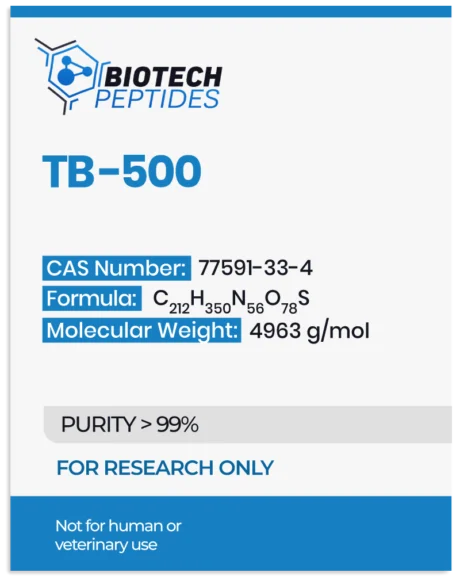
TB-500 (Thymosin Beta-4) (10mg)

$122.00
TB-500 peptides are synthesised and lyophilised in the USA.
Exploring the Science Behind a Thymosin Beta-4 Research Peptide
TB-500 (10mg) is a synthetic peptide associated with research into thymosin beta-4, cellular migration, tissue biology, and wound healing mechanisms. It has attracted considerable interest in peptide research because of its connection to biological processes involved in cell movement, angiogenesis, inflammation, and tissue remodelling.
The name TB-500 is commonly used in commercial and research contexts to describe a synthetic peptide related to thymosin beta-4 (Tβ4). However, the terminology can be confusing, and researchers should distinguish between specific molecular preparations rather than assuming that every product labelled TB-500 is identical to naturally occurring thymosin beta-4.
This article explores the scientific background of TB-500 10mg, its relationship with thymosin beta-4, areas of research interest, and frequently asked questions.
What Is TB-500?
TB-500 is commonly described as a synthetic peptide related to thymosin beta-4, a naturally occurring peptide involved in numerous cellular processes.
Thymosin beta-4 is present in many tissues and has been investigated for its role in cellular migration, actin regulation, angiogenesis, inflammation, and tissue repair.
TB-500 is frequently discussed in the context of research into these mechanisms. However, researchers should carefully examine the exact molecular identity of a particular preparation because terminology used in peptide markets is not always consistent with scientific nomenclature.
The 10mg designation refers to the stated amount of material in a particular preparation. It represents mass and should not be interpreted as a recommended amount for human administration.
The Science Behind Thymosin Beta-4
To understand TB-500 research, it is useful to understand thymosin beta-4.
Thymosin beta-4 is a small peptide consisting of 43 amino acids. It has been studied extensively because of its interactions with actin, an important structural protein found in cells.
Actin is involved in cell shape, movement, division, and intracellular organization.
Thymosin beta-4 can interact with actin and influence the availability of actin monomers within cells. This relationship is one reason scientists are interested in its potential role in cellular migration and tissue remodeling.
TB-500 and Cellular Migration
Cell migration is an essential biological process.
During tissue repair, cells must move toward areas where they are needed. This includes processes involving epithelial cells, endothelial cells, fibroblasts, and immune cells.
Researchers have investigated thymosin beta-4 and related peptides because of their potential relationship with cellular movement.
Studying these pathways may help scientists understand how cells coordinate responses following tissue injury.
However, findings from laboratory models should not automatically be interpreted as proof that a particular peptide accelerates healing in humans.
TB-500 and Tissue Repair Research
Tissue repair involves several overlapping processes.
These can include inflammation, cellular migration, formation of new tissue, extracellular matrix remodeling, and restoration of normal tissue structure.
Thymosin beta-4 has been investigated in experimental models involving these processes. Researchers have explored whether the peptide influences cellular behavior during different stages of tissue repair.
This makes TB-500 a subject of interest within regenerative biology and peptide research.
Scientific evidence remains important when evaluating claims about tissue regeneration, and laboratory observations should be distinguished from established medical treatments.
TB-500 and Angiogenesis Research
Angiogenesis is the formation of new blood vessels from existing vascular structures.
New blood vessel formation is an important part of tissue biology because developing or repairing tissues require adequate blood supply.
Research involving thymosin beta-4 has examined its relationship with angiogenic signaling and endothelial cell behavior.
These investigations have helped scientists explore the molecular mechanisms connecting peptide signaling, cellular migration, and vascular development.
The complexity of angiogenesis means that research findings should be interpreted within the specific experimental context.
TB-500 and Actin Biology
One of the most interesting aspects of thymosin beta-4 research is its relationship with actin.
Actin is a fundamental component of the cytoskeleton, the internal structural network that helps cells maintain their shape and move through their environment.
Because cell movement requires coordinated changes in the cytoskeleton, molecules that interact with actin can have important effects on cellular behavior.
TB-500 research is therefore connected to a much broader field of cytoskeletal biology.
TB-500 and Inflammation Research
Inflammation is another area associated with thymosin beta-4 research.
Following tissue injury, inflammatory signaling helps coordinate the body’s response. Immune cells and signaling molecules participate in clearing damaged material and initiating repair processes.
Researchers have examined whether thymosin beta-4 can influence aspects of inflammatory signaling.
These studies are relevant to understanding how peptides interact with complex biological systems. They do not, however, establish TB-500 as an approved anti-inflammatory or wound-healing treatment.
TB-500 (10mg) for Research
A preparation labeled TB-500 10mg generally indicates a stated quantity of peptide.
For legitimate research applications, investigators may examine:
- Molecular identity
- Peptide purity
- Certificate of analysis
- Batch or lot information
- Molecular characterization
- Formulation
- Stability
- Storage conditions
The stated 10mg quantity does not establish a clinical dose, therapeutic benefit, or suitability for human administration.
Why Researchers Are Interested in TB-500
TB-500 is scientifically interesting because research surrounding thymosin beta-4 touches several areas of modern biology.
These include:
- Cellular migration
- Actin and cytoskeletal biology
- Tissue remodeling
- Wound healing mechanisms
- Angiogenesis
- Inflammatory signaling
- Regenerative biology
- Peptide pharmacology
Investigating these pathways can help researchers understand how cells respond to injury and environmental changes.
TB-500 vs. Thymosin Beta-4
The terms TB-500 and thymosin beta-4 are sometimes used interchangeably online, but researchers should be cautious about doing so.
Thymosin beta-4 refers to the naturally occurring 43-amino-acid peptide.
TB-500 is commonly used as a name for a synthetic peptide preparation associated with thymosin beta-4 research. The exact molecular composition of products marketed under this name should be verified through appropriate analytical documentation.
This distinction is particularly important when interpreting scientific literature.
Frequently Asked Questions About TB-500 (10mg)
What is TB-500?
TB-500 is a synthetic peptide commonly associated with research into thymosin beta-4 and biological processes such as cellular migration, tissue remodelling, angiogenesis, and actin regulation.
What does TB-500 10mg mean?
TB-500 10mg indicates a preparation containing a stated quantity of the peptide. The 10mg figure represents mass and should not be interpreted as a recommended human dose.
Is TB-500 the same as thymosin beta-4?
The terminology is often used interchangeably in commercial discussions, but researchers should not automatically assume they are identical. Thymosin beta-4 is a naturally occurring 43 amino acid peptide, while TB-500 is generally marketed as a synthetic peptide related to thymosin beta-4.
What is thymosin beta-4?
Thymosin beta-4 is a naturally occurring peptide that has been studied extensively for its interactions with actin and its potential involvement in cellular migration, angiogenesis, inflammation, and tissue remodeling.
Why is TB-500 studied in tissue research?
Research interest comes from the relationship between thymosin beta-4 and cellular processes involved in tissue response, including cell migration, cytoskeletal organization, and vascular biology.
Is TB-500 a growth factor?
TB-500 is not generally classified as a conventional growth factor. It is a peptide associated with thymosin beta-4 research and cellular signaling.
Is TB-500 approved as a medicine?
Regulatory status depends on the specific compound, formulation, indication, and jurisdiction. Research-grade TB-500 should not automatically be considered an approved pharmaceutical treatment.
Is TB-500 safe for human use?
Safety cannot be established from a product label or research description alone. TB-500 is a biologically active research compound, and laboratory findings do not automatically establish safety or effectiveness for personal use.
What should researchers look for when evaluating TB-500?
Researchers may consider molecular identity, purity, analytical testing, certificate of analysis, batch information, formulation, stability, and storage requirements. Appropriate laboratory and regulatory standards should also be followed.
Conclusion: Understanding the Science Behind TB-500
TB-500 (10mg) is a research peptide commonly associated with thymosin beta-4 and scientific investigations into cellular migration, actin biology, tissue remodelling, angiogenesis, and inflammatory processes.
Its research significance comes from the role that thymosin beta-4 plays in fundamental cellular mechanisms. Understanding how cells move, reorganise their cytoskeleton, respond to injury, and participate in tissue remodelling remains an important area of modern biological research.
When evaluating TB-500 10mg, researchers should distinguish commercial terminology from precise molecular identity. Appropriate analytical documentation, purity information, batch details, and formulation data can help establish what a particular research preparation contains.
As research into regenerative biology and peptide signalling continues, TB-500 and thymosin beta-4 remain subjects of scientific interest. Their study provides researchers with an opportunity to investigate the complex relationship between peptide biology, cellular movement, vascular signalling, and tissue responses.
Brand
Biotech Peptides
Be the first to review “TB-500 (Thymosin Beta-4) (10mg)”
Related products
PEPTIDES
PEPTIDES
PEPTIDES

PEPTIDES
PEPTIDES
PEPTIDES
PEPTIDES
PEPTIDES
Reviews
There are no reviews yet.