
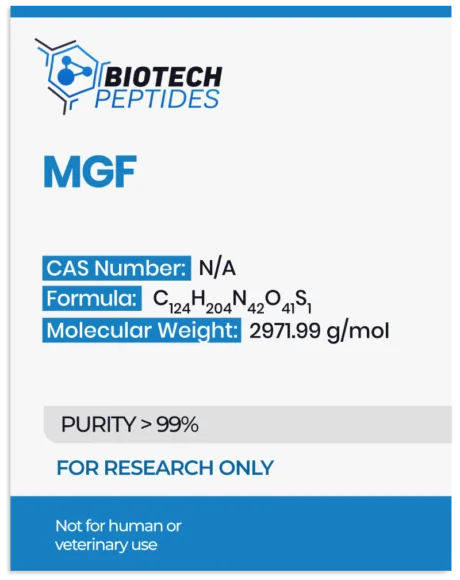
MGF (Mechano-Growth Factor) (5mg)

$57.00
MGF (Mechano-Growth Factor) peptides are synthesised and lyophilised in the USA.
Research Overview, Biological Properties and Frequently Asked Questions
MGF (Mechano-Growth Factor) (5mg) is a peptide associated with research into muscle biology, tissue repair, cellular signalling, and the biological response to mechanical stress. Also referred to as mechano-growth factor, MGF has attracted scientific interest because of its relationship with insulin-like growth factor signalling and its proposed role in how tissues respond to physical or mechanical stimuli.
Researchers studying MGF 5mg may investigate its molecular characteristics, cellular interactions, and relationship with muscle and tissue biology. Understanding MGF requires distinguishing it from conventional growth factors and recognising that research findings do not automatically establish clinical applications.
This article provides an educational overview of MGF, its biological background, research interests, and frequently asked questions.
What Is MGF?
Mechano-Growth Factor, commonly abbreviated as MGF, is a peptide associated with the insulin-like growth factor 1 (IGF-1) system. It has been investigated in connection with tissue responses to mechanical stress and cellular processes involving muscle.
MGF is generally discussed as a splice variant associated with the IGF-1 gene. Alternative splicing can produce different molecular forms from the same gene, potentially allowing biological signals to vary between tissues and physiological conditions.
The relationship between MGF and IGF-1 is therefore an important area of research. Scientists have explored how different IGF-1-related peptides may participate in processes involving cell growth, differentiation, and tissue remodelling.
The 5mg designation describes the stated amount of peptide in a particular research preparation. It should not be interpreted as a recommended amount for human administration.
How Is MGF Related to IGF-1?
IGF-1 is an important growth factor involved in numerous biological processes. It participates in signalling pathways associated with cell growth, differentiation, metabolism, and tissue development.
MGF has been investigated as an IGF-1-related splice variant that may have distinct biological characteristics.
Research into alternative IGF-1 variants is important because gene expression is not always a simple process. Cells can produce different molecular forms depending on tissue type and biological conditions.
MGF research therefore contributes to broader scientific interest in how growth factor signalling responds to mechanical stress and tissue damage.
MGF and Mechanical Stress
The name Mechano-Growth Factor reflects the peptide’s association with research into mechanical loading and tissue response.
Mechanical stress occurs naturally when tissues experience forces such as stretching, resistance, movement, or physical loading. Skeletal muscle is particularly responsive to mechanical stimuli.
Scientists have investigated molecular signalling pathways that may become active following mechanical stress. MGF has been studied as part of this broader biological response.
This research may help scientists better understand how cells detect changes in their physical environment and translate those changes into biochemical signals.
MGF and Muscle Research
Muscle biology is one of the major areas associated with MGF research.
Skeletal muscle is a highly adaptable tissue. In response to changes in mechanical demands, nutrition, hormones, and other factors, muscle cells can undergo structural and metabolic changes.
Researchers have investigated growth factor pathways to understand mechanisms involved in muscle cell activity, repair, and remodelling.
MGF is particularly interesting because of its proposed connection with the response of muscle tissue to mechanical stress. However, laboratory observations should not be interpreted as proof that externally administered MGF produces a particular outcome in humans.
MGF and Satellite Cells
Another important topic in muscle research is the role of satellite cells.
Satellite cells are specialised muscle stem cells involved in skeletal muscle maintenance and regeneration. Under appropriate biological conditions, they can become activated and contribute to muscle repair.
Growth factor signalling is one of many systems involved in regulating these cells.
Research involving MGF has explored possible relationships between IGF-1-related signalling and cellular processes relevant to muscle regeneration. These mechanisms remain an area of scientific investigation.
MGF and Tissue Repair Research
Beyond skeletal muscle, growth factor signalling is relevant to broader tissue biology.
Cells must coordinate processes such as proliferation, differentiation, migration, and extracellular matrix remodelling when tissues undergo structural changes.
Researchers have therefore investigated growth factor pathways as potential components of tissue repair mechanisms.
MGF is of interest because of its proposed relationship with tissue response to mechanical stress. Nevertheless, research findings should be interpreted carefully, particularly when moving from experimental models to potential human applications.
MGF (5mg) for Research
A product labeled MGF 5mg generally refers to a research preparation containing a stated quantity of mechano-growth factor.
For legitimate laboratory research, investigators may be interested in characteristics such as:
- Peptide identity
- Purity
- Molecular characterization
- Certificate of analysis
- Batch information
- Formulation
- Storage conditions
- Analytical testing
The quantity listed on a research product does not establish a clinical dose or indicate that the material is approved for human use.
Why Is MGF Scientifically Interesting?
MGF is interesting to researchers because it sits at the intersection of several important biological areas.
These include:
- IGF-1 signaling
- Muscle physiology
- Mechanical stress responses
- Cellular regeneration
- Growth factor biology
- Tissue remodeling
- Satellite cell research
Understanding these mechanisms may help researchers develop a clearer picture of how tissues respond to physical stress and injury.
MGF vs. IGF-1
MGF and IGF-1 are closely related but should not be treated as identical compounds.
IGF-1 is a well-established growth factor with important physiological functions throughout the body. MGF is generally discussed as an alternatively spliced IGF-1-related peptide associated with specific biological contexts.
Their molecular characteristics, expression patterns, and proposed functions can differ. Consequently, scientific information about conventional IGF-1 should not automatically be applied to MGF.
Frequently Asked Questions About MGF (5mg)
What is MGF?
MGF stands for Mechano-Growth Factor. It is an IGF-1-related peptide that has been investigated in connection with mechanical stress, muscle biology, cellular signalling, and tissue remodelling.
What does MGF 5mg mean?
MGF 5mg indicates that a research preparation contains a stated quantity of five milligrams of peptide. The number represents mass and does not establish a recommended human dose.
Is MGF the same as IGF-1?
No. MGF is generally described as an alternatively spliced form associated with the IGF-1 gene, while IGF-1 refers to the broader growth factor itself. They are related but should not be considered interchangeable.
Why is MGF studied in muscle research?
Researchers are interested in MGF because of its proposed connection to mechanical stress responses and IGF-1-related signalling in skeletal muscle. Studies may examine its relationship with muscle cells, satellite cells, and tissue remodelling.
Is MGF naturally produced in the body?
MGF has been investigated as an IGF-1-related splice variant associated with tissue responses. Research into its endogenous production and biological role continues to examine how IGF-1 expression and processing vary under different conditions.
Is MGF approved as a medicine?
Regulatory status depends on the jurisdiction and specific product. Research-grade MGF should not automatically be considered an approved medication or treatment.
Is MGF safe for human use?
Safety cannot be established simply from a product label or laboratory research study. MGF is biologically active, and human use should not be inferred from experimental findings. Anyone considering medically relevant peptide use should consult an appropriately qualified healthcare professional.
What should researchers look for when evaluating MGF?
Researchers may examine identity, purity, analytical testing, batch information, certificate of analysis, formulation, and storage requirements. Reliable documentation is important when evaluating research materials.
Conclusion
MGF (Mechano-Growth Factor) (5mg) is an IGF-1-related peptide that has generated scientific interest in areas including muscle biology, mechanical stress responses, satellite cell activity, cellular signalling, and tissue remodelling.
Its relationship with the IGF-1 system makes MGF an interesting subject for researchers investigating how tissues respond to mechanical and physiological changes. At the same time, laboratory research should be distinguished from established clinical applications.
For legitimate research purposes, evaluating the identity, purity, analytical documentation, formulation, and storage requirements of MGF can help researchers better understand the material being studied. As research into growth factor signalling continues, MGF remains a subject of interest in the broader field of peptide and muscle biology.
Brand
Biotech Peptides
Be the first to review “MGF (Mechano-Growth Factor) (5mg)”
Related products

PEPTIDES
PEPTIDES

PEPTIDES
PEPTIDES

PEPTIDES
PEPTIDES
PEPTIDES

PEPTIDES
Reviews
There are no reviews yet.