
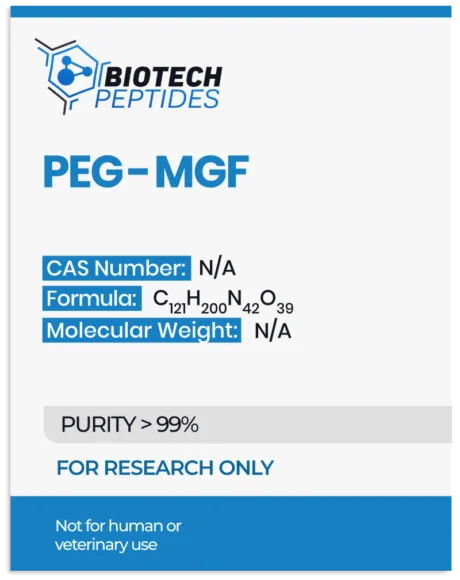
PEG-MGF (Pegylated MGF) (5mg)
$78.00
PEG-MGF (Pegylated MGF) peptides are synthesised and lyophilised in the USA.
Exploring the Science Behind PEGylated Mechano-Growth Factor
PEG-MGF (5mg) is a modified peptide that has attracted scientific interest because of its relationship with Mechano-Growth Factor (MGF) and the broader insulin-like growth factor (IGF) signalling system. Researchers have explored PEG-MGF in the context of peptide stability, growth factor biology, cellular signalling, and muscle research.
PEG-MGF is commonly discussed as a PEGylated form of MGF. PEGylation refers to the attachment of polyethene glycol to a molecule, a modification used in pharmaceutical and biochemical research to alter characteristics such as molecular size, stability, and persistence.
For researchers interested in PEG-MGF 5mg, understanding the underlying biology is essential. This guide explores what PEG-MGF is, how it relates to MGF and IGF-1, why PEGylation matters, and what researchers should consider when evaluating this type of peptide preparation.
The Science Behind PEG-MGF
MGF, or Mechano-Growth Factor, is commonly discussed as an IGF-1-related peptide associated with research into muscle biology and mechanical stress responses.
PEG-MGF combines the concept of MGF-related signalling with PEGylation, a biochemical modification that attaches polyethene glycol chains to a molecule.
PEGylation has been extensively studied across biotechnology because it can alter the physical and pharmacological characteristics of molecules. Depending on the molecule and PEG structure involved, PEGylation may influence properties such as molecular size, solubility, resistance to degradation, and circulation characteristics.
These properties make PEGylated molecules interesting subjects for laboratory investigation.
What Is PEGylation?
PEGylation is the process of attaching polyethene glycol, commonly abbreviated as PEG, to a biological molecule.
Polyethene glycol is a polymer that has been used in pharmaceutical and biochemical research for decades. Scientists have investigated PEGylation as a way of modifying proteins and peptides.
The modification can change how a molecule behaves in biological environments. For example, adding PEG may increase the apparent molecular size of a peptide and potentially affect how quickly it is broken down.
The precise effect depends on factors including PEG molecular weight, attachment site, peptide structure, and the surrounding biological environment.
PEG-MGF and MGF: What’s the Difference?
MGF and PEG-MGF are related but should not be considered identical.
MGF refers to Mechano-Growth Factor, an IGF-1-related peptide investigated in muscle and tissue biology.
PEG-MGF refers to a PEGylated form of MGF, meaning that the peptide has been chemically modified through the attachment of polyethene glycol.
This distinction is important because chemical modification can change the physical and biological characteristics of a peptide.
Researchers should therefore avoid assuming that findings from studies involving unmodified MGF automatically apply to PEG-MGF.
PEG-MGF and the IGF-1 Signalling System
The IGF-1 signalling system is involved in numerous biological processes, including cellular growth, differentiation, metabolism, and tissue development.
MGF is generally discussed within this broader IGF-1 research field. Scientists have investigated how different IGF-1-related molecular forms may participate in cellular signalling.
PEG-MGF is of interest because PEGylation introduces another variable that may influence the behaviour of the peptide.
Studying these relationships can help researchers understand how chemical modifications affect peptide biology and receptor-related signalling.
Why Researchers Study PEG-MGF
Research interest in PEG-MGF is connected to several areas of peptide science.
Potential research topics include:
- Peptide stability
- PEGylation chemistry
- Growth factor signalling
- IGF-related pathways
- Muscle cell biology
- Protein and peptide pharmacology
- Molecular interactions
- Tissue research
These areas can help scientists understand how peptide structure influences biological behaviour.
It is important to distinguish this type of research from claims that a peptide will produce a specific result in humans.
PEG-MGF and Muscle Biology Research
MGF has been studied in connection with skeletal muscle and the biological response to mechanical stress.
Skeletal muscle can adapt to changes in physical demand. This adaptation involves multiple signalling pathways, growth factors, hormones, and cellular processes.
Scientists investigate these mechanisms to better understand muscle development, repair, remodelling, and cellular activity.
PEG-MGF may be of interest within this research because PEGylation can potentially change the characteristics of a peptide compared with its unmodified counterpart.
However, experimental findings should not be interpreted as evidence that PEG-MGF is an established muscle-building treatment.
PEG-MGF and Peptide Stability
One of the central reasons scientists investigate PEGylation is its potential effect on molecular stability.
Peptides can be susceptible to enzymatic degradation and other processes that alter their structure. Chemical modification may influence how a molecule behaves in biological environments.
The effect is not universal. PEGylation does not guarantee that every modified peptide will have the same stability characteristics.
Researchers therefore need to evaluate each PEGylated molecule independently using appropriate analytical methods.
What Does PEG-MGF 5mg Mean?
The term PEG-MGF 5mg generally describes a preparation containing a stated quantity of PEG-MGF.
The 5mg figure is a measurement of mass. It does not establish a recommended dose, treatment protocol, or clinical application.
For research purposes, scientists should evaluate the specific preparation’s documentation, including identity, purity, formulation, batch information, and analytical testing.
Research Quality Matters
When evaluating PEG-MGF for laboratory research, documentation can be particularly important because PEGylation involves a chemically modified peptide.
Researchers may consider:
- Peptide identity
- Purity testing
- Molecular characterization
- PEG modification information
- Certificate of analysis
- Batch or lot details
- Formulation
- Storage requirements
- Stability information
These factors can help researchers understand exactly what material they are working with.
Analytical purity does not establish that a research peptide is approved for human use or clinically effective.
PEG-MGF: A Fascinating Area of Peptide Research
The combination of peptide biology and PEGylation makes PEG-MGF an interesting subject for scientific investigation.
Researchers can examine how modifying a peptide’s structure changes its physical characteristics and biological behavior. This broader field of research has implications for understanding protein chemistry, peptide stability, receptor signaling, and biotechnology.
Rather than focusing solely on potential outcomes, scientific research can provide a more detailed understanding of the molecular mechanisms involved.
Frequently Asked Questions About PEG-MGF (5mg)
What is PEG-MGF?
PEG-MGF is a PEGylated form of Mechano-Growth Factor, an IGF-1-related peptide studied in connection with growth factor signaling, muscle biology, and cellular processes.
What does PEG mean in PEG-MGF?
PEG stands for polyethylene glycol. PEGylation involves chemically attaching polyethylene glycol to a molecule, potentially changing characteristics such as molecular size, stability, and biological behavior.
What does PEG-MGF 5mg mean?
PEG-MGF 5mg refers to a preparation containing a stated quantity of the peptide. The 5mg measurement represents mass and does not indicate a recommended amount for human administration.
Is PEG-MGF the same as MGF?
No. PEG-MGF is a chemically modified form of MGF. The addition of polyethylene glycol can alter the characteristics of the original peptide, so the two should not automatically be considered interchangeable.
Is PEG-MGF related to IGF-1?
Yes. MGF is generally discussed as an IGF-1-related peptide, placing PEG-MGF within the broader field of IGF-related research.
Why is PEGylation used in peptide research?
PEGylation can modify characteristics such as molecular size, solubility, stability, and susceptibility to degradation. The exact effects depend on the specific peptide and PEG modification.
Is PEG-MGF approved as a medicine?
Regulatory status depends on the specific compound, formulation, indication, and jurisdiction. Research-grade PEG-MGF should not be assumed to be an approved pharmaceutical treatment.
Is PEG-MGF safe for human use?
Safety cannot be established from a product label or laboratory description alone. PEG-MGF is a biologically active research compound, and experimental findings should not be interpreted as proof of safety for personal use.
What should researchers look for when evaluating PEG-MGF?
Researchers may examine peptide identity, purity, PEG modification, molecular characterisation, certificate of analysis, batch information, formulation, stability, and storage requirements.
Conclusion: Understanding the Potential of PEG-MGF Research
PEG-MGF (5mg) represents an interesting intersection between growth factor research and peptide modification technology. By combining MGF-related biology with PEGylation, researchers can investigate how structural modifications influence peptide characteristics and biological behaviour.
Research into PEG-MGF may contribute to broader scientific understanding of IGF-related signalling, muscle biology, peptide stability, and biochemical modification.
For legitimate laboratory research, the quality and identity of the material are essential considerations. Researchers should review appropriate analytical documentation and follow relevant laboratory procedures and regulations.
As peptide science continues to evolve, PEG-MGF remains an intriguing research subject for scientists exploring the relationship between molecular structure, peptide stability, and biological signalling.
Brand
Biotech Peptides
Be the first to review “PEG-MGF (Pegylated MGF) (5mg)”
Related products
PEPTIDES
PEPTIDES
PEPTIDES
PEPTIDES
PEPTIDES
PEPTIDES

PEPTIDES
PEPTIDES
Reviews
There are no reviews yet.