
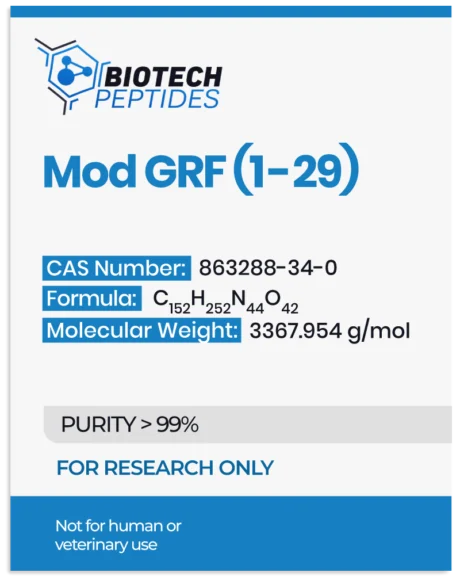
Mod GRF 1-29 (CJC-1295 NO DAC) (5mg)
$45.00
Mod GRF 1-29 (CJC-1295 NO DAC) peptides are synthesised and lyophilised in the USA.
Research Overview, Properties and FAQs
Mod GRF 1-29 (CJC-1295 NO DAC) (5mg) is a synthetic peptide studied in relation to growth hormone-releasing hormone signalling and endocrine research. It is commonly discussed in peptide research because of its structural relationship to growth hormone-releasing hormone, or GHRH, and its potential to help researchers investigate pathways involved in growth hormone secretion.
Also referred to as CJC-1295 without DAC, Mod GRF 1-29 represents a modified form of the first 29 amino acids of GHRH. The absence of the drug affinity complex, commonly abbreviated as DAC, distinguishes it from longer-acting CJC-1295 formulations.
This article provides an educational overview of Mod 1-29 (5mg), including its biological background, research applications, terminology, and frequently asked questions.
What Is Mod GRF 1-29?
Mod GRF 1-29 is a synthetic peptide based on the N-terminal region of growth hormone-releasing hormone. GHRH is a naturally occurring hormone produced in the hypothalamus and plays an important role in regulating growth hormone release from the pituitary gland.
The term 1-29 refers to the peptide’s relationship to the first 29 amino acids of GHRH. Mod GRF 1-29 is designed as a modified GHRH-related peptide intended for research into growth hormone signalling.
The compound is often described as CJC-1295 without DAC because it lacks the additional drug affinity complex associated with long-acting CJC-1295.
The 5mg designation refers to the stated quantity of peptide in a research preparation. It does not represent a recommended human dose.
What Does GHRH Do?
Growth hormone releasing hormone, or GHRH, is an important component of the body’s endocrine system.
Produced primarily by the hypothalamus, GHRH signals the pituitary gland to release growth hormone. This process forms part of a complex regulatory network involving growth hormone, insulin-like growth factor 1, somatostatin, and other biological signals.
Growth hormone secretion is naturally influenced by factors such as sleep, age, nutritional status, physical activity, and metabolic conditions.
Researchers study GHRH-related compounds such as Mod GRF 1-29 to better understand these signaling pathways.
How Is Mod GRF 1-29 Related to CJC-1295?
Mod GRF 1-29 and CJC-1295 are closely related terms within peptide research, but they are not necessarily interchangeable.
CJC-1295 can refer to a modified GHRH analogue that was developed with an additional modification known as the drug affinity complex, or DAC. This modification was intended to alter the compound’s interaction with albumin and extend its persistence in circulation.
Mod GRF 1-29 is generally used to describe a shorter-acting GHRH-related peptide without the DAC modification.
Understanding this distinction is important when reading scientific literature or evaluating research materials.
What Is the Difference Between CJC-1295 DAC and No DAC?
The most important distinction is the presence or absence of the drug affinity complex.
CJC-1295 with DAC incorporates the additional modification associated with longer persistence.
Mod GRF 1-29, often called CJC-1295 No DAC, does not contain that DAC modification and is generally discussed as a shorter-acting GHRH analogue.
These differences can affect pharmacological characteristics and research applications. Researchers should therefore verify the exact compound being studied rather than assuming that all products labelled CJC-1295 have identical properties.
Mod GRF 1-29 and Growth Hormone Research
One major area of scientific interest surrounding Mod GRF 1-29 is growth hormone physiology.
Growth hormone is released by the pituitary gland in pulses rather than at a constant rate. GHRH contributes to the regulation of these pulses, while somatostatin acts as an important inhibitory signal.
Research involving GHRH-related peptides can help scientists examine how these competing pathways influence growth hormone secretion.
This makes Mod GRF 1-29 relevant to laboratory investigations involving endocrine signalling and receptor activity.
Why Study Mod GRF 1-29?
Researchers may investigate Mod GRF 1-29 for several reasons, including:
- GHRH receptor signaling
- Growth hormone physiology
- Peptide pharmacology
- Endocrine regulation
- Hormonal signalling pathways
- Receptor activation
- Structure and activity relationships
Research into these areas can provide insight into how synthetic peptides interact with naturally occurring hormonal systems.
However, experimental evidence does not automatically establish that a research compound is safe or effective for treating a medical condition.
What Does “5mg” Mean?
When a research product is labelled Mod 1-29 5mg, the 5mg figure generally indicates the stated mass of peptide contained in the preparation.
This measurement should not be interpreted as a therapeutic dose or recommendation for human administration.
Researchers evaluating a peptide preparation should consider its identity, purity, formulation, analytical documentation, and storage requirements rather than relying on the quantity alone.
Research Quality Considerations
Quality documentation can be important when evaluating research-grade peptide materials.
Researchers may look for:
- Peptide identity testing
- Purity analysis
- Certificate of analysis
- Batch or lot information
- Molecular characterization
- Formulation details
- Storage requirements
- Manufacturer documentation
Analytical purity is useful when assessing a research material, but it does not establish clinical safety, effectiveness, or regulatory approval.
Frequently Asked Questions About Mod GRF 1-29 (5mg)
What is Mod GRF 1-29?
Mod 1-29 is a synthetic peptide related to growth hormone-releasing hormone. It is studied for its interaction with pathways involved in growth hormone signalling and endocrine physiology.
Is Mod GRF 1-29 the same as CJC-1295?
The terminology can be confusing. Mod 1-29 is commonly referred to as CJC-1295 No DAC, distinguishing it from versions of CJC-1295 that contain the drug affinity complex. Researchers should verify the exact molecular specification of a product rather than relying solely on its name.
What does CJC-1295 No DAC mean?
“No DAC” means that the peptide does not contain the additional drug affinity complex associated with longer-acting CJC-1295 formulations.
What does 5mg mean?
Five milligrams refers to the stated mass of peptide in the preparation. It does not indicate a recommended dose or establish that the material is appropriate for human use.
What is Mod GRF 1-29 studied for?
Research has focused on its relationship with GHRH signalling, growth hormone secretion, receptor activity, peptide pharmacology, and endocrine physiology.
Is Mod GRF 1-29 a growth hormone?
No. Mod GRF 1-29 is not growth hormone. It is a synthetic peptide related to GHRH, which is involved in regulating the release of growth hormone from the pituitary gland.
Is Mod GRF 1-29 approved as a medicine?
Regulatory status depends on the specific compound, product, indication, and jurisdiction. Research-grade Mod GRF 1-29 should not automatically be considered an approved pharmaceutical treatment.
Is Mod GRF 1-29 safe for human use?
Safety cannot be established from a product label or research description alone. Because Mod GRF 1-29 interacts with hormonal signalling pathways, human use should not be inferred from laboratory research. Medical questions should be discussed with a qualified healthcare professional.
How should researchers evaluate Mod GRF 1-29?
Researchers should consider identity, purity, analytical testing, batch information, certificate of analysis, formulation, storage requirements, and applicable laboratory regulations.
Conclusion
Mod GRF 1-29 (CJC-1295 NO DAC) (5mg) is a synthetic GHRH-related peptide that has attracted interest in research involving growth hormone signalling and endocrine physiology. Its relationship with the first 29 amino acids of GHRH and the absence of the drug-affinity complex distinguish it from longer-acting CJC-1295 formulations.
For researchers studying peptide pharmacology, Mod GRF 1-29 can provide a useful subject for investigating GHRH receptor signalling and the regulation of growth hormone secretion.
When evaluating research materials, it is important to distinguish scientific terminology from marketing claims. The 5mg quantity describes the amount of material and does not establish a clinical dose, safety profile, or therapeutic application. Researchers should rely on appropriate analytical documentation, laboratory procedures, and applicable regulations when working with biologically active peptides.
Brand
Biotech Peptides
Be the first to review “Mod GRF 1-29 (CJC-1295 NO DAC) (5mg)”
Related products
PEPTIDES
PEPTIDES
PEPTIDES
PEPTIDES
PEPTIDES
PEPTIDES
PEPTIDES
PEPTIDES
Reviews
There are no reviews yet.