
Research Overview, Biological Properties
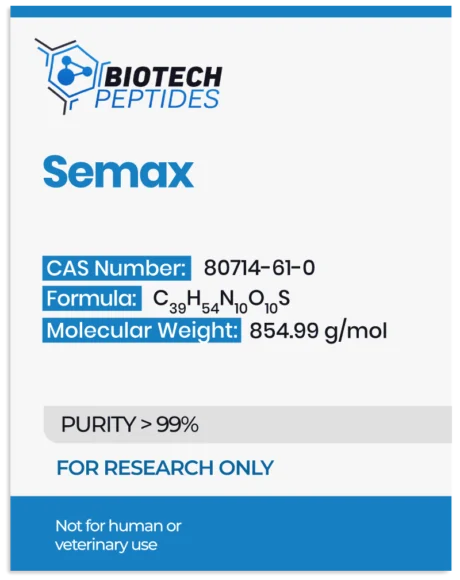
Semax (25mg) is a synthetic peptide that has been investigated primarily in Russia and other research settings for its effects on neurological and cognitive processes. Scientific interest in Semax includes research into neuroprotection, neuronal signalling, inflammation, and mechanisms associated with learning and memory.
Semax is derived from a short fragment of adrenocorticotropic hormone (ACTH), but it does not function simply as conventional ACTH. Researchers have investigated how modifications to this peptide sequence may influence biological activity.
For those researching Semax 25mg, understanding its molecular background, proposed mechanisms, research applications, and limitations is important. This article provides an educational overview without presenting Semax as an approved treatment or providing instructions for personal use.
What Is Semax?
Semax is a synthetic peptide developed from a portion of the ACTH molecule. Unlike full ACTH, Semax has been studied primarily for biological effects associated with the nervous system rather than for stimulating adrenal hormone production.
Research has examined Semax in relation to neurological signalling, neurotrophic factors, oxidative stress, and inflammatory pathways.
The 25mg designation refers to the stated quantity of peptide in a particular research preparation. It describes the amount of material and should not be interpreted as a recommended dose or treatment protocol.
How Does Semax Work?
The precise mechanisms of Semax continue to be investigated.
Experimental research has explored its relationship with several biological pathways, including signalling involving brain-derived neurotrophic factor (BDNF) and other molecules associated with neuronal function.
Researchers have also investigated possible effects on oxidative stress and inflammatory signalling. These mechanisms are complex, and findings can vary depending on the experimental model, concentration, and biological environment.
Because Semax affects biological signalling pathways, research findings should be interpreted carefully rather than translated directly into claims about human health or cognitive performance.
Semax and Neuroprotection Research
One of the most prominent areas of Semax research involves neuroprotection.
Neurons can be affected by oxidative stress, inflammation, inadequate oxygen supply, and other forms of cellular stress. Scientists study neuroprotective mechanisms to better understand how nervous system cells respond to these challenges.
Experimental studies have investigated whether Semax can influence biological pathways associated with neuronal survival and cellular stress responses.
These findings are of scientific interest, but laboratory and preclinical observations do not by themselves establish clinical effectiveness.
Semax and BDNF Research
Brain-derived neurotrophic factor, commonly known as BDNF, is an important protein involved in neuronal development, synaptic function, and neural plasticity.
Researchers have investigated whether Semax can influence BDNF-related signalling. This is particularly interesting because changes in neurotrophic signalling may affect how neurons communicate and adapt.
However, the relationship between Semax and BDNF is an active area of research. A biological association does not necessarily mean that taking a Semax preparation will produce a predictable change in cognitive or neurological function.
Semax and Cognitive Research
Semax has attracted interest because of research involving memory, attention, learning, and other aspects of neurological function.
Scientific investigations have examined Semax in experimental models of cognitive performance and neurological stress. Some clinical research has also been conducted, particularly in Russia.
The available evidence should be interpreted within the context of study quality, population, methodology, and regulatory status. Research findings from one setting cannot automatically be generalised to all individuals.
Semax and Inflammation
Inflammatory signalling is another area of interest in Semax research.
The nervous system interacts closely with immune and inflammatory pathways. Researchers therefore investigate molecules that may influence inflammatory mediators and cellular responses.
Experimental studies have explored whether Semax can affect certain inflammatory pathways. These observations contribute to scientific understanding of peptide signalling but do not establish Semax as a general-purpose anti-inflammatory treatment.
Semax and Oxidative Stress
Oxidative stress occurs when the production of reactive molecules exceeds the body’s ability to neutralize them effectively.
Neural tissue can be particularly sensitive to oxidative processes. Consequently, antioxidant and cellular stress pathways are important subjects in neuroscience research.
Semax has been investigated in experimental models involving oxidative stress and cellular protection. Researchers continue to examine the molecular mechanisms that may explain these observations.
Semax (25mg) for Research
A product labelled Semax 25mg indicates a preparation containing a stated quantity of Semax.
For legitimate laboratory research, scientists may evaluate factors such as:
- Peptide identity
- Purity
- Molecular characterization
- Certificate of analysis
- Batch or lot information
- Formulation
- Stability
- Storage requirements
The stated quantity does not establish clinical suitability, effectiveness, or a recommended human dose.
Why Is Semax Scientifically Interesting?
Semax is particularly interesting because it connects peptide biology with neuroscience.
Research areas include:
- Neuroprotective signaling
- BDNF and neurotrophic pathways
- Neural plasticity
- Cognitive research
- Oxidative stress
- Inflammatory signaling
- Peptide pharmacology
- Neurological research
Studying these pathways may help scientists better understand how peptide-based signaling interacts with the nervous system.
Frequently Asked Questions About Semax (25mg)
What is Semax?
Semax is a synthetic peptide derived from a fragment of ACTH. It has been investigated for potential effects on neurological signalling, neuroprotection, cognitive processes, oxidative stress, and inflammatory pathways.
What does Semax 25mg mean?
Semax 25mg refers to a preparation containing a stated quantity of 25 milligrams of peptide. The measurement represents mass and should not be interpreted as a recommended amount for human administration.
Is Semax a form of ACTH?
Semax is derived from a fragment of ACTH, but it is not simply equivalent to full ACTH. Structural modifications distinguish Semax from the naturally occurring hormone and are relevant to its research properties.
What is Semax studied for?
Research has examined Semax in areas including neurological signalling, neuroprotection, cognitive processes, BDNF-related pathways, oxidative stress, and inflammatory responses.
Does Semax increase BDNF?
Research has investigated possible effects of Semax on BDNF and related neurotrophic signalling. However, experimental findings should not be interpreted as a guarantee that Semax will increase BDNF in an individual.
Is Semax approved as a medicine?
Regulatory status varies by country and by specific formulation or indication. Semax should not automatically be considered an approved medication simply because it has been studied clinically or is available through certain suppliers.
Is Semax safe for human use?
Safety depends on factors including the specific formulation, individual circumstances, exposure, and regulatory status. A research product description cannot establish safety for personal use. Anyone considering medically relevant peptide use should consult a qualified healthcare professional.
What should researchers look for when evaluating Semax?
Researchers may review identity testing, purity analysis, certificates of analysis, batch information, formulation details, stability data, and storage requirements. Appropriate laboratory standards should also be followed.
Conclusion
Semax (25mg) is a synthetic peptide with a growing body of research surrounding neurological signalling and peptide pharmacology. Derived from an ACTH-related sequence, Semax has been investigated in areas including neuroprotection, BDNF signalling, cognitive research, oxidative stress, and inflammatory pathways.
Its scientific interest comes from the possibility of influencing biological processes involved in neuronal function and cellular responses. At the same time, research findings need to be interpreted carefully, particularly when distinguishing laboratory evidence from established clinical applications.
For legitimate research purposes, evaluating peptide identity, purity, analytical documentation, stability, and storage requirements can help researchers characterise the material accurately. As neuroscience and peptide research continue to develop, Semax remains an interesting subject for investigation into the relationship between peptide signalling and the nervous system.
Brand
Biotech Peptides
Be the first to review “Semax (25mg)”
Related products
PEPTIDES
PEPTIDES

PEPTIDES
PEPTIDES
PEPTIDES
PEPTIDES

PEPTIDES

PEPTIDES
Reviews
There are no reviews yet.