

Exploring the Science Behind an Intriguing Research Peptide
Selank (10mg) is a synthetic peptide that has attracted scientific interest because of research into its potential effects on the nervous system, immune signalling, stress-related pathways, and cognitive processes. Developed from a naturally occurring immune-related peptide sequence, Selank has been investigated primarily in Russian scientific research.
Interest in Selank 10mg comes from its proposed interaction with several biological pathways rather than from a single mechanism. Researchers have explored its relationship with neurotransmitter systems, neurotrophic factors, inflammatory signalling, and molecules involved in the body’s stress response.
This article provides an educational overview of Selank, its molecular background, research areas, and frequently asked questions.
What Is Selank?
Selank is a synthetic peptide derived from a naturally occurring peptide called tuftsin. Tuftsin is a small peptide associated with immune system activity.
Researchers developed Selank by modifying the structure of tuftsin to investigate whether the resulting peptide could demonstrate additional biological properties.
Scientific studies have explored Selank in relation to anxiety-related behaviour, cognitive processes, immune regulation, and neurotransmitter activity.
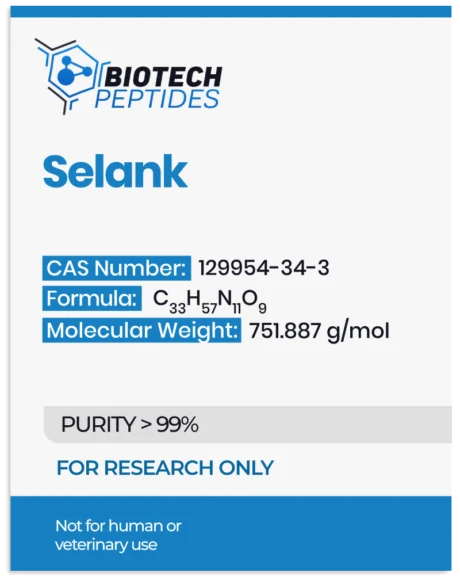
The 10mg designation refers to the stated quantity of peptide in a particular research preparation. It represents mass and should not be interpreted as a recommended dose or treatment protocol.
The Tuftsin Connection
Understanding Selank begins with tuftsin.
Tuftsin is a naturally occurring tetrapeptide associated with immune function. It has been investigated for its interactions with immune cells and biological signalling.
Selank incorporates a modified sequence related to tuftsin, creating a synthetic peptide with different molecular characteristics.
This connection between immune biology and neurological research is one reason Selank has attracted attention from scientists studying interactions between the nervous and immune systems.
How Does Selank Work?
The precise mechanism of Selank remains an area of scientific investigation.
Research has examined potential effects involving neurotransmitter systems, neurotrophic signalling, and stress-related pathways.
Some experimental studies have investigated Selank’s relationship with GABAergic signalling, particularly the system involving gamma-aminobutyric acid, or GABA. GABA is one of the brain’s major inhibitory neurotransmitters and plays an important role in regulating neuronal activity.
Researchers have also investigated whether Selank influences expression or activity of molecules involved in neural plasticity and immune regulation.
Because these pathways are interconnected, the biological effects of Selank may involve multiple mechanisms rather than a single receptor.
Selank and Neuroscience Research
One of the primary areas of interest surrounding Selank is neuroscience.
Researchers have investigated the peptide in experimental models involving:
- Stress responses
- Anxiety-related behaviour
- Learning
- Memory
- Neurotransmitter signaling
- Neural plasticity
- Cognitive processes
These studies have contributed to interest in Selank as a research compound.
However, results observed in experimental models cannot automatically be translated into predictable effects in humans.
Selank and GABA Signalling
GABA is an important inhibitory neurotransmitter that helps regulate neuronal excitability.
Researchers have explored whether Selank can influence aspects of GABAergic signalling. This research is particularly relevant because GABA pathways are involved in processes associated with stress, anxiety, sleep, and neuronal regulation.
Understanding how peptides interact with neurotransmitter systems may help scientists investigate new approaches to studying neurological function.
Nevertheless, the existence of research involving GABA does not establish Selank as an approved treatment for anxiety, insomnia, or other neurological conditions.
Selank and Cognitive Research
Cognitive function is another area that has received attention in Selank research.
Experimental studies have examined potential relationships between Selank and processes such as learning, memory, and adaptation to stress.
Researchers are interested in whether peptide signalling can influence neural pathways associated with cognitive performance.
The evidence should be interpreted carefully, particularly when moving from animal or laboratory models to human populations. Scientific investigation is necessary to determine whether findings are reproducible and clinically meaningful.
Selank and the Immune System
Selank’s connection with tuftsin has also encouraged research into immune signalling.
The nervous system and immune system communicate through complex networks of hormones, neurotransmitters, cytokines, and other signalling molecules.
Scientists study these interactions through the field sometimes described as neuroimmunology.
Selank is of interest because its structural relationship to an immune-associated peptide provides an opportunity to investigate how synthetic peptides may interact with both neurological and immune-related processes.
Selank and Stress Research
Stress involves interactions between the nervous system, endocrine system, and immune system.
Researchers have investigated Selank in experimental models of stress to better understand how peptide signalling may influence behavioural and physiological responses.
Some studies have explored anxiety-related behaviour and stress adaptation, while others have investigated molecular markers associated with stress regulation.
These findings provide potential avenues for further research but should not be interpreted as evidence that Selank is an established treatment for stress-related disorders.
Selank (10mg) as a Research Material
A preparation labelled Selank 10mg indicates a stated quantity of the peptide.
Researchers evaluating a research material may examine:
- Peptide identity
- Purity
- Certificate of analysis
- Batch information
- Molecular characterization
- Formulation
- Stability
- Storage requirements
The stated 10mg quantity does not establish a clinical dose, therapeutic effectiveness, or suitability for human administration.
Why Researchers Are Interested in Selank
Selank is particularly interesting because it sits at the intersection of neuroscience and immune biology.
Research areas include:
- GABAergic signaling
- Cognitive processes
- Stress response
- Neurotransmitter regulation
- Neuroimmunology
- Neural plasticity
- Peptide pharmacology
- Immune signaling
Studying these connections may help researchers understand how small peptides can influence complex biological systems.
Frequently Asked Questions About Selank (10mg)
What is Selank?
Selank is a synthetic peptide derived from the naturally occurring immune-related peptide tuftsin. It has been researched in connection with neurological, cognitive, stress-related, and immune signalling pathways.
What does Selank 10mg mean?
Selank 10mg refers to a preparation containing a stated quantity of 10 milligrams of peptide. The measurement describes mass and should not be interpreted as a recommended dose.
What is Selank derived from?
Selank is structurally related to tuftsin, a naturally occurring tetrapeptide associated with immune system activity.
What is Selank studied for?
Research has examined Selank in areas including stress responses, anxiety-related behaviour, cognitive processes, GABAergic signalling, neural plasticity, and immune regulation.
Does Selank affect GABA?
Research has investigated possible relationships between Selank and GABAergic signalling. However, the precise mechanisms and significance of these interactions remain subjects of scientific investigation.
Is Selank a nootropic?
Selank is sometimes described online as a nootropic, but such terminology is not equivalent to regulatory approval or established clinical effectiveness. Scientific evidence should be evaluated independently of marketing terminology.
Is Selank approved as a medicine?
Regulatory status varies between countries and specific formulations. Selank should not automatically be considered an approved medication simply because it has been investigated in scientific studies.
Is Selank safe for human use?
Safety cannot be established from a product label or research description alone. Selank is biologically active, and research findings do not automatically establish safety for personal use. Questions concerning medical use should be discussed with a qualified healthcare professional.
What should researchers look for when evaluating Selank?
Researchers may review identity testing, purity analysis, certificates of analysis, batch information, formulation, stability data, and storage requirements. Appropriate laboratory and regulatory standards should also be followed.
Conclusion: Understanding the Research Behind Selank
Selank (10mg) is a synthetic peptide that has generated interest across several areas of biological research. Its relationship with tuftsin makes it particularly interesting for scientists studying the connection between immune signalling and neurological processes.
Research has examined Selank in relation to GABAergic signalling, cognitive processes, stress responses, neural plasticity, and neuroimmune interactions. These diverse research areas highlight the complexity of peptide biology and the interconnected nature of the nervous and immune systems.
For researchers evaluating Selank 10mg, understanding the distinction between experimental findings and established medical applications is essential. The 10mg quantity identifies the stated mass of the research material but does not establish a therapeutic dose or clinical benefit.
Careful evaluation of peptide identity, purity, analytical documentation, stability, and storage requirements can help researchers characterise their materials appropriately. As research into neuropeptides and neuroimmunology continues, Selank remains an interesting subject for investigating the complex relationship between peptide signalling, cognition, stress, and immune biology.
Brand
Biotech Peptides
Be the first to review “Selank (10mg)”
Related products

PEPTIDES
PEPTIDES
PEPTIDES

PEPTIDES
PEPTIDES
PEPTIDES
PEPTIDES
PEPTIDES
Reviews
There are no reviews yet.