
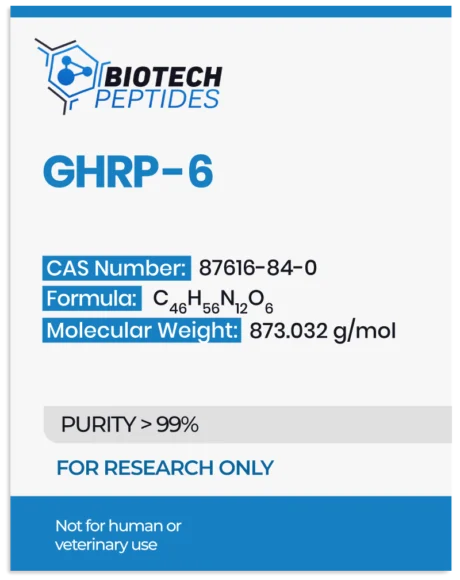
Research Overview, Peptide Science and Key Facts
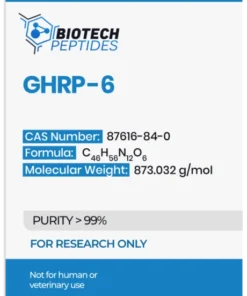
GHRP-6 (5mg) is an investigational peptide that has received attention in peptide research, endocrinology, molecular biology, and growth hormone physiology. GHRP-6 stands for Growth Hormone-Releasing Peptide-6, a synthetic peptide belonging to the growth hormone secretagogue family.
Researchers have studied GHRP-6 because of its interaction with the growth hormone secretagogue receptor (GHS-R) and its relationship with growth hormone secretion. Its connection to ghrelin-related signalling has also made it an interesting subject for research into endocrine and metabolic pathways.
For researchers and biotechnology professionals, understanding GHRP-6 (5mg) requires looking at its molecular characteristics, research applications, potential mechanisms, product quality considerations, and current limitations of the scientific evidence.
What Is GHRP-6?
GHRP-6, or Growth Hormone-Releasing Peptide-6, is a synthetic peptide that has been investigated for its ability to influence growth hormone secretion.
GHRP-6 belongs to a class of compounds known as growth hormone secretagogues. Research has demonstrated that these compounds can interact with the growth hormone secretagogue receptor, which is closely associated with the naturally occurring hormone ghrelin.
Because of this activity, GHRP-6 has been used as an experimental research compound for studying growth hormone regulation and receptor signalling.
It is important to distinguish GHRP-6 from human growth hormone. GHRP-6 is not growth hormone itself. Rather, it is an experimental peptide investigated for its influence on pathways involved in growth hormone secretion.
What Does GHRP-6 (5mg) Mean?
The term GHRP-6 (5mg) refers to a research product containing a stated quantity of 5 milligrams of GHRP-6.
The 5mg specification indicates the quantity of material supplied. It should not be interpreted as a recommended human dosage or treatment protocol.
For legitimate research purposes, scientists evaluating GHRP-6 should consider information such as peptide identity, purity, batch or lot number, analytical testing, storage requirements, and available product documentation.
How Does GHRP-6 Work?
GHRP-6 has been investigated primarily for its interaction with the growth hormone secretagogue receptor, also known as GHS-R.
Growth hormone secretion is controlled by a complex endocrine system involving the hypothalamus and pituitary gland. Growth hormone-releasing hormone can stimulate growth hormone secretion, while somatostatin generally suppresses it.
GHRP-6 provides researchers with another mechanism for investigating this system through the secretagogue pathway.
The relationship between GHRP-6 and GHS-R signaling is therefore an important area of peptide pharmacology research.
GHRP-6 and Growth Hormone Research
One of the central areas of GHRP-6 research is growth hormone physiology.
Growth hormone has numerous physiological functions, including involvement in growth, metabolism, tissue development, and regulation of insulin-like growth factor 1, commonly referred to as IGF-1.
Researchers have investigated GHRP-6 to better understand how stimulation of growth hormone secretagogue pathways can affect growth hormone release.
These studies provide useful information about endocrine signaling, but experimental changes in hormone levels should not automatically be interpreted as evidence of a specific therapeutic or performance benefit.
GHRP-6 and Ghrelin-Related Research
GHRP-6 is also relevant to research involving ghrelin.
Ghrelin is a naturally occurring peptide hormone with several physiological functions. It is particularly known for its relationship with growth hormone secretion and appetite regulation.
The relationship between GHRP-6 and the growth hormone secretagogue receptor has therefore made the peptide useful for investigating the connection between receptor signaling, endocrine function, and metabolic pathways.
This is one reason GHRP-6 continues to attract interest within experimental peptide research.
GHRP-6 and Appetite Research
Researchers have also investigated GHRP-6 in experimental studies involving appetite and feeding behavior.
The relationship between GHS-R and ghrelin has created scientific interest in how activation of this receptor may influence metabolic and appetite-related signaling.
However, research findings should not be interpreted as establishing GHRP-6 as a weight-management medication or appetite-control treatment.
Appetite regulation involves multiple hormones, neurological pathways, and environmental factors, making the underlying biology considerably more complex.
Why Is GHRP-6 Interesting to Researchers?
GHRP-6 is relevant to several areas of experimental research, including:
- Growth hormone physiology
- GHS-R receptor signaling
- Ghrelin-related pathways
- Endocrinology
- Pituitary biology
- Metabolic research
- Peptide pharmacology
- Structure-activity research
Its ability to interact with a receptor involved in endocrine signaling makes GHRP-6 an interesting compound for laboratory investigation.
GHRP-6 Compared With GHRP-2
GHRP-6 and GHRP-2 are related but distinct experimental peptides.
Both compounds have been investigated as growth hormone secretagogues and are associated with GHS-R signaling. However, their molecular structures and pharmacological characteristics are not identical.
For this reason, researchers should evaluate each peptide independently rather than assuming that GHRP-6 and GHRP-2 will produce identical experimental results.
The precise peptide sequence, purity, formulation, experimental conditions, and research model can all influence findings.
GHRP-6 and Peptide Pharmacology
GHRP-6 provides researchers with an example of how synthetic peptides can be used to study receptor-mediated biological activity.
Peptide pharmacology can involve investigation of:
- Molecular structure
- Receptor affinity
- Biological activity
- Stability
- Metabolism
- Pharmacokinetics
- Structure-activity relationships
Understanding these characteristics helps researchers investigate how individual peptide sequences interact with biological receptors.
Product Quality and Research Considerations
When evaluating GHRP-6 (5mg) for legitimate research, product characterisation is an important consideration.
Researchers may want to review:
- Peptide identity
- Stated quantity
- Purity information
- Lot or batch number
- Certificate of Analysis, where available
- Analytical testing
- Storage recommendations
- Manufacturer or supplier information
Synthetic peptides may be affected by degradation, impurities, aggregation, and inappropriate storage. Reliable documentation can therefore help researchers evaluate materials and improve experimental reproducibility.
Is GHRP-6 FDA Approved?
GHRP-6 should not be represented as an FDA-approved treatment for growth hormone deficiency, weight management, appetite control, muscle development, anti-ageing, or another medical condition.
An experimental peptide can be the subject of scientific research without being an approved pharmaceutical treatment.
Businesses and researchers should therefore distinguish between research materials and approved medications and ensure that their handling, labelling, marketing, and use comply with applicable requirements.
Frequently Asked Questions About GHRP-6 (5mg)
What is GHRP-6?
GHRP-6 stands for Growth Hormone-Releasing Peptide-6. It is a synthetic peptide investigated for its interaction with the growth hormone secretagogue receptor and its relationship with growth hormone secretion.
What does GHRP-6 5mg mean?
GHRP-6 5mg refers to a research product containing a stated quantity of 5 milligrams of GHRP-6. The 5mg amount does not represent a recommended therapeutic dose.
What is GHRP-6 researched for?
Research has examined GHRP-6 in connection with growth hormone secretion, GHS-R signaling, ghrelin-related pathways, pituitary physiology, metabolic research, and peptide pharmacology.
Does GHRP-6 stimulate growth hormone?
GHRP-6 has been investigated for its ability to stimulate growth hormone secretion. Experimental findings should not be interpreted as a recommendation for human use or proof of a specific health or performance benefit.
Is GHRP-6 the same as human growth hormone?
No. GHRP-6 is a synthetic growth hormone secretagogue. It is not human growth hormone.
Is GHRP-6 the same as GHRP-2?
No. GHRP-6 and GHRP-2 are different peptides. Although both have been studied as growth hormone secretagogues, they have distinct molecular structures and pharmacological properties.
Is GHRP-6 FDA-approved?
No. GHRP-6 should not be marketed as an FDA-approved medication or treatment.
Why is GHRP-6 interesting in peptide research?
GHRP-6 provides researchers with a way to investigate growth hormone secretagogue receptor signalling, growth hormone physiology, ghrelin-related pathways, and peptide pharmacology.
How should researchers evaluate GHRP-6 products?
Researchers should consider peptide identity, purity, quantity, analytical documentation, batch information, storage requirements, and applicable laboratory standards.
Is GHRP-6 safe for human use?
Available research does not establish GHRP-6 as an approved or generally safe human treatment. Safety can depend on factors including purity, formulation, exposure, and route of administration. Experimental research should not be interpreted as establishing general human safety.
Final Thoughts on GHRP-6 (5mg)
GHRP-6 (5mg) is an interesting experimental peptide within endocrinology, peptide pharmacology, and growth hormone research. Its interaction with the growth hormone secretagogue receptor has made it useful for investigating growth hormone secretion and the broader relationship between synthetic peptides and endocrine signalling.
Its connection with ghrelin-related pathways also provides researchers with an opportunity to examine the interaction between growth hormone regulation and metabolic signalling.
For biotechnology researchers, GHRP-6 offers an interesting subject for investigating receptor biology, peptide structure, endocrine physiology, and growth hormone pathways.
At the same time, responsible scientific communication requires a clear distinction between experimental research and established clinical applications. GHRP-6 should not be presented as a proven treatment for growth hormone deficiency, weight loss, appetite control, muscle development, anti-ageing, or another health condition.
Research Use Notice: GHRP-6 products should be treated as research materials where legally permitted. This information is provided for educational and scientific purposes only and does not constitute medical advice, treatment recommendations, or instructions for human use.
Brand
Biotech Peptides
Be the first to review “GHRP-6 (5mg)”
Related products
PEPTIDES
PEPTIDES
PEPTIDES
PEPTIDES
PEPTIDES
PEPTIDES

PEPTIDES

PEPTIDES
Reviews
There are no reviews yet.