
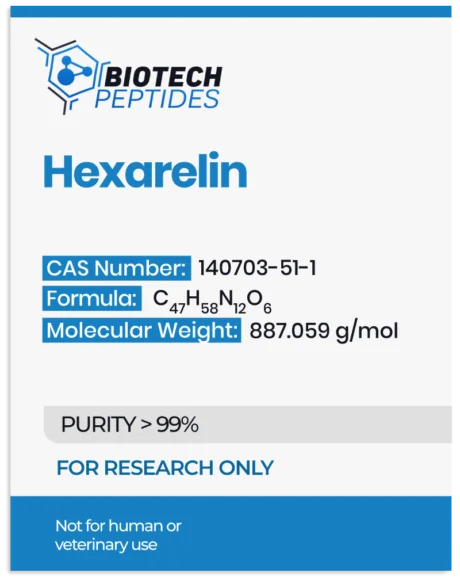
Hexarelin (5mg)

Original price was: $64.00.$46.00Current price is: $46.00.
Hexarelin peptides are synthesised and lyophilised in the USA.
Research Overview, Peptide Science and Key Facts
Hexarelin (5mg) is an investigational synthetic peptide that has attracted interest in endocrinology, peptide pharmacology, and growth hormone research. Hexarelin belongs to the growth hormone secretagogue family and has been studied for its interaction with pathways involved in growth hormone release.
As a research peptide, Hexarelin has been investigated in experimental settings involving growth hormone secretion, cardiovascular biology, endocrine signaling, and receptor pharmacology. Its scientific profile makes it an interesting subject for researchers studying how synthetic peptides can influence hormone signaling.
This article provides an educational overview of Hexarelin (5mg), including its research background, proposed mechanism, scientific applications, product considerations, and frequently asked questions.
What Is Hexarelin?
Hexarelin is a synthetic peptide belonging to the growth hormone secretagogue class. It was developed through research into compounds capable of stimulating growth hormone secretion.
Like other peptides in this category, Hexarelin has been investigated for its interaction with the growth hormone secretagogue receptor (GHS-R). This receptor is closely associated with ghrelin signalling and plays an important role in the regulation of growth hormone release.
Because of its activity within this pathway, Hexarelin has been used as an experimental research compound in studies of endocrine physiology and peptide pharmacology.
It is important to distinguish Hexarelin from human growth hormone. Hexarelin is not growth hormone itself. It is an experimental peptide studied for its potential influence on growth hormone signalling.
What Does Hexarelin (5mg) Mean?
The term Hexarelin (5mg) refers to a research product containing a stated quantity of 5 milligrams of Hexarelin.
The 5mg designation describes the quantity of research material supplied. It should not be interpreted as a recommended human dosage or treatment protocol.
Researchers evaluating Hexarelin should consider available product documentation, including peptide identity, purity, batch information, analytical testing, storage requirements, and other relevant specifications.
How Does Hexarelin Work?
Hexarelin has been studied primarily for its interaction with the growth hormone secretagogue receptor.
The body’s growth hormone system involves several interconnected hormones and signaling pathways. Growth hormone-releasing hormone promotes growth hormone secretion, while somatostatin generally inhibits it. Ghrelin and related signaling pathways can also influence growth hormone release.
Hexarelin provides researchers with an experimental tool for studying the secretagogue pathway and how receptor activation may influence pituitary hormone secretion.
This makes the peptide relevant to research involving endocrine signaling and receptor pharmacology.
Hexarelin and Growth Hormone Research
One of the main reasons researchers investigate Hexarelin is its relationship with growth hormone secretion.
Growth hormone is involved in numerous physiological processes, including growth, metabolism, protein synthesis, and regulation of insulin-like growth factor 1, commonly referred to as IGF-1.
Experimental research involving Hexarelin has helped scientists investigate how growth hormone secretagogues interact with endocrine pathways.
However, experimental observations involving hormone secretion should not be interpreted as proof that Hexarelin provides a specific therapeutic, bodybuilding, fitness, or anti-aging benefit.
Hexarelin and GHS-R Research
The growth hormone secretagogue receptor is an important component of Hexarelin research.
GHS-R is closely related to ghrelin signaling. Ghrelin is a naturally occurring peptide hormone involved in growth hormone secretion and several other physiological processes.
Studying Hexarelin therefore provides researchers with an opportunity to investigate how synthetic peptide molecules interact with this receptor and influence downstream biological signaling.
This receptor-focused research contributes to the broader understanding of peptide pharmacology.
Hexarelin and Cardiovascular Research
Beyond growth hormone research, Hexarelin has attracted scientific interest because experimental studies have examined its potential cardiovascular effects.
Researchers have investigated growth hormone secretagogues in relation to cardiovascular physiology and cardiac signaling. These studies have contributed to broader research into how peptide receptors and endocrine pathways may interact with cardiovascular systems.
The findings remain part of experimental research and should not be interpreted as evidence that Hexarelin is a cardiovascular treatment.
Why Is Hexarelin Interesting to Researchers?
Hexarelin is relevant to several areas of experimental science, including:
- Growth hormone physiology
- Endocrinology
- GHS-R receptor signaling
- Peptide pharmacology
- Cardiovascular research
- Pituitary biology
- Hormonal regulation
- Structure-activity research
Its ability to interact with growth hormone secretagogue pathways makes it a useful subject for studying endocrine signaling.
Hexarelin Compared With Other Growth Hormone Secretagogues
Hexarelin belongs to the same broad research category as compounds such as GHRP-2 and GHRP-6.
Although these peptides share an interest in growth hormone secretagogue signalling, they are distinct molecules with different structures and pharmacological characteristics.
Researchers should therefore avoid assuming that results obtained with one secretagogue automatically apply to another.
The specific peptide sequence, purity, experimental model, receptor interactions, and research conditions can all influence experimental outcomes.
Hexarelin and Peptide Pharmacology
Hexarelin provides an interesting example of how synthetic peptides can be investigated for receptor-mediated biological activity.
Researchers studying peptide pharmacology may examine:
- Molecular structure
- Receptor affinity
- Biological activity
- Peptide stability
- Metabolism
- Pharmacokinetics
- Structure-activity relationships
These characteristics can help researchers understand how peptide structure influences biological activity and receptor signaling.
Product Quality and Research Considerations
When evaluating Hexarelin (5mg) for legitimate research, product characterization is an important consideration.
Researchers may want to review:
- Peptide identity
- Stated quantity
- Purity information
- Lot or batch number
- Certificate of Analysis, where available
- Analytical testing
- Storage recommendations
- Manufacturer or supplier information
Synthetic peptides can be affected by degradation, aggregation, impurities, and inappropriate storage. Reliable analytical documentation can therefore help researchers assess research materials and improve experimental reproducibility.
Is Hexarelin FDA Approved?
Hexarelin should not be represented as an FDA-approved treatment for growth hormone deficiency, muscle development, weight management, cardiovascular conditions, anti-aging, or another medical condition.
Scientific research into an experimental peptide does not automatically mean that the compound has been approved as a pharmaceutical product.
Researchers and businesses should distinguish clearly between experimental research materials and approved medicines and ensure that activities involving Hexarelin comply with applicable laws and regulations.
Frequently Asked Questions About Hexarelin (5mg)
What is Hexarelin?
Hexarelin is a synthetic peptide belonging to the growth hormone secretagogue family. It has been investigated for its relationship with growth hormone secretion and GHS-R signaling.
What does Hexarelin 5mg mean?
Hexarelin 5mg refers to a research product containing a stated quantity of 5 milligrams of Hexarelin. The quantity does not represent a recommended therapeutic dosage.
What is Hexarelin researched for?
Research has examined Hexarelin in relation to growth hormone secretion, endocrine signaling, GHS-R pathways, peptide pharmacology, and cardiovascular research.
Does Hexarelin stimulate growth hormone?
Hexarelin has been investigated for its ability to influence growth hormone secretion. Experimental findings should not be interpreted as a recommendation for human use or proof of a specific health or performance benefit.
Is Hexarelin the same as human growth hormone?
No. Hexarelin is a synthetic peptide studied as a growth hormone secretagogue. It is not human growth hormone.
Is Hexarelin the same as GHRP-6?
No. Hexarelin and GHRP-6 are different synthetic peptides, although both have been investigated within the growth hormone secretagogue field.
Is Hexarelin FDA approved?
No. Hexarelin should not be marketed as an FDA-approved medication or treatment.
Why is Hexarelin interesting in peptide research?
Hexarelin provides researchers with an experimental model for investigating growth hormone secretagogue receptor signalling, endocrine regulation, peptide pharmacology, and related physiological pathways.
How should researchers evaluate Hexarelin products?
Researchers should consider peptide identity, purity, stated quantity, analytical documentation, batch information, storage requirements, and applicable laboratory standards.
Is Hexarelin safe for human use?
Available research does not establish Hexarelin as an approved or generally safe human treatment. Safety can depend on factors such as purity, formulation, exposure, and route of administration. Experimental research should not be interpreted as establishing general human safety.
Final Thoughts on Hexarelin (5mg)
Hexarelin (5mg) is an interesting experimental peptide within the fields of endocrinology, peptide pharmacology, and growth hormone research. Its relationship with the growth hormone secretagogue receptor has made it useful for investigating growth hormone regulation and peptide-mediated signalling.
Research involving Hexarelin has also extended into areas such as cardiovascular biology, providing scientists with opportunities to explore interactions between endocrine and cardiovascular pathways.
For biotechnology researchers, Hexarelin offers a useful subject for investigating receptor biology, peptide structure, hormone regulation, and growth hormone physiology.
At the same time, responsible scientific communication requires a clear distinction between experimental research and established clinical applications. Hexarelin should not be presented as a proven treatment for growth hormone deficiency, muscle development, weight loss, cardiovascular conditions, anti-ageing, or other health conditions.
Research Use Notice: Hexarelin products should be treated as research materials where legally permitted. This information is provided for educational and scientific purposes only and does not constitute medical advice, treatment recommendations, or instructions for human use.
Brand
Biotech Peptides
Be the first to review “Hexarelin (5mg)”
Related products
PEPTIDES
PEPTIDES
PEPTIDES
PEPTIDES
PEPTIDES
PEPTIDES
PEPTIDES
PEPTIDES
Reviews
There are no reviews yet.