

Research Overview, Biological Properties
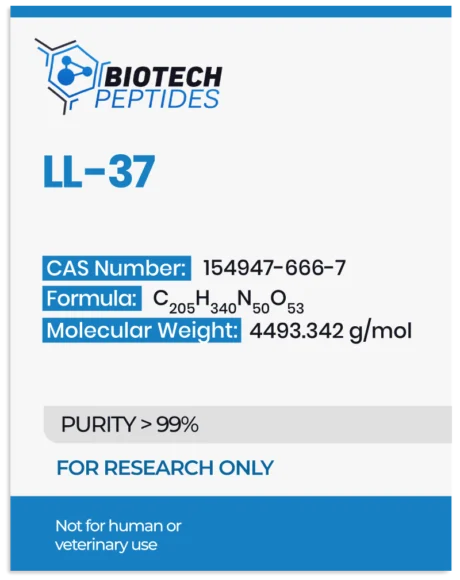
LL-37 (5mg) is a research peptide associated with the human innate immune system and has attracted considerable scientific interest because of its involvement in antimicrobial defence, immune signalling, inflammation, and tissue biology. As a naturally occurring peptide, LL-37 is different from many synthetic peptides commonly discussed in laboratory research because it is derived from a protein naturally produced by the human body.
Researchers studying LL-37 5mg may investigate its biological activity, interactions with cellular membranes, immune signalling pathways, and role in host defence. This article provides an educational overview of LL-37, its characteristics, and areas of scientific interest.
What Is LL-37?
LL-37 is a naturally occurring antimicrobial peptide derived from the human protein cathelicidin antimicrobial peptide, commonly known as CAMP. It is generated when the precursor protein is processed into an active peptide.
LL-37 belongs to the cathelicidin family of antimicrobial peptides. These molecules are part of the body’s innate immune defence and can contribute to the first line of protection against microorganisms.
The peptide has been studied extensively because of its broad biological activity. Research has examined its interactions with bacterial membranes, immune cells, inflammatory mediators, and pathways involved in tissue repair.
The term 5mg describes the stated quantity of peptide in a particular research preparation. It should not be interpreted as a recommended amount for human administration.
How Does LL-37 Work?
One of the most studied properties of LL-37 is its interaction with microbial membranes. Because of its molecular characteristics, LL-37 can interact with negatively charged components found on certain microbial surfaces.
Research has explored how these interactions may contribute to antimicrobial activity. Scientists have also investigated LL-37’s ability to interact with mammalian cells and influence signalling processes.
Importantly, LL-37 is not simply an antimicrobial molecule. Research indicates that it can participate in complex immune and inflammatory processes. Its biological effects can depend on concentration, cellular environment, tissue type, and other molecular factors.
LL-37 and the Innate Immune System
The innate immune system provides an immediate form of defence against potential pathogens. Antimicrobial peptides such as LL-37 form part of this system.
LL-37 can be produced by several types of cells and has been investigated in tissues and biological environments associated with host defence.
Scientists are particularly interested in how LL-37 interacts with immune cells and signaling molecules. These interactions may influence processes such as cellular recruitment, inflammatory signaling, and responses to microbial exposure.
Because the immune system is highly interconnected, research into LL-37 can provide insights into broader mechanisms of innate immunity.
LL-37 and Antimicrobial Research
Antimicrobial resistance is an important area of modern biomedical research. As microorganisms develop resistance to conventional antimicrobial agents, scientists continue investigating alternative biological mechanisms.
Antimicrobial peptides are one area of interest. LL-37 has been studied against a range of microorganisms in laboratory models, including certain bacteria and other microbial organisms.
Laboratory activity, however, should not automatically be interpreted as evidence that LL-37 is an effective treatment for an infection in humans. Results from cell culture or other experimental models require further investigation before clinical conclusions can be drawn.
LL-37 and Inflammation
Another major area of LL-37 research involves inflammation.
Inflammation is a complex biological response involving immune cells, signaling molecules, blood vessels, and tissue processes. LL-37 can interact with several components of this system.
Researchers have investigated whether LL-37 may influence inflammatory signaling under different experimental conditions. Its effects can be context dependent, meaning that the same molecule may produce different biological outcomes depending on the surrounding environment.
This complexity is one reason LL-37 remains an active subject of scientific investigation.
LL-37 and Tissue Research
Scientists have also examined LL-37 in relation to cellular migration, tissue remodeling, and wound biology.
Some laboratory research has explored interactions between LL-37 and cells involved in tissue repair. These studies may help researchers understand how naturally occurring antimicrobial peptides participate in processes beyond microbial defense.
However, laboratory findings should be interpreted cautiously. Research observations do not necessarily demonstrate that administering LL-37 externally will reproduce the same effects in humans.
What Does LL-37 5mg Mean?
The phrase LL-37 (5mg) generally identifies a preparation containing a stated quantity of LL-37.
The milligram measurement refers to mass. It does not establish a clinically appropriate dose, treatment protocol, or safety profile.
For laboratory research, investigators should rely on the documentation associated with the specific research material, including information about identity, purity, formulation, storage, and analytical testing.
Research Quality and Documentation
Researchers evaluating LL-37 may consider several quality factors before using a peptide in laboratory work.
These can include:
- Peptide identity
- Purity percentage
- Certificate of analysis
- Batch or lot information
- Analytical testing
- Manufacturing specifications
- Formulation details
- Storage recommendations
A certificate of analysis can provide useful information about a particular batch, but analytical purity alone does not establish clinical safety or therapeutic effectiveness.
Frequently Asked Questions About LL-37 (5mg)
What is LL-37?
LL-37 is a naturally occurring antimicrobial peptide belonging to the human cathelicidin family. It is involved in innate immune defence and has been extensively studied for antimicrobial, immune signalling, inflammatory, and tissue-related biological activity.
What does LL-37 5mg mean?
LL-37 5mg refers to a research preparation containing a stated quantity of LL-37. The 5mg measurement indicates mass and should not be interpreted as a recommended human dose.
Is LL-37 naturally produced by the human body?
Yes. LL-37 is derived from the human cathelicidin antimicrobial peptide precursor, CAMP. The precursor undergoes biological processing to generate the active LL-37 peptide.
What is LL-37 studied for?
Research has investigated LL-37 in areas including innate immunity, antimicrobial activity, inflammation, cellular signalling, tissue biology, and host defence.
Does LL-37 kill bacteria?
LL-37 has demonstrated antimicrobial activity in various laboratory studies. However, laboratory antimicrobial activity does not establish that LL-37 is an approved or effective treatment for bacterial infections in humans.
Is LL-37 an antibiotic?
LL-37 is not a conventional antibiotic. It is an antimicrobial peptide that forms part of innate immune defence and has a different biological structure and mechanism from many traditional antibiotics.
Is LL-37 approved as a medicine?
Regulatory status depends on the jurisdiction and specific application. A research peptide should not be assumed to be an approved medicine simply because it is available commercially or has been investigated in scientific studies.
Is LL-37 safe for human use?
Safety cannot be established from a product description alone. LL-37 is biologically active and can interact with immune and cellular pathways. Human use should not be inferred from laboratory research, and questions concerning medical use should be addressed with a qualified healthcare professional.
Conclusion
LL-37 (5mg) represents a research preparation of a naturally occurring human antimicrobial peptide with a wide range of biological functions. Scientific interest in LL-37 extends beyond antimicrobial activity to include innate immunity, inflammatory signalling, cellular interactions, and tissue biology.
For researchers, understanding the distinction between naturally occurring biological activity and experimentally administered peptide preparations is essential. Laboratory findings can provide valuable insight into LL-37’s mechanisms, but they should not automatically be interpreted as evidence of clinical effectiveness or safety.
When evaluating LL-37 for legitimate research, researchers should consider peptide identity, analytical purity, batch documentation, storage requirements, and applicable laboratory and regulatory standards.
Brand
Biotech Peptides
Be the first to review “LL-37 (5mg)”
Related products

PEPTIDES

PEPTIDES
PEPTIDES
PEPTIDES
PEPTIDES

PEPTIDES
PEPTIDES
PEPTIDES
Reviews
There are no reviews yet.