
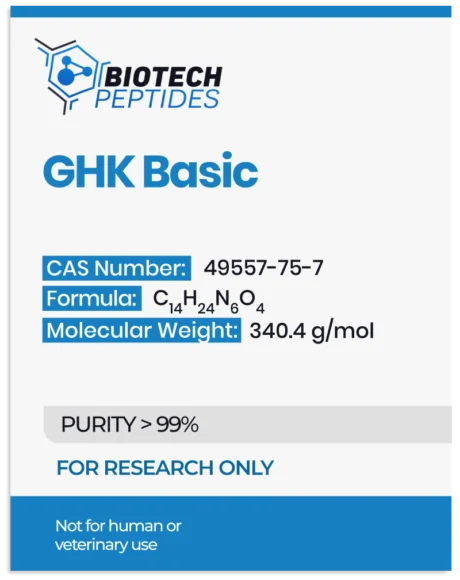
GHK Basic (Tripeptide-1) (200mg)
$163.00
GHK Basic (Tripeptide-1) peptides are synthesised and lyophilised In the USA
Exploring the Science of a Versatile Peptide
GHK Basic (Tripeptide-1) (200mg) is an experimental peptide material associated with research into skin biology, cellular signalling, extracellular matrix science, and peptide chemistry.
GHK, also known as Tripeptide-1, is a naturally occurring tripeptide made from three amino acids: glycine, histidine, and lysine. It has attracted scientific and cosmetic research interest because of its biological activity and its ability to interact with copper ions.
GHK Basic is distinct from GHK-Cu. GHK Basic refers to the peptide itself, while GHK-Cu refers to the copper-associated form of the peptide.
This distinction is important when evaluating peptide materials for laboratory or formulation research.
With a stated quantity of 200mg, GHK Basic provides researchers with a defined amount of material for controlled experimental work.
Research disclaimer: GHK Basic (Tripeptide-1) is presented as an experimental research material. Research findings should not be interpreted as proof that the peptide is a medical treatment or that it produces guaranteed cosmetic results.
1. What Is GHK Basic? Discover the Science Behind Tripeptide-1
GHK Basic, also known as Tripeptide-1, is a small peptide consisting of three amino acids.
Its full name is glycyl-L-histidyl-L-lysine.
These three amino acids give GHK its distinctive biochemical properties.
Because of its simple structure, GHK has become an interesting subject in peptide research.
The Three Amino Acids Behind GHK
GHK is made from:
- Glycine
- Histidine
- Lysine
Each amino acid contributes to the structure and chemical behavior of the peptide.
The combination creates a small molecule that researchers can investigate in controlled laboratory environments.
Why Is GHK Called Tripeptide-1?
The term Tripeptide-1 is commonly used to identify GHK in cosmetic ingredient and peptide research contexts.
The word “tripeptide” refers to a peptide made from three amino acids.
GHK is therefore a classic example of a short peptide.
What Does GHK Basic 200mg Mean?
GHK Basic 200mg refers to a preparation containing a stated quantity of 200 milligrams of the peptide.
The 200mg specification describes the amount of material.
It does not indicate a recommended dosage, treatment schedule, or therapeutic strength.
For research applications, the amount required depends on the experimental protocol.
2. The Fascinating GHK Connection: Copper Binding and Cellular Signaling
One of the most interesting characteristics of GHK is its relationship with copper.
Copper is an essential trace element involved in numerous biological processes.
GHK can interact with copper ions and form the complex commonly known as GHK-Cu.
This property has contributed significantly to the scientific interest surrounding GHK.
GHK Basic vs. GHK-Cu
Although the names are closely related, the materials are not identical.
GHK Basic is the peptide itself.
GHK-Cu is the copper-associated complex.
This difference matters when conducting research or evaluating ingredients.
Researchers should always verify the exact identity and composition of the material they are studying.
GHK and Copper-Binding Research
Copper plays a role in many enzymatic and cellular processes.
Researchers therefore investigate molecules that interact with copper to better understand these biological systems.
GHK provides an interesting model because its structure allows it to coordinate with copper.
This creates opportunities for research into peptide chemistry and metal binding.
GHK and Cellular Communication
Peptides can participate in complex biological signaling networks.
GHK has been investigated in relation to cellular signaling and tissue biology.
Researchers have explored how GHK may interact with cellular pathways associated with extracellular matrix components and tissue structure.
These areas remain important subjects in molecular and cosmetic research.
3. GHK Basic Research: Exploring Skin Biology and the Extracellular Matrix
GHK has received considerable attention in skin research and cosmetic science.
The skin is a complex organ made up of multiple cell types and structural components.
Its extracellular matrix contains proteins such as collagen and elastin that help provide structure and organization.
GHK and Skin Research
Research involving GHK has examined its potential relationship with skin related cellular processes.
Scientists have investigated areas such as:
- Fibroblast biology
- Extracellular matrix research
- Collagen related pathways
- Cellular signaling
- Tissue remodeling
- Skin structure
- Gene expression
These areas help explain why GHK remains popular in cosmetic peptide research.
However, experimental observations should not be presented as guaranteed cosmetic outcomes.
GHK and Fibroblast Research
Fibroblasts are important cells within connective tissue.
They contribute to the production and organisation of extracellular matrix components.
Researchers study fibroblast activity to understand how connective tissue develops and maintains its structure.
GHK is an interesting research molecule within this area because of its association with extracellular matrix biology.
GHK and Collagen Research
Collagen is a major structural protein found throughout connective tissue.
Changes in collagen production and organization can influence tissue structure.
Research into GHK has examined pathways related to collagen and other extracellular matrix components.
This does not mean GHK Basic should be presented as a clinically proven collagen treatment.
Instead, these findings provide a foundation for further research.
GHK and Cellular Ageing Research
Cellular ageing is another area where peptide research continues to develop.
Scientists investigate how cells change over time and how signalling pathways respond to age-related changes.
GHK has attracted interest within this broader field because of research involving cellular signalling and tissue biology.
Further research is needed to understand the full significance of these observations.
4. GHK Basic (Tripeptide-1) (200mg): Quality, Purity, and Research Considerations
When evaluating GHK Basic 200mg, the quantity on the label is only one factor.
Researchers should also consider identity, purity, characterization, and documentation.
Useful product information may include:
- Peptide name
- Amino acid sequence
- Molecular formula
- Molecular weight
- Purity
- Certificate of analysis
- Batch number
- Analytical testing
- Stability information
- Storage requirements
Why GHK Basic Purity Matters
Purity can affect research consistency.
Unexpected impurities may introduce additional variables into an experiment.
A certificate of analysis can provide useful batch specific information about peptide identity and purity.
Researchers should review available analytical documentation rather than relying only on a product description.
A 200mg label alone does not establish purity, biological activity, effectiveness, or safety.
GHK Basic Stability
Peptides can be affected by environmental conditions.
Factors such as temperature, moisture, light, pH, and repeated handling may influence stability.
The exact stability profile depends on the specific preparation.
Researchers should follow the documented storage and handling instructions supplied with the material.
Research Material and Cosmetic Ingredients
GHK has a history of interest in cosmetic formulation research.
However, a laboratory peptide and a finished cosmetic product are not necessarily the same thing.
Finished formulations may contain additional ingredients that influence stability, delivery, texture, and performance.
Researchers and formulators should evaluate each material according to its intended application and applicable regulations.
5. The Future of GHK Basic Research: Unlocking New Possibilities in Peptide Science
GHK remains an interesting molecule because it connects several areas of science.
Its simple three-amino-acid structure provides a useful model for studying peptide chemistry.
Its copper-binding properties create additional research opportunities.
Its relationship with skin and extracellular matrix biology has also contributed to its popularity in cosmetic science.
Potential Areas for Future Research
Future studies may explore:
- Peptide and copper interactions
- Cellular signaling
- Skin biology
- Fibroblast activity
- Extracellular matrix biology
- Collagen related pathways
- Gene expression
- Tissue remodeling
- Peptide stability
- Cosmetic formulation science
Why GHK Basic Remains Relevant
GHK is a naturally occurring peptide with a long history of scientific interest.
Its small size makes it convenient to study as a defined molecular structure.
At the same time, its biological interactions are complex enough to support research across multiple disciplines.
This combination makes GHK particularly interesting to peptide researchers and cosmetic scientists.
The Bigger Picture of Tripeptide-1 Research
Modern peptide science continues to investigate how small molecules can interact with biological systems.
GHK provides a useful example.
A peptide containing only three amino acids can interact with metal ions and participate in research involving cellular and tissue biology.
That makes GHK Basic (Tripeptide-1) (200mg) an interesting material for continued laboratory investigation.
Frequently Asked Questions About GHK Basic (Tripeptide-1) (200mg)
What is GHK Basic?
GHK Basic is the peptide glycyl-L-histidyl-L-lysine, also known as Tripeptide-1. It is studied in areas such as peptide chemistry, cellular signalling, skin biology, and extracellular matrix research.
What does GHK Basic 200mg mean?
GHK Basic 200mg indicates a preparation containing a stated quantity of 200 milligrams. The amount describes the quantity of material and does not represent a recommended dosage.
What does Tripeptide-1 mean?
Tripeptide-1 refers to a peptide containing three amino acids. In this context, it is another name associated with GHK.
What amino acids make up GHK?
GHK consists of glycine, histidine, and lysine.
Is GHK naturally occurring?
Yes. GHK is a naturally occurring tripeptide that has been studied in biological and cosmetic research.
What is the difference between GHK Basic and GHK-Cu?
GHK Basic refers to the peptide itself. GHK-Cu refers to GHK associated with copper. They are related but chemically distinct materials.
Does GHK Basic contain copper?
GHK Basic refers to the peptide rather than the copper-bound complex. The exact composition of a particular preparation should always be verified through its product documentation.
What is GHK studied for?
GHK has been studied in areas including copper binding, cellular signalling, skin biology, extracellular matrix research, fibroblast biology, and cosmetic science.
Is GHK Basic a skincare ingredient?
GHK has been used and studied in cosmetic research. Whether a particular preparation is appropriate for a finished cosmetic formulation depends on its specifications, formulation, and applicable regulations.
Is GHK Basic an anti-ageing treatment?
GHK has been investigated in research related to cellular ageing and skin biology. However, experimental research does not establish GHK Basic as a proven anti-ageing treatment.
What should researchers look for when buying GHK Basic 200mg?
Researchers should consider peptide identity, amino acid sequence, purity, molecular characterisation, certificate of analysis, batch information, stability, and storage requirements.
Why is peptide purity important?
Purity can influence experimental consistency. Well-characterized materials help researchers reduce unwanted variables during laboratory studies.
How should GHK Basic be stored?
Storage requirements vary according to the specific preparation. Researchers should follow the supplier’s documented storage and handling instructions.
Is GHK Basic approved as a medical treatment?
GHK Basic should not be presented as an approved medical treatment. Research findings do not automatically establish clinical effectiveness.
Is GHK Basic safe for personal use?
Safety cannot be assumed from laboratory research. Experimental peptide materials should not automatically be considered suitable for personal use or self-administration.
Final Thoughts on GHK Basic (Tripeptide-1) (200mg)
GHK Basic (Tripeptide-1) (200mg) is an interesting peptide for research into copper binding, cellular signalling, skin biology, extracellular matrix science, and cosmetic peptide research.
Its structure is remarkably simple. GHK contains only three amino acids: glycine, histidine, and lysine.
Yet this small peptide has generated significant scientific interest because of its biochemical properties and interaction with copper.
The distinction between GHK Basic and GHK-Cu is important. GHK Basic refers to the peptide itself, while GHK-Cu describes the copper-associated form.
For researchers evaluating GHK Basic 200mg, quality should remain a priority. Identity, sequence, purity, analytical testing, batch information, stability, and storage conditions can all contribute to reliable research.
As peptide science continues to advance, GHK remains a fascinating example of how a small peptide can provide insight into complex biological processes.
Three amino acids. A unique biochemical structure. A remarkable history of research in peptide and skin science.
Brand
Biotech Peptides
Be the first to review “GHK Basic (Tripeptide-1) (200mg)”
Related products
PEPTIDES
PEPTIDES
PEPTIDES
PEPTIDES
PEPTIDES
PEPTIDES
PEPTIDES
PEPTIDES
Reviews
There are no reviews yet.