
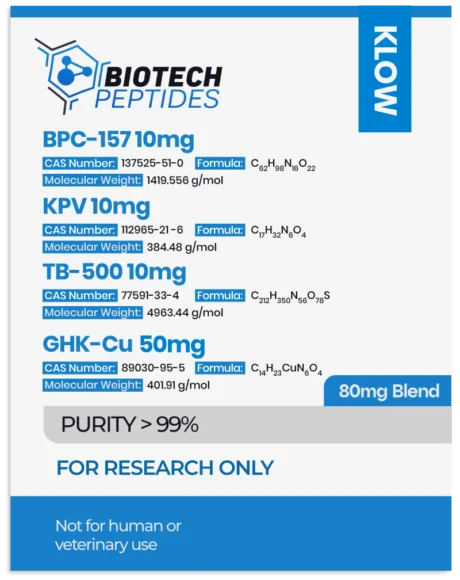
KLOW Blend (80mg)
$218.00
BPC-157 & TB-500 & GHK-Cu & KPV Peptide Blend Peptides are synthesised and lyophilised In the USA
Explore the Science Behind a Multi-Peptide Research Formula
KLOW Blend (80mg) is a multi-peptide research preparation designed for researchers exploring peptide chemistry, molecular biology, cellular signalling, and formulation science. KLOW Blend Peptides
The name KLOW Blend may be used for a specific combination of research peptides, so accurate product characterization is essential. Researchers should confirm the exact ingredients, peptide sequences, quantities, purity, and analytical specifications before beginning experimental work.
The 80mg designation refers to the stated total quantity of the preparation. It should not automatically be interpreted as an equal amount of each component, a recommended dose, or evidence of clinical effectiveness.
Multi-peptide formulations can be especially interesting because they allow researchers to examine several molecular components within the same experimental preparation. This can create opportunities to investigate peptide compatibility, stability, molecular interactions, and analytical behavior.
Research disclaimer: This product description is intended for experimental research purposes. It does not claim that KLOW Blend or any of its individual components treats, prevents, or cures a disease or medical condition. Researchers should verify product composition, identity, purity, analytical documentation, storage requirements, and applicable regulations before use.
1. What Is KLOW Blend (80mg)? A Closer Look at Multi-Peptide Research
The KLOW Blend 80mg is best approached as a multi-component research material rather than as a single peptide.
Unlike a product containing one defined compound, a blend requires researchers to consider each component individually and the preparation as a whole.
Understanding the KLOW Blend
The first step in evaluating any multi-peptide preparation is confirming exactly what it contains.
Researchers should review the product specification for:
- Individual peptide names
- Peptide sequences
- Molecular weights
- Individual quantities
- Total blend quantity
- Purity
- Analytical testing
- Batch information
This information helps establish a clear experimental baseline.
What Does 80mg Mean?
The 80mg label identifies the stated total quantity of the blend.
It does not necessarily mean that every peptide contributes the same amount.
For example, a blend containing several components could use different proportions for each compound. Therefore, researchers should rely on the product documentation rather than infer the ratio from the total weight.
Why Accurate Identification Matters
Precise identification is essential in peptide research.
Different peptides can have very different structures, properties, and biological targets.
Knowing the exact composition allows researchers to compare experimental findings more accurately and reproduce laboratory methods.
2. The Science Behind KLOW Blend: Why Multi-Peptide Research Is So Interesting
Multi-peptide research provides an opportunity to examine several molecular components within one preparation.
Each peptide can have unique chemical and structural characteristics.
Exploring Peptide Structure
Peptides are chains of amino acids connected through peptide bonds.
Even relatively small differences in amino acid sequence can influence molecular structure and behavior.
Researchers may therefore examine:
- Amino acid sequence
- Molecular weight
- Chemical modifications
- Solubility
- Stability
- Purity
- Binding characteristics
These factors can influence how a peptide behaves during laboratory analysis.
Studying Molecular Interactions
A multi-peptide blend introduces additional questions about molecular interactions.
Researchers may investigate whether the components remain chemically stable when combined and whether the presence of one compound influences the characteristics of another.
These questions can be explored through appropriate analytical techniques.
Investigating Peptide Stability
Stability is another important consideration.
Environmental factors such as temperature, moisture, light, pH, and repeated handling can influence peptide integrity.
A multi-component preparation may require careful evaluation to determine how each component behaves over time.
Understanding Formulation Science
Formulation research examines how different compounds behave within a preparation.
Researchers can investigate factors such as:
- Compatibility
- Solubility
- Stability
- Degradation
- Storage conditions
- Analytical consistency
This makes multi-peptide blends an interesting subject for pharmaceutical and biochemical research.
3. KLOW Blend Research: Exploring Molecular Biology From Multiple Angles
Interest in KLOW Blend research can extend across several scientific disciplines.
The exact research applications depend on the confirmed composition of the preparation.
Peptide Chemistry Research
Researchers can study the chemical characteristics of the individual peptides.
This may include sequence verification, molecular weight analysis, purity testing, and stability assessment.
Accurate chemical characterization provides the foundation for reliable experiments.
Cellular Research
Where scientifically appropriate, researchers may investigate how specific peptide components interact with cellular systems.
Such studies should use validated experimental models and appropriate controls.
Results should also be interpreted according to the strength of the available evidence.
Receptor Research
If the individual components have known receptor targets, researchers may investigate receptor interactions using suitable laboratory models.
This can help explore relationships between peptide structure and molecular signaling.
Comparative Peptide Research
A blend can also provide opportunities for comparison.
Researchers may examine how the individual components differ in:
- Molecular structure
- Stability
- Binding behavior
- Analytical profile
- Experimental characteristics
These comparisons can help scientists better understand structure-function relationships.
4. KLOW Blend (80mg): Quality, Purity, and Analytical Documentation Matter
When evaluating KLOW Blend 80mg, the stated quantity is only one part of product characterization.
Quality assessment should begin with clear documentation.
What Should Researchers Verify?
Before using a multi-peptide preparation, researchers should consider verifying:
- Complete ingredient list
- Exact peptide identities
- Amino acid sequences
- Molecular weights
- Individual quantities
- Total blend quantity
- Purity information
- Certificate of analysis
- Batch number
- Analytical testing
- Stability information
- Storage requirements
Why Is Purity Important?
Research depends on reliable experimental materials.
Unknown impurities can introduce unwanted variables and make results more difficult to interpret.
Analytical testing can help researchers understand the composition and quality of the material being evaluated.
A batch-specific certificate of analysis can provide useful information about the tested preparation.
However, documentation should be assessed carefully. A label or certificate does not by itself establish clinical safety, therapeutic effectiveness, or suitability for human use.
Confirm the Exact Formulation
The term KLOW Blend should not be treated as a universal scientific definition.
Different suppliers may use similar names for different formulations.
Researchers should therefore verify the exact formulation before comparing products or scientific findings.
Storage and Handling Considerations
Peptide stability can be affected by environmental conditions.
Researchers should follow the specific storage and handling instructions supplied with the material.
Avoiding unnecessary temperature changes, moisture exposure, light exposure, and repeated handling can help preserve research material according to its documented requirements.
5. The Future of Multi-Peptide Research: Where Could KLOW Blend Studies Lead?
Modern peptide science continues to develop across biochemistry, molecular biology, analytical chemistry, and pharmaceutical research.
Multi-peptide preparations offer researchers another way to explore complex molecular systems.
Potential Research Directions
Depending on the confirmed composition, laboratory research may explore:
- Peptide structure
- Molecular stability
- Cellular signaling
- Receptor interactions
- Peptide compatibility
- Formulation science
- Analytical chemistry
- Structure-function relationships
- Degradation pathways
- Multi-component stability
Why Multi-Peptide Formulas Matter
Studying individual compounds provides valuable information about their separate characteristics.
Studying them together introduces another level of complexity.
Researchers can ask whether the components remain stable, whether their analytical profiles change, and how the complete preparation behaves under controlled conditions.
Evidence Should Guide Interpretation
Peptide research can generate exciting possibilities, but scientific evidence remains essential.
Laboratory observations should not automatically be presented as proven human outcomes.
Researchers should distinguish between in vitro studies, animal research, clinical evidence, and anecdotal reports.
This approach helps maintain accurate scientific communication.
Frequently Asked Questions About KLOW Blend (80mg)
What is KLOW Blend (80mg)?
KLOW Blend (80mg) is a multi-peptide research preparation. The exact scientific composition should be confirmed through product documentation before use.
What does 80mg mean?
The 80mg specification refers to the stated total quantity of the blend. It does not necessarily indicate equal quantities of the individual components.
What peptides are included in KLOW Blend?
The exact components should be verified from the product specification or batch documentation. Researchers should not assume a formulation based solely on the KLOW name.
Why is the exact formulation important?
Different peptides have different molecular structures and properties. Knowing the exact composition is essential for accurate research and reproducible results.
Is KLOW Blend a single peptide?
No. The term “blend” indicates a preparation containing multiple components rather than one individual peptide.
Why are multi-peptide blends studied?
They can provide researchers with an opportunity to investigate peptide compatibility, stability, molecular interactions, and formulation characteristics.
What should researchers check before purchasing KLOW Blend?
Researchers should review the ingredient list, peptide identities, sequences, molecular weights, individual quantities, purity, certificate of analysis, batch information, analytical testing, and storage requirements.
Why is a certificate of analysis useful?
A certificate of analysis can provide batch-specific information about the identity and quality characteristics of a research material.
Does 80mg represent a recommended dose?
No. The 80mg figure describes the stated quantity of the research preparation. It should not be interpreted as a recommended human dose.
Can the individual peptides be studied separately?
That depends on the composition and research design. When individual components are available as separate research materials, studying them independently can help researchers compare their characteristics with the complete blend.
Can results from one component be applied to the entire blend?
Not automatically. A blend can behave differently from its individual components because composition, concentration, stability, and interactions may differ.
Why does peptide purity matter?
Purity can affect experimental consistency. Unidentified impurities may introduce variables that influence analytical or biological results.
How should KLOW Blend be stored?
Researchers should follow the specific storage and handling instructions provided with the material. Peptide stability can be affected by temperature, moisture, light, pH, and handling conditions.
Is KLOW Blend an approved medical treatment?
A research preparation should not automatically be considered an approved medical treatment. Regulatory status depends on the exact product and jurisdiction.
Can KLOW Blend be used personally?
Experimental research material should not automatically be considered suitable for personal use. Human use requires appropriate safety evaluation and regulatory consideration. KLOW Blend Peptides
Is KLOW Blend proven to treat any medical condition?
No therapeutic claim should be inferred from the existence of a peptide research product. Evidence must be evaluated separately for each specific compound, formulation, and intended application.
Why is analytical testing important?
Analytical testing can help researchers characterize the material and identify important properties such as identity, purity, and composition.
What makes KLOW Blend interesting for peptide research?
Its multi-component nature creates opportunities to investigate several peptide characteristics within one preparation, including stability, compatibility, molecular interactions, and analytical behavior. KLOW Blend Peptides
Final Thoughts on KLOW Blend (80mg)
KLOW Blend (80mg) represents an interesting category of multi-peptide research material.
Rather than focusing only on the total quantity, researchers should consider the complete scientific profile of the preparation. Exact peptide identity, sequence, composition, purity, blend ratio, analytical testing, stability, and storage requirements are all important factors.
The 80mg specification identifies the stated total quantity of the preparation. It does not establish a recommended dose, clinical effectiveness, or therapeutic use.
For researchers interested in KLOW Blend research, careful characterization provides the foundation for meaningful experiments. KLOW Blend Peptides. A well-documented preparation can help researchers investigate peptide chemistry, molecular biology, formulation behavior, stability, and structure-function relationships.
As peptide science continues to evolve, multi-component preparations may offer valuable opportunities to explore how different molecular structures behave independently and together.
Multiple peptides. Multiple research questions. One fascinating opportunity to explore the complexity of modern peptide science.
Brand
Biotech Peptides
Be the first to review “KLOW Blend (80mg)”
Related products
PEPTIDES
PEPTIDE BLENDS

PEPTIDES
PEPTIDES
PEPTIDE BLENDS
PEPTIDE BLENDS
PEPTIDE BLENDS
PEPTIDE BLENDS
Reviews
There are no reviews yet.