
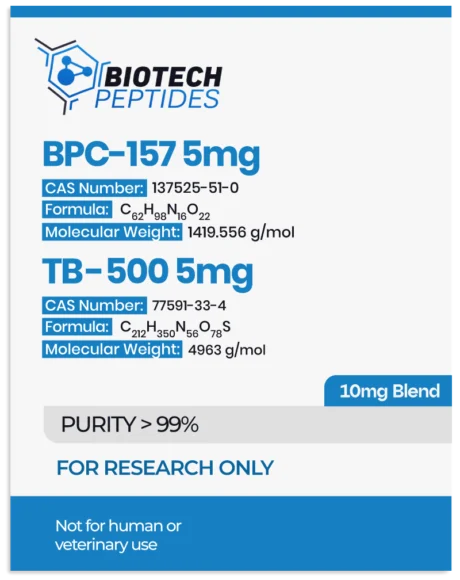
BPC-157 & TB-500 Blend (10mg)
$113.00
BPC-157 & TB-500 Blend Peptides are synthesised and lyophilised In the USA
Exploring the Science of Two Research Peptides
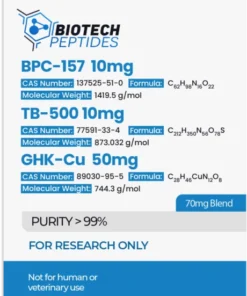
BPC-157 & TB-500 Blend (10mg) combines two synthetic peptides that have attracted significant interest in peptide research, cellular biology, tissue research, and molecular science.
BPC-157 and TB-500 are frequently discussed together because both have been investigated in experimental research involving cellular processes, tissue biology, and recovery-related pathways. However, they are distinct peptides with different molecular structures.
This combination allows researchers to examine two peptide systems within the same research framework. It may also support comparative studies focused on peptide stability, molecular interactions, and biological signalling.
The 10mg specification refers to the stated total quantity of the blend. It does not indicate a recommended dose or establish a human-use protocol.
Research disclaimer: BPC-157 and TB-500 are presented here as experimental research materials. This content does not establish either peptide, or the combination, as an approved treatment for any disease or medical condition. Researchers should verify product identity, composition, purity, analytical documentation, storage requirements, and applicable regulations before use.
1. What Is the BPC-157 & TB-500 Blend? Meet Two Fascinating Peptides
The BPC-157 & TB-500 Blend brings together two different peptides in one research preparation.
Although they are often mentioned in the same research conversations, BPC-157 and TB-500 are not the same molecule.
Understanding their individual characteristics provides useful context for studying the blend.
What Is BPC-157?
BPC-157 is a synthetic peptide that has been investigated primarily in preclinical research.
Researchers have examined BPC-157 in experimental models involving cellular signalling, gastrointestinal biology, vascular processes, and tissue-related pathways.
Much of the available research remains preclinical, so findings from laboratory and animal studies should not be interpreted as proof of clinical effectiveness in humans.
What Is TB-500?
TB-500 is commonly described as a synthetic peptide related to thymosin beta-4.
Thymosin beta-4 is a naturally occurring peptide involved in biological processes related to cell migration and tissue biology.
TB-500 is frequently studied in experimental peptide research because of its relationship to these biological pathways.
Importantly, TB-500 and naturally occurring thymosin beta-4 should not automatically be treated as identical substances.
What Does 10mg Mean?
BPC-157 & TB-500 Blend 10mg refers to a preparation containing a stated total quantity of 10 milligrams.
The exact ratio of BPC-157 to TB-500 should be confirmed through product documentation.
A 10mg total does not necessarily mean that each peptide contributes 5mg.
2. The Science Behind BPC-157 & TB-500: Two Peptides, Distinct Research Pathways
The scientific interest surrounding this blend comes from the different characteristics of its two components.
Exploring BPC-157 Research
BPC-157 has been studied in experimental models involving several biological processes.
Researchers have explored topics such as:
- Cellular signaling
- Vascular biology
- Gastrointestinal research
- Tissue-related pathways
- Inflammatory signaling
- Molecular interactions
These studies provide scientific questions for further investigation, but they do not establish BPC-157 as a proven human therapy.
Understanding TB-500 Research
TB-500 is associated with research involving thymosin beta-4-related biology.
Thymosin beta-4 has been investigated in relation to:
- Cell migration
- Cytoskeletal organization
- Angiogenesis
- Tissue biology
- Cellular repair mechanisms
Research involving TB-500 itself should be considered separately from research involving naturally occurring thymosin beta-4.
Why Study the Two Together?
Combining two distinct peptides creates an opportunity for researchers to investigate their behaviour within the same experimental system.
Potential questions include:
- Do the peptides behave independently?
- How stable is the combined preparation?
- Do their molecular properties change when combined?
- How does the blend compare with individual peptide preparations?
- What analytical methods best characterise the mixture?
These questions require controlled laboratory research.
3. BPC-157 & TB-500 Research: Exploring Cellular Biology and Tissue-Related Pathways
Interest in BPC-157 & TB-500 research continues to grow as scientists explore peptide-based approaches to understanding cellular processes.
BPC-157 and Cellular Research
Preclinical studies have investigated BPC-157 in several biological models.
Researchers have examined its relationship with cellular signalling and tissue-associated processes.
However, preclinical findings cannot automatically be translated into human outcomes.
Further research is needed to determine how experimental observations relate to human biology.
TB-500 and Cell Migration Research
Thymosin beta-4-related research has examined cell migration and other cellular processes.
Cell migration is important in many areas of biology because cells must move in response to signals during normal physiological processes.
Researchers can use peptide models to explore these mechanisms in controlled environments.
Studying Tissue-Related Biology
Tissue biology involves numerous interacting systems.
Cells communicate through signalling molecules, extracellular matrix components, growth factors, and other biological mediators.
BPC-157 and TB-500 are interesting to researchers because they have been investigated in areas connected to these complex processes.
Why Combination Studies Matter
Studying individual peptides is important.
Studying them as a combination can provide additional information about:
- Molecular compatibility
- Stability
- Biological interactions
- Formulation behavior
- Analytical characteristics
A combination should not be assumed to produce the same findings as either peptide studied separately.
4. BPC-157 & TB-500 Blend (10mg): Purity, Composition, and Quality Considerations
When evaluating BPC-157 & TB-500 Blend 10mg, total quantity is only one factor.
Researchers should also consider the identity and quality of each component.
Verify the Exact Composition
A reliable research material should have documentation describing:
- BPC-157 identity
- TB-500 identity
- Exact blend ratio
- Molecular weights
- Purity
- Batch number
- Certificate of analysis
- Analytical testing
- Storage requirements
Knowing the exact composition is particularly important with combination products.
Why Purity Matters
Research results depend on consistent experimental materials.
Unknown impurities can introduce unwanted variables and make experimental findings harder to interpret.
Batch-specific analytical documentation can help researchers evaluate the material before beginning a study.
Analytical Testing
Researchers may use suitable analytical techniques to confirm peptide identity and purity.
Depending on the research objectives, methods such as chromatography and mass spectrometry may be relevant.
The appropriate testing strategy depends on the characteristics of the material and the laboratory protocol.
Storage and Stability
Peptides may be sensitive to environmental conditions.
Temperature, moisture, light, pH, and repeated handling can influence stability.
A blend containing two peptides may require additional consideration because each component can have its own stability characteristics.
Researchers should follow the supplier’s documented storage and handling instructions.
5. The Future of BPC-157 & TB-500 Research: Exploring New Questions in Peptide Science
Peptide research continues to expand across molecular biology, cellular science, tissue research, and analytical chemistry.
The BPC-157 and TB-500 combination represents an interesting area for controlled experimental investigation.
Potential Areas for Future Research
Future research may examine:
- Cellular signaling
- Tissue biology
- Cell migration
- Molecular interactions
- Peptide stability
- Combination peptide research
- Analytical characterization
- Structure-function relationships
- Formulation science
- Preclinical models
Why Research Blends Are Interesting
A peptide blend allows researchers to examine more than one molecular structure within the same preparation.
This can create new research questions involving compatibility, stability, and biological interactions.
However, combination research requires careful experimental design.
Results from one peptide cannot automatically be attributed to the other.
The Importance of Evidence-Based Research
Interest in BPC-157 and TB-500 has grown quickly, particularly online.
However, online popularity is not the same as scientific validation.
Researchers should distinguish between laboratory evidence, animal research, human clinical evidence, and anecdotal claims.
This distinction is essential when evaluating experimental peptides.
Frequently Asked Questions About BPC-157 & TB-500 Blend (10mg)
What is the BPC-157 & TB-500 Blend?
It is a research preparation combining BPC-157 and TB-500, two distinct synthetic peptides investigated in experimental biological research.
What is BPC-157?
BPC-157 is a synthetic peptide that has been studied mainly in preclinical research involving cellular, vascular, gastrointestinal, and tissue-related processes.
What is TB-500?
TB-500 is a synthetic peptide commonly described as being related to thymosin beta-4. It has attracted research interest in areas involving cell migration and tissue biology.
Are BPC-157 and TB-500 the same peptide?
No. They are chemically distinct peptides with different structures and research profiles.
What does 10mg mean?
The 10mg specification refers to the stated total quantity of the blend. It does not necessarily mean 5mg of BPC-157 and 5mg of TB-500.
Why are BPC-157 and TB-500 combined?
Researchers may be interested in studying two different peptide structures within the same experimental system. Combination research can raise questions about molecular interactions, stability, and biological pathways.
Does research on BPC-157 apply to the blend?
Not automatically. A combination product should be evaluated independently because combining peptides can change the experimental environment.
Does research on thymosin beta-4 prove the effects of TB-500?
No. TB-500 and naturally occurring thymosin beta-4 should not automatically be treated as identical substances. Research findings must be evaluated according to the exact compound studied.
What is BPC-157 studied for?
BPC-157 has been investigated in preclinical models involving cellular signalling, vascular biology, gastrointestinal research, and tissue-related processes.
What is TB-500 studied for?
TB-500 is associated with experimental research involving thymosin beta-4-related pathways, including cell migration and tissue biology.
Is the BPC-157 & TB-500 Blend an approved medical treatment?
This research material should not be presented as an approved medical treatment. Experimental findings do not establish safety or effectiveness for treating human medical conditions.
Can BPC-157 and TB-500 be used personally?
Experimental research materials should not automatically be considered suitable for personal use. Human use involves safety, clinical, and regulatory considerations that are outside the scope of research material.
What should researchers check before purchasing this blend?
Researchers should verify the exact composition, peptide identities, blend ratio, purity, molecular weights, certificate of analysis, batch information, analytical testing, stability, and storage requirements.
Why is the blend ratio important?
Knowing the ratio helps researchers understand the composition of the experimental material. A total quantity of 10mg does not establish how much of each peptide is present.
Why is a certificate of analysis useful?
A certificate of analysis can provide batch-specific information about identity and quality characteristics. Researchers can use this documentation as part of their material verification process.
How should the BPC-157 & TB-500 Blend be stored?
Researchers should follow the supplier’s specific storage and handling instructions. Environmental conditions can influence peptide stability.
Does 10mg indicate a recommended dose?
No. The 10mg specification describes the stated quantity of material. It is not a recommended human dose.
Why is BPC-157 & TB-500 research attracting attention?
Both peptides have generated interest in preclinical peptide research involving cellular and tissue-related biology. Online interest, however, should not be confused with established clinical evidence.
Final Thoughts on BPC-157 & TB-Blend (10mg)
BPC-157 & TB-500 Blend (10mg) brings together two distinct peptides that have attracted interest across experimental peptide and cellular research.
BPC-157 has been investigated mainly in preclinical models involving cellular signalling and tissue-related pathways. TB-500 is associated with research related to thymosin beta-4 and cellular processes such as migration.
Studying these peptides together creates opportunities to investigate peptide stability, molecular interactions, cellular biology, tissue research, and combination peptide science.
For researchers evaluating this material, accurate characterisation is essential. The exact blend ratio, peptide identity, purity, analytical documentation, batch information, stability, and storage requirements should all be reviewed carefully.
The 10mg specification identifies the stated total quantity of the preparation. It should not be interpreted as a dosage or evidence of clinical effectiveness.
As peptide science continues to develop, carefully controlled research can help separate promising molecular questions from unsupported claims and provide a clearer understanding of how experimental peptides behave.
Two distinct peptides. One research blend. A closer look at the science of peptide interactions and cellular biology.
Brand
Biotech Peptides
Be the first to review “BPC-157 & TB-500 Blend (10mg)”
Related products

PEPTIDES
PEPTIDE BLENDS
PEPTIDES
PEPTIDE BLENDS

PEPTIDES
PEPTIDES
PEPTIDES

Reviews
There are no reviews yet.