
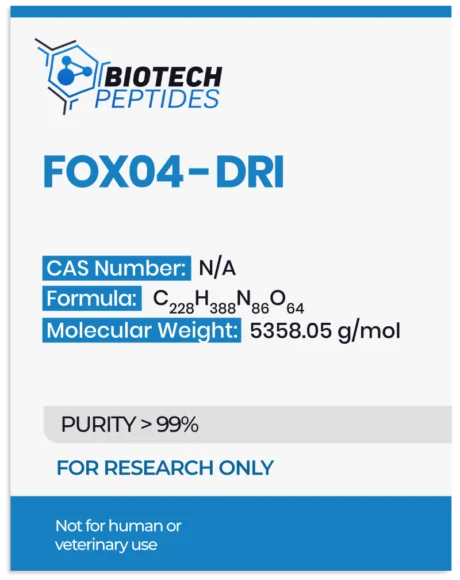
FOXO4-DRI (Proxofim) (10mg)

$267.00
FOXO4-DRI peptides are synthesised and lyophilised in the USA.
Exploring the Science of Cellular Senescence Research
FOXO4-DRI (Proxofim) (10mg) is an experimental research peptide that has attracted attention in the field of cellular senescence and ageing biology. Researchers have investigated FOXO4-DRI because of its relationship with FOXO4, p53 signalling, senescent cells, and apoptosis.
The compound is particularly interesting because cellular senescence has become an important area of modern biomedical research. Scientists are studying how senescent cells accumulate with age and how their altered behaviour may influence surrounding tissues.
For researchers searching for FOXO4-DRI 10mg, understanding its molecular mechanism and research background is more useful than relying on broad anti-ageing claims. This guide explores the science behind FOXO4-DRI, its relationship with cellular senescence, and frequently asked questions.
1. What Is FOXO4-DRI (Proxofim)?
FOXO4-DRI is an experimental peptide designed to interfere with interactions between the transcription factor FOXO4 and the tumour suppressor protein p53.
The name FOXO4-DRI refers to a FOXO4-derived D-retro-inverso peptide, a structural design intended to improve resistance to enzymatic degradation compared with conventional peptide sequences.
Research involving FOXO4-DRI became particularly notable after studies investigated its ability to influence the survival of senescent cells.
The compound is sometimes referred to as Proxofim, although terminology can vary between research and commercial sources.
The 10mg designation refers to the stated quantity of material in a particular preparation. It represents mass and should not be interpreted as a recommended human dose or treatment protocol.
Why FOXO4-DRI Attracted Scientific Attention
Cellular senescence is a fascinating biological phenomenon.
A senescent cell is a cell that has permanently or semi-permanently stopped dividing while remaining metabolically active. Senescence can occur in response to factors such as cellular stress, DNA damage, oncogene activation, and replicative exhaustion.
Senescent cells can also release signalling molecules that influence neighbouring cells. This collection of secreted factors is often referred to as the senescence-associated secretory phenotype, or SASP.
Because senescent cells may accumulate during aging and disease, researchers are investigating whether selectively targeting these cells could alter biological outcomes.
FOXO4-DRI became an important experimental tool within this field.
2. The Fascinating Science Behind FOXO4-DRI
To understand FOXO4-DRI, it is helpful to examine the FOXO family of transcription factors.
FOXO proteins regulate the expression of numerous genes involved in cellular processes such as stress responses, metabolism, cell survival, and longevity-related pathways.
FOXO4 is one member of this family.
One of its research-relevant interactions involves p53, a protein that plays a central role in DNA damage responses, cell-cycle regulation, apoptosis, and tumour suppression.
Researchers have investigated whether disrupting FOXO4-p53 interactions could influence the survival characteristics of senescent cells.
FOXO4 and p53: A Critical Cellular Relationship
The relationship between FOXO4 and p53 is central to the proposed mechanism of FOXO4-DRI.
p53 can promote cellular responses to significant stress or DNA damage. Depending on the cellular context, these responses can include cell-cycle arrest or programmed cell death.
Research has suggested that FOXO4 can interact with p53 and influence aspects of its cellular behaviour.
FOXO4-DRI was designed as an experimental molecule capable of interfering with this interaction.
This provides researchers with a way to investigate whether disrupting specific protein-protein interactions can influence the fate of senescent cells.
What Makes FOXO4-DRI Different?
The D-retro-inverso design is an important feature of FOXO4-DRI.
D-retro-inverso peptides use D-amino acids arranged in a reversed sequence orientation. This approach can create a molecule that maintains certain spatial characteristics of the original peptide while potentially increasing resistance to enzymatic degradation.
This is particularly relevant in peptide research because conventional peptides can be susceptible to enzymatic breakdown.
The structural design of FOXO4-DRI is therefore an important part of its research profile.
3. FOXO4-DRI and Cellular Senescence Research
Cellular senescence is not simply another form of cell death.
Senescent cells generally remain alive but enter a state of stable growth arrest. They can exhibit significant changes in gene expression, metabolism, and communication with surrounding cells.
Researchers study senescence because it plays roles in:
- Aging biology
- Cancer research
- Tissue remodeling
- Chronic inflammation
- DNA damage responses
- Cellular stress
- Age-related diseases
The accumulation of senescent cells has led scientists to investigate compounds capable of selectively affecting their survival.
This broader research area is sometimes described as senolytic research.
FOXO4-DRI and Senolytic Research
A senolytic is broadly defined as an agent being investigated for its ability to selectively eliminate senescent cells.
FOXO4-DRI has been investigated as an experimental senolytic peptide.
The scientific rationale is based on the idea that senescent cells may rely on particular survival pathways to resist apoptosis. Interfering with these pathways could potentially change the survival of senescent cells.
Importantly, FOXO4-DRI research remains experimental. Findings from cellular and animal studies should not be interpreted as proof that the compound is an established anti-ageing therapy in humans.
FOXO4-DRI and p53 Signaling
The p53 pathway is one of the most important regulatory systems in cell biology.
It responds to cellular stress and DNA damage and can influence whether cells repair damage, stop dividing, or undergo apoptosis.
FOXO4-DRI research is interesting because it investigates how altering FOXO4-p53 interactions might affect the behavior of senescent cells.
Understanding these interactions could contribute to broader research into cellular aging and stress responses.
4. FOXO4-DRI (10mg): Research Considerations
A preparation labelled FOXO4-DRI 10mg indicates a stated quantity of ten milligrams.
However, the quantity alone tells researchers very little about the quality or characteristics of a particular preparation.
Researchers evaluating experimental FOXO4-DRI materials may consider:
- Molecular identity
- Peptide purity
- D-amino acid configuration
- Certificate of analysis
- Batch information
- Molecular characterization
- Formulation
- Stability data
- Storage requirements
Analytical documentation is particularly important for specialised peptides because structural configuration can be relevant to biological behaviour.
Why Molecular Identity Matters
FOXO4-DRI is not simply a conventional peptide sequence. Its D-retro-inverso configuration is central to its design.
Consequently, researchers should verify that the material being studied corresponds to the intended molecular structure.
A product label or online description alone does not establish molecular identity, purity, biological activity, or suitability for human use.
FOXO4-DRI and Ageing Research
Aging involves numerous interconnected processes.
These include genomic instability, mitochondrial changes, cellular senescence, altered intercellular communication, and changes in immune function.
Cellular senescence is one of the major areas investigated within modern aging biology.
FOXO4-DRI research contributes to this field by providing researchers with an experimental tool for examining whether specific protein interactions can influence senescent cell survival.
This does not mean that FOXO4-DRI has been proven to reverse human aging or extend human lifespan.
5. The Future of FOXO4-DRI Research
The discovery and study of senescent cells has opened new directions in ageing research.
Scientists continue to investigate how senescent cells develop, how they communicate with neighbouring tissues, and whether selectively targeting them can influence age-related biological processes.
FOXO4-DRI remains interesting because it represents a protein-interaction-based approach to studying senescent cell survival.
Future research may help determine how selective this approach is, which biological systems it affects, and whether findings from experimental models have meaningful clinical relevance.
As with other experimental compounds, rigorous research is necessary before laboratory observations can be translated into established medical applications.
Frequently Asked Questions About FOXO4-DRI (Proxofim) (10mg)
What is FOXO4-DRI?
FOXO4-DRI is an experimental D-retro-inverso peptide designed to investigate interactions between FOXO4 and p53. It has attracted particular interest in cellular senescence research.
What does FOXO4-DRI 10mg mean?
FOXO4-DRI 10mg refers to a preparation containing a stated quantity of ten milligrams. The quantity represents mass and does not establish a recommended human dose.
What does D-retro-inverso mean?
D-retro-inverso describes a peptide design involving D-amino acids arranged in a reversed sequence orientation. This approach can alter peptide stability and molecular properties.
What is cellular senescence?
Cellular senescence is a state in which cells permanently stop dividing while remaining metabolically active. Senescent cells can produce signalling molecules that influence their surrounding environment.
Why is FOXO4-DRI studied?
FOXO4-DRI has been studied primarily in relation to cellular senescence, FOXO4-p53 interactions, apoptosis, and senolytic research.
Is FOXO4-DRI an anti-ageing treatment?
No established conclusion should be made that FOXO4-DRI reverses ageing or extends human lifespan. Its anti-ageing potential remains an experimental research question.
Is FOXO4-DRI a senolytic?
FOXO4-DRI has been investigated as an experimental senolytic peptide because researchers have studied its potential to influence the survival of senescent cells.
What is p53?
p53 is a major tumour suppressor protein involved in DNA damage responses, cell-cycle regulation, cellular stress responses, and apoptosis.
Is FOXO4-DRI approved as a medicine?
FOXO4-DRI is an experimental research compound and should not automatically be considered an approved pharmaceutical treatment.
Is FOXO4-DRI safe for human use?
Safety cannot be established from a product label or research description. Experimental findings, particularly from laboratory or animal models, do not automatically establish safety in humans.
What should researchers look for when evaluating FOXO4-DRI?
Researchers may examine molecular identity, purity, D-retro-inverso configuration, certificate of analysis, batch information, formulation, stability, and storage requirements.
Conclusion: Understanding FOXO4-DRI (10mg)
FOXO4-DRI (Proxofim) (10mg) is an intriguing experimental peptide at the intersection of cellular senescence, ageing biology, protein interactions, and apoptosis research.
Its scientific significance comes from its designed interaction with the FOXO4-p53 pathway and its investigation as a potential experimental senolytic. The D-retro-inverso structure also makes FOXO4-DRI particularly interesting from a peptide engineering perspective.
For researchers evaluating FOXO4-DRI 10mg, it is important to look beyond the product name and stated quantity. Molecular identity, peptide configuration, purity, analytical characterisation, formulation, stability, and appropriate laboratory standards all matter.
Most importantly, experimental research should be distinguished from established medical evidence. While FOXO4-DRI has generated significant interest in cellular ageing research, further investigation is needed to understand its biological effects, limitations, and potential clinical relevance.
Brand
Biotech Peptides
Be the first to review “FOXO4-DRI (Proxofim) (10mg)”
Related products
PEPTIDES
PEPTIDES
PEPTIDES
PEPTIDES
PEPTIDES
PEPTIDES
PEPTIDES
PEPTIDES
Reviews
There are no reviews yet.