
Exploring the Science Behind This EPO-Derived Research Peptide
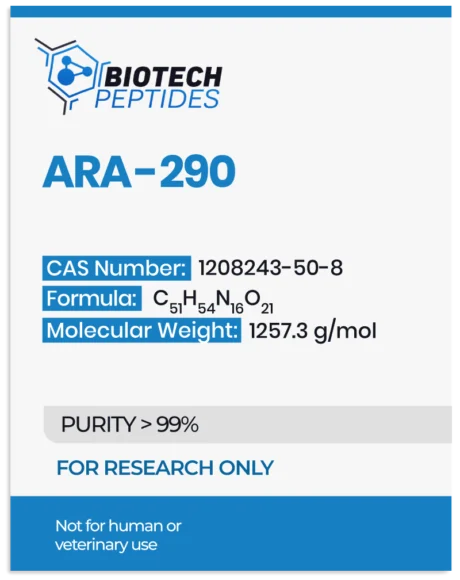
ARA-290 (16mg) is an experimental peptide derived from the tissue protective region of erythropoietin (EPO). Unlike conventional EPO, ARA-290 has been investigated primarily for its potential interactions with tissue-protective signalling pathways rather than its effects on red blood cell production.
Scientific interest in ARA-290 has centred on areas such as neuropathic pain research, inflammation, neuroprotection, metabolic biology, and tissue repair mechanisms. Its unique design makes it an interesting compound for researchers studying how erythropoietin-related signalling can be separated from erythropoiesis.
For researchers searching for information about ARA-290 16mg, this guide examines its biological background, proposed mechanism, research history, and frequently asked questions.
1. What Is ARA-290?
ARA-290, also known as cibenitide in some research literature, is a synthetic peptide derived from a specific region of the erythropoietin molecule.
Erythropoietin is best known for stimulating red blood cell production. However, research has revealed that EPO also interacts with biological pathways involved in tissue protection and cellular responses.
Scientists became interested in identifying whether these tissue-protective properties could be investigated independently of EPO’s erythropoietic activity.
ARA-290 was developed as an experimental peptide based on this concept.
The 16mg designation refers to the stated quantity of material in a particular preparation. It describes mass and should not be interpreted as a recommended dose or treatment protocol.
The Difference Between ARA-290 and EPO
Understanding the distinction between ARA-290 and erythropoietin is essential.
EPO is a glycoprotein hormone involved in the regulation of red blood cell production.
ARA-290 is a much smaller synthetic peptide derived from the tissue-protective region of EPO.
Researchers have investigated ARA-290 because its design aims to explore tissue-protective signalling without reproducing the full erythropoietic activity associated with EPO.
This distinction is one of the most scientifically interesting aspects of the compound.
2. The Fascinating Science Behind ARA-290
ARA-290 research focuses heavily on the concept of tissue protective signaling.
Scientists have identified signaling interactions involving EPO and other receptor systems that appear to influence cellular survival, inflammation, and tissue responses.
Research has proposed that a receptor complex involving the EPO receptor and CD131, sometimes referred to as the beta common receptor, may participate in some of these non-erythropoietic effects.
ARA-290 has been investigated in connection with this signalling concept.
Rather than functioning primarily as a stimulator of red blood cell production, its research profile centres on potential effects involving cellular protection and inflammatory regulation.
ARA-290 and the Innate Repair Receptor
The proposed receptor system associated with tissue-protective EPO signalling is sometimes described in scientific literature as the innate repair receptor.
Research suggests this signalling pathway may be involved in cellular responses to injury and inflammation.
Scientists have investigated whether activation of this pathway can influence:
- Inflammatory signaling
- Cell survival
- Tissue responses
- Neural function
- Metabolic processes
The biology remains an active research area, and proposed mechanisms should be distinguished from established clinical outcomes.
ARA-290 and Neuropathic Pain Research
One of the most notable areas of ARA-290 research involves neuropathic pain.
Neuropathic pain occurs when the nervous system itself is damaged or altered, producing abnormal pain signalling.
Researchers have investigated whether tissue-protective signalling could influence mechanisms involved in nerve injury and neuropathic symptoms.
Early clinical studies of ARA-290 generated interest in its potential effects in particular neuropathic conditions.
However, experimental results should not be interpreted as establishing ARA-290 as an approved pain treatment.
Neuroprotection: Another Area of Interest
The nervous system is particularly sensitive to inflammation, oxidative stress, and cellular injury.
Neuroprotection research seeks to understand mechanisms that may help preserve neuronal structure and function under damaging conditions.
Because ARA-290 is associated with tissue-protective signalling, scientists have investigated its potential relevance to neurological research.
Laboratory studies have explored pathways involving neuronal survival, inflammatory signalling, and interactions between nervous and immune systems.
These studies provide hypotheses for further investigation rather than definitive evidence of clinical effectiveness.
3. ARA-290 and Inflammation Research
Inflammation is a highly coordinated biological process involving immune cells, signalling molecules, and tissues.
Although inflammation is essential for normal defence and repair, dysregulated inflammatory activity can contribute to tissue damage and chronic disease.
ARA-290 has been investigated for its potential influence on inflammatory signalling without directly acting as a conventional immunosuppressive drug.
Researchers are particularly interested in how tissue protective pathways might alter the cellular response to injury.
This makes ARA-290 relevant to research involving inflammation, tissue protection, and regenerative biology.
ARA-290 and Metabolic Research
Research has also explored ARA-290 in relation to metabolic biology.
Scientists have investigated whether tissue protective signalling may interact with metabolic pathways and influence cellular responses to metabolic stress.
These studies are part of a broader effort to understand how inflammatory and metabolic signalling overlap.
The relationship between metabolism, inflammation, and tissue function is complex, meaning that individual laboratory observations require careful interpretation.
ARA-290 and Tissue Repair
Tissue repair involves several stages, including inflammation, cellular migration, extracellular matrix remodelling, and restoration of tissue structure.
Researchers have investigated EPO-derived tissue-protective peptides because of their potential relationship with these processes.
ARA-290’s proposed activity makes it an interesting tool for exploring how cells respond to injury.
Importantly, evidence from laboratory models does not automatically demonstrate that a research peptide produces tissue repair or regeneration in humans.
4. Why Is ARA-290 Important to Peptide Research?
ARA-290 is scientifically interesting because it represents an attempt to separate different biological functions associated with a larger hormone.
EPO has a well-established role in erythropoiesis, but scientists have also investigated its tissue-protective properties.
ARA-290 provides a model for studying these non-erythropoietic pathways.
Research areas include:
- Neuropathic pain biology
- Neuroprotection
- Inflammatory signaling
- Tissue protection
- Cellular survival
- Metabolic research
- EPO receptor signalling
- Regenerative biology
This broad research profile has contributed to continuing interest in ARA-290.
What Does ARA-290 16mg Mean?
A product labelled ARA-290 16mg indicates a stated quantity of 16 milligrams.
The number describes the mass of the preparation. It does not establish a therapeutic dose, administration schedule, safety profile, or clinical effectiveness.
Researchers evaluating a preparation may instead focus on:
- Molecular identity
- Peptide purity
- Certificate of analysis
- Batch information
- Molecular characterization
- Formulation
- Stability
- Storage requirements
Analytical documentation can help establish the characteristics of a particular research material.
Research Quality and Analytical Documentation
Because research peptides can vary significantly between suppliers and preparations, analytical information is important.
A certificate of analysis may provide information about the tested batch, while additional analytical techniques can help verify molecular identity and purity.
Researchers should also consider the manufacturing source, formulation, storage requirements, and applicable laboratory standards.
A product description alone is not sufficient evidence of biological activity or clinical suitability.
5. The Future of ARA-290 Research
ARA-290 represents an interesting intersection between endocrinology, neuroscience, immunology, and regenerative biology.
Research into tissue-protective EPO signalling continues to explore how receptor pathways can influence cellular responses to inflammation and injury.
Future studies may provide additional information about the mechanisms underlying ARA-290 and whether findings observed in experimental models translate into meaningful clinical applications.
The compound’s research history also highlights an important principle in biomedical science: a promising molecular mechanism does not automatically translate into an effective or approved therapy.
Frequently Asked Questions About ARA-290 (16mg)
What is ARA-290?
ARA-290 is a synthetic peptide derived from the tissue protective region of erythropoietin. It has been investigated for its potential involvement in tissue-protective and anti-inflammatory signalling pathways.
What does ARA-290 16mg mean?
ARA-290 16mg refers to a preparation containing a stated quantity of 16 milligrams. The figure represents mass and does not establish a recommended human dose.
Is ARA-290 the same as erythropoietin?
No. ARA-290 is a small synthetic peptide derived from part of the EPO molecule, while erythropoietin is a larger glycoprotein hormone involved primarily in red blood cell production.
Does ARA-290 increase red blood cells?
ARA-290 was specifically investigated in part because researchers wanted to explore tissue-protective EPO-related signalling separately from the erythropoietic effects of full length EPO.
What is ARA-290 studied for?
Research has investigated ARA-290 in areas including neuropathic pain, neuroprotection, inflammatory signalling, tissue protection, metabolic biology, and cellular responses to injury.
What is the innate repair receptor?
The term refers to a proposed receptor signalling system involving the EPO receptor and CD131 that has been associated with certain tissue-protective effects of EPO related signaling.
Is ARA-290 an approved medicine?
ARA-290 is an experimental compound and should not automatically be considered an approved pharmaceutical treatment. Regulatory status can vary by jurisdiction and specific formulation.
Is ARA-290 safe for human use?
A research preparation should not automatically be considered suitable for personal use. Safety depends on the specific compound, formulation, individual circumstances, and clinical evidence.
What should researchers look for when evaluating ARA-290?
Researchers may examine molecular identity, purity, certificate of analysis, batch information, formulation, stability data, and storage requirements. Appropriate laboratory standards should also be followed.
Is ARA-290 a growth hormone?
No. ARA-290 is not a growth hormone. It is an EPO-derived synthetic peptide investigated primarily for tissue-protective signalling.
Final Thoughts on ARA-290 (16mg)
ARA-290 (16mg) is an intriguing experimental peptide that has helped researchers explore the tissue-protective side of erythropoietin biology.
Its research profile encompasses neuropathic pain, neuroprotection, inflammation, cellular survival, tissue responses, and metabolic signalling. The compound is particularly interesting because it was developed around the concept of investigating EPO-related tissue protection without reproducing the full erythropoietic activity of EPO.
For researchers evaluating ARA-290 16mg, the stated quantity is only one aspect of the material. Molecular identity, purity, analytical characterisation, batch information, formulation, and stability are equally important considerations.
As research into tissue protective signalling continues, ARA-290 remains a useful subject for investigating the complex relationship between peptide signalling, inflammation, nervous system biology, and cellular responses to injury.
Brand
Biotech Peptides
Be the first to review “ARA-290 (16mg)”
Related products

PEPTIDES
PEPTIDES
PEPTIDES
PEPTIDES
PEPTIDES
PEPTIDES
PEPTIDES
PEPTIDES
Reviews
There are no reviews yet.