
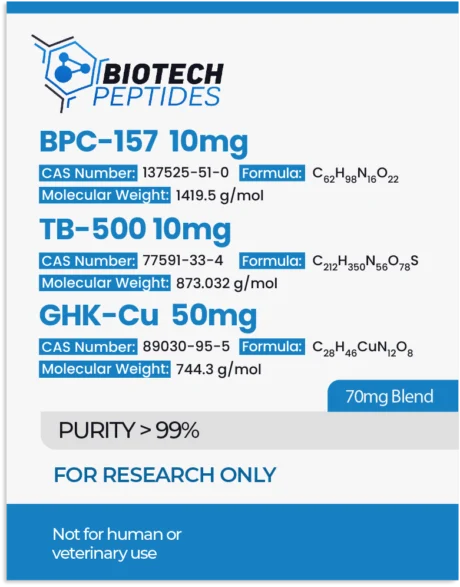
BPC-157 & TB-500 & GHK-Cu Blend (70mg)
$203.00
BPC-157 & TB-500 & GHK-Cu Blend Peptides are synthesised and lyophilised In the USA
Explore the Science Behind a Three-Peptide Research Formula
BPC-157 & TB-500 & GHK-Cu Blend (70mg) combines three synthetic peptides that have attracted interest in modern peptide research. Each compound has a different molecular profile, making the combination an intriguing subject for laboratory studies involving peptide chemistry, molecular biology, tissue signaling, and cellular research.
BPC-157 is a synthetic peptide studied primarily in experimental models. TB-500 is commonly associated with research surrounding thymosin beta-4-related peptide biology. GHK-Cu is a copper-binding peptide that has been investigated in areas including skin biology, extracellular matrix research, and cellular signaling.
Together, these three compounds provide researchers with an opportunity to investigate several biological pathways within one preparation.
The 70mg designation refers to the stated total amount of the blend. It does not necessarily mean that each peptide is present in equal quantities.
Research disclaimer: This product description is intended for experimental research purposes. It does not claim that BPC-157, TB-500, GHK-Cu, or this combination treats, prevents, or cures any disease or medical condition. Researchers should verify product identity, composition, purity, analytical documentation, stability, storage requirements, and applicable regulations before use.
1. What Is BPC-157, TB-500 & GHK-Cu Blend? Three Peptides With Distinct Research Profiles
The BPC-157 & TB-500 & GHK-Cu Blend brings together three different research peptides.
Although they are frequently discussed within the broader peptide community, they should not be considered interchangeable.
What Is BPC-157?
BPC-157 is a synthetic peptide that has been investigated mainly through preclinical and laboratory research.
Researchers have explored BPC-157 in experimental models involving cellular signaling, tissue biology, and other biological processes.
Importantly, preclinical findings do not automatically establish safety or effectiveness in humans.
What Is TB-500?
TB-500 is a name commonly used for a synthetic peptide associated with research into thymosin beta-4-related biology.
Thymosin beta-4 is a naturally occurring peptide that has been investigated for its role in cellular processes.
Commercial TB-500 products may differ in sequence or characterization from full-length thymosin beta-4, so researchers should verify the exact molecular identity of a specific material.
What Is GHK-Cu?
GHK-Cu, also known as copper tripeptide-1, is a copper-binding peptide.
It has attracted scientific interest in research involving skin biology, extracellular matrix components, cellular signaling, and peptide chemistry.
Its copper-binding characteristics make it particularly interesting for biochemical research.
What Does 70mg Mean?
BPC-157 & TB-500 & GHK-Cu 70mg refers to the stated total quantity of the preparation.
It does not automatically indicate that the product contains equal amounts of all three peptides.
The exact blend ratio should be confirmed through product documentation and batch-specific analytical information.
2. Three Peptides, Three Research Directions: Understanding the Molecular Science
The appeal of this combination comes from the distinct characteristics of its individual components.
BPC-157 Research
BPC-157 has been investigated in experimental models involving cellular and tissue-related processes.
Research may examine:
- Peptide structure
- Molecular stability
- Cellular signaling
- Experimental tissue models
- Structure-function relationships
Much of the available literature remains preclinical, so researchers should avoid treating experimental observations as established human outcomes.
TB-500 Research
TB-500 is associated with research into thymosin beta-4-related biology.
Experimental research may examine peptide structure, molecular interactions, cellular behavior, and mechanisms associated with thymosin beta-4 research.
Because the term TB-500 can be used inconsistently, accurate characterization is particularly important.
GHK-Cu Research
GHK-Cu offers a different research perspective.
The peptide can bind copper, creating opportunities for research into peptide-metal interactions, cellular signaling, extracellular matrix biology, and skin-related molecular research.
Its biochemical characteristics distinguish it from BPC-157 and TB-500.
Why Study These Peptides Together?
A three-peptide preparation introduces an interesting research question.
Researchers can investigate whether the individual compounds retain their expected characteristics within a combined formulation.
Potential areas include:
- Peptide compatibility
- Molecular stability
- Analytical characterization
- Cellular signaling
- Peptide interactions
- Formulation science
- Structure-function relationships
Research involving one component alone should not automatically be interpreted as evidence about the complete blend.
3. BPC-157, TB-500 & GHK-Cu Research: A Closer Look at Peptide Biology
Interest in BPC-157, TB-500 and GHK-Cu research reflects the growing use of synthetic peptides as tools for studying complex biological systems.
Each peptide offers a different molecular perspective.
Exploring BPC-157
Researchers can study BPC-157 through controlled experimental models.
Areas of interest may include peptide stability, molecular interactions, cellular signaling, and structure-function relationships.
Because much of the research is preclinical, careful interpretation is essential.
Exploring TB-500
TB-500 provides a research subject connected to thymosin beta-4-related biology.
Researchers may investigate its chemical identity, peptide sequence, stability, and interactions within controlled laboratory systems.
Exact characterization is important because commercial terminology does not always provide sufficient molecular detail.
Exploring GHK-Cu
GHK-Cu is particularly interesting from a biochemical perspective because of its copper-binding properties.
Research can examine:
- Copper-peptide interactions
- Molecular stability
- Cellular signaling
- Extracellular matrix biology
- Peptide chemistry
- Structure-function relationships
Comparing the Three Peptides
Researchers may compare the compounds based on:
- Amino acid sequence
- Molecular weight
- Chemical structure
- Stability
- Binding characteristics
- Analytical profile
- Experimental behavior
Such comparisons can help researchers understand how differences in molecular structure influence peptide characteristics.
4. BPC-157 & TB-500 & GHK-Cu Blend (70mg): Why Quality and Characterization Matter
For researchers evaluating BPC-157 & TB-500 & GHK-Cu Blend 70mg, total quantity is only one part of product evaluation.
Accurate identity, purity, composition, and analytical documentation are equally important.
What Should Researchers Verify?
Useful documentation may include:
- BPC-157 identity
- TB-500 identity and sequence
- GHK-Cu identity
- Peptide sequences
- Molecular weights
- Blend ratio
- Purity information
- Certificate of analysis
- Batch number
- Analytical testing
- Stability information
- Storage requirements
Why Does Purity Matter?
Research results depend on consistent experimental materials.
Unknown impurities can introduce variables and complicate analytical findings.
A batch-specific certificate of analysis can provide useful information about the identity and quality characteristics of a preparation.
However, a product label or certificate alone does not establish clinical safety or effectiveness.
Verify TB-500 Identity
Researchers should pay particular attention to the exact identity of TB-500.
The commercial term may refer to different peptide preparations.
Checking the sequence, molecular weight, and analytical data can help researchers distinguish between materials.
Consider GHK-Cu Composition
GHK-Cu is a copper-binding peptide, so its composition and chemical characterisation are important.
Researchers should verify how the material is characterized and whether analytical documentation supports the stated composition.
Storage and Stability
Peptides can be affected by environmental conditions such as temperature, moisture, light, pH, and repeated handling.
A three-peptide blend may introduce additional stability considerations.
Researchers should follow the specific storage and handling information provided for the research material.
5. The Future of Multi-Peptide Research: Exploring New Frontiers in Molecular Science
Peptide research continues to expand across molecular biology, biochemistry, analytical chemistry, cellular research, and pharmaceutical science.
The BPC-157 & TB-500 & GHK-Cu Blend creates an interesting model for examining three different peptide systems in one preparation.
Potential Research Areas
Future experimental studies may explore:
- Peptide chemistry
- Cellular signaling
- Tissue biology
- Copper-peptide interactions
- Extracellular matrix research
- Peptide stability
- Molecular characterization
- Structure-function relationships
- Combination peptide research
- Analytical testing
Why Combination Peptides Are Interesting
Studying individual peptides can reveal their separate molecular characteristics.
Studying multiple peptides together introduces additional questions about compatibility, stability, and formulation behavior.
These questions can be especially valuable for researchers investigating complex biological systems.
Evidence Comes First
Peptide discussions online can sometimes move faster than the scientific literature.
Researchers should distinguish between laboratory studies, animal research, human clinical evidence, and anecdotal reports.
Reliable scientific conclusions require appropriate evidence, controlled experiments, validated analytical methods, and reproducible results.
Frequently Asked Questions About BPC-157 & TB-500 & GHK-Cu Blend (70mg)
What is BPC-157 & TB-500 & GHK-Cu Blend?
It is a three-peptide research preparation containing BPC-157, TB-500, and GHK-Cu.
What is BPC-157?
BPC-157 is a synthetic peptide investigated primarily in preclinical and laboratory research involving cellular and tissue-related processes.
What is TB-500?
TB-500 is a synthetic peptide name commonly associated with thymosin beta-4-related research. Researchers should verify the exact sequence and molecular identity of a specific preparation.
What is GHK-Cu?
GHK-Cu is a copper-binding tripeptide also known as copper tripeptide-1. It has been studied in areas such as peptide chemistry, cellular signaling, and extracellular matrix research.
Are BPC-157, TB-500, and GHK-Cu the same peptide?
No. They are chemically distinct peptides with different molecular structures and research profiles.
What does 70mg mean?
The 70mg specification refers to the stated total quantity of the preparation. It does not necessarily mean that each peptide contributes an equal amount.
Why combine three peptides?
Researchers may investigate the three compounds together to study peptide compatibility, stability, molecular interactions, and different biological signaling systems.
Does research on BPC-157 prove that the blend is effective?
No. Research involving BPC-157 alone does not establish the safety or effectiveness of a three-peptide blend.
Does research on TB-500 apply directly to this product?
Not automatically. Researchers should confirm that the TB-500 material has the same sequence and molecular characteristics as the compound described in the relevant research.
Why is GHK-Cu different from the other peptides?
GHK-Cu is a copper-binding peptide. Its metal-binding characteristics create a distinct area of biochemical research.
What should researchers check before purchasing this blend?
Researchers should verify peptide identities, sequences, molecular weights, blend ratio, purity, certificate of analysis, batch information, analytical testing, stability, and storage requirements.
Why is the blend ratio important?
The total 70mg quantity does not identify how much of each peptide is present. The precise ratio is important for experimental characterisation.
Why is a certificate of analysis useful?
A certificate of analysis can provide batch-specific information about identity and quality characteristics.
How should the blend be stored?
Researchers should follow the supplier’s specific storage and handling instructions. Temperature, moisture, light, pH, and repeated handling can influence peptide stability.
Does 70mg represent a recommended dose?
No. The 70mg figure identifies the stated quantity of research material. It should not be interpreted as a recommended human dose.
Is this blend an approved medical treatment?
A research preparation should not automatically be considered an approved medical treatment. Regulatory status depends on the specific product and jurisdiction.
Can this blend be used personally?
Experimental research material should not automatically be considered suitable for personal use. Human use requires appropriate safety evaluation and regulatory consideration.
Why is this blend interesting for peptide research?
The three peptides have distinct molecular characteristics. Studying them together can provide a research model for examining peptide stability, molecular interactions, cellular signalling, and formulation behaviour.
Final Thoughts on BPC-157 & TB-500 & GHK-Cu Blend (70mg)
BPC-157 & TB-500 & GHK-Cu Blend (70mg) combines three distinct synthetic peptides with different research profiles.
BPC-157 is primarily associated with preclinical peptide research. TB-500 is connected with thymosin beta-4-related research, while GHK-Cu provides a unique perspective through its copper-binding properties.
For researchers evaluating this 70mg peptide blend, careful characterization is essential. Important considerations include peptide identity, sequence, molecular weight, blend ratio, purity, analytical documentation, batch information, stability, and storage requirements.
The 70mg specification represents the stated total quantity of the preparation. It does not represent a recommended dose or establish clinical effectiveness.
As peptide science continues to evolve, carefully characterised multi-peptide preparations can provide useful models for exploring molecular interactions, cellular signaling, peptide chemistry, and formulation science.
Three distinct peptides. Three fascinating research profiles. One compelling preparation for exploring modern peptide biology.
Brand
Biotech Peptides
Be the first to review “BPC-157 & TB-500 & GHK-Cu Blend (70mg)”
Related products
PEPTIDE BLENDS
PEPTIDE BLENDS
PEPTIDE BLENDS

PEPTIDES
PEPTIDE BLENDS
PEPTIDES
PEPTIDES
PEPTIDE BLENDS
Reviews
There are no reviews yet.