
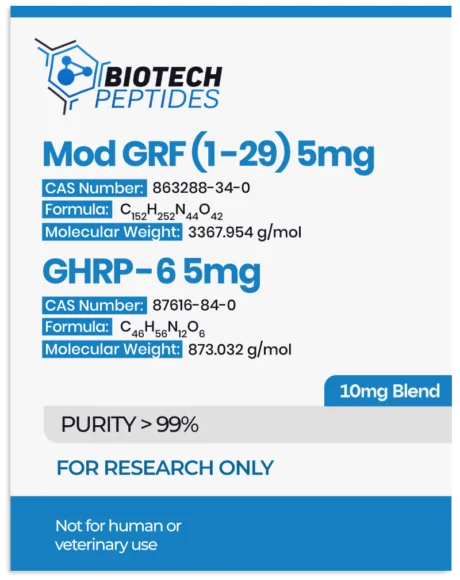
Mod GRF 1-29 & GHRP-6 (10mg)
$86.00
Mod GRF 1-29 & GHRP-6 Peptides are synthesised and lyophilised In the USA
Explore the Science Behind a Powerful Peptide Research Combination
Mod GRF 1-29 & GHRP-6 (10mg) is a research peptide combination featuring two synthetic peptides with distinct molecular profiles. Mod GRF 1-29 is associated with growth hormone-releasing hormone research, while GHRP-6 is studied as a growth hormone secretagogue.
This combination has attracted attention within peptide research, molecular biology, receptor science, and growth hormone pathway studies. Its two components provide researchers with an interesting model for exploring different signalling mechanisms within the same experimental framework.
The 10mg specification refers to the stated total amount of the preparation. It does not necessarily mean an equal quantity of each peptide, nor does it represent a recommended human dosage.
Research disclaimer: This product is presented as an experimental research material. The information below does not claim that Mod GRF 1-29, GHRP-6, or this combination treats, prevents, or cures any disease or medical condition. Researchers should verify product identity, composition, purity, analytical documentation, storage requirements, and applicable regulations before use.
1. What Is Mod GRF 1-29 & GHRP-6? Two Peptides With Distinct Research Profiles
The Mod GRF 1-29 & GHRP-6 Blend combines two synthetic peptides that are studied in related areas of growth hormone biology.
Although they are often discussed together, they are different compounds with different structures and research characteristics.
What Is Mod GRF 1-29?
Mod GRF 1-29 is a synthetic peptide based on the first 29 amino acids of growth hormone-releasing hormone, commonly abbreviated as GHRH.
It is often discussed in connection with CJC-1295 without DAC terminology.
Researchers may investigate Mod GRF 1-29 to explore peptide signaling, receptor interactions, molecular structure, and growth hormone-related pathways.
Because terminology can vary between research and commercial sources, confirming the exact molecular identity is important.
What Is GHRP-6?
GHRP-6, or growth hormone releasing peptide-6, is a synthetic peptide belonging to the growth hormone secretagogue family.
It has been investigated in experimental research involving growth hormone signalling and the growth hormone secretagogue receptor.
GHRP-6 has a different molecular structure from Mod GRF 1-29, making the pair useful for comparative peptide research.
What Does 10mg Mean?
The term Mod GRF 1-29 & GHRP-6 10mg refers to the stated total quantity of the preparation.
It does not automatically indicate that 5mg of each peptide is present.
Researchers should review product documentation to determine the precise composition and ratio.
2. The Science Behind Mod GRF 1-29 & GHRP-6: Two Pathways, One Research Question
The scientific interest in this combination comes from the distinct signaling systems associated with its components.
Mod GRF 1-29 and GHRH Research
GHRH is an important signaling molecule involved in the regulation of growth hormone secretion.
Mod GRF 1-29 is related to this pathway and provides researchers with a synthetic peptide model for studying GHRH related signaling.
Research may focus on:
- Peptide structure
- Receptor interactions
- Molecular signaling
- Peptide stability
- Analytical characterization
GHRP-6 and Secretagogue Research
GHRP-6 belongs to the growth hormone secretagogue family.
Researchers have investigated its relationship with the growth hormone secretagogue receptor, also known as the ghrelin receptor.
This gives GHRP-6 a distinct research profile from GHRH-related peptides.
Why Study Both Peptides Together?
Combining Mod GRF 1-29 and GHRP-6 creates an interesting experimental model.
Researchers can explore how two structurally different peptides behave within the same research system.
Potential areas include:
- Receptor signaling
- Peptide compatibility
- Molecular interactions
- Growth hormone pathways
- Stability
- Structure-function relationships
- Analytical properties
However, findings involving either peptide alone should not automatically be applied to the combined preparation.
3. Mod GRF 1-29 & GHRP-6 Research: A Closer Look at Peptide Biology
Interest in Mod GRF 1-29 & GHRP-6 research reflects the broader growth of peptide science.
Researchers can study peptide structure and molecular behavior using controlled laboratory models and modern analytical techniques.
Exploring Mod GRF 1-29
Mod GRF 1-29 offers a research model related to GHRH signaling.
Scientists may examine its molecular characteristics, stability, receptor interactions, and analytical profile.
Accurate identification is especially important when comparing different peptide preparations.
Exploring GHRP-6
GHRP-6 provides a model for studying growth hormone secretagogue biology.
Experimental research may investigate receptor interactions, molecular behavior, stability, and signaling characteristics.
Its unique structure makes it useful for comparative studies.
Comparing the Two Peptides
Researchers can compare the compounds across several characteristics.
These may include:
- Molecular structure
- Molecular weight
- Stability
- Receptor interactions
- Signaling characteristics
- Analytical profile
Such comparisons can help researchers better understand how molecular structure relates to peptide behavior.
Combination Research Opens New Questions
A two-peptide preparation introduces additional variables.
Researchers may investigate whether the compounds maintain their individual characteristics when combined.
They may also study the stability and analytical behaviour of the complete preparation.
These questions require appropriate laboratory controls and testing.
4. Mod GRF 1-29 & GHRP-6 (10mg): Quality Begins With Accurate Characterisation
For researchers evaluating Mod GRF 1-29 & GHRP-6 10mg, total quantity is only one part of product evaluation.
The identity, purity, blend composition, and analytical documentation are also important.
What Should Researchers Verify?
Product documentation may include:
- Exact Mod GRF 1-29 identity
- Exact GHRP-6 identity
- Peptide sequences
- Molecular weights
- Blend ratio
- Purity information
- Certificate of analysis
- Batch number
- Analytical testing
- Stability information
- Storage requirements
Why Does Purity Matter?
Reliable research depends on consistent experimental materials.
Unknown impurities can introduce unwanted variables and make results more difficult to interpret.
A batch-specific certificate of analysis can provide useful information about the supplied material.
However, a label alone does not establish purity, biological activity, stability, or suitability for a specific experiment.
Confirm the Exact Peptide Identity
Researchers should verify the precise identity of Mod GRF 1-29 and GHRP-6.
Commercial terminology can vary, particularly around CJC-1295 and Mod GRF 1-29 descriptions.
Accurate identification supports reproducible research.
Storage and Stability
Peptides can be sensitive to environmental conditions.
Temperature, moisture, light, pH, and repeated handling may affect peptide stability.
A combination product can create additional stability considerations.
Researchers should follow the documented storage and handling requirements for the specific material.
5. The Future of Mod GRF 1-29 & GHRP-6 Research: Exploring New Frontiers in Peptide Science
Peptide research continues to develop across molecular biology, receptor science, analytical chemistry, and cellular research.
The Mod GRF 1-29 & GHRP-6 combination provides researchers with an interesting model for studying two different peptide structures within one preparation.
Potential Research Areas
Future research may explore:
- Growth hormone signaling
- GHRH-related pathways
- Growth hormone secretagogue receptors
- Peptide receptor interactions
- Molecular characterization
- Peptide stability
- Combination peptide research
- Structure-function relationships
- Analytical testing
- Formulation science
Why Multi Peptide Research Matters
Studying peptides separately provides insight into their individual properties.
Studying them together introduces additional questions about compatibility, stability, and molecular behaviour.
This makes combination research an important area for scientists exploring complex biological signalling.
Let the Evidence Lead
Online peptide information can include claims that go beyond established research.
Researchers should distinguish between laboratory findings, animal research, human studies, and anecdotal reports.
Reliable conclusions require appropriate evidence, controlled experiments, and reproducible methods.
Frequently Asked Questions About Mod GRF 1-29 & GHRP-6 (10mg)
What is Mod GRF 1-29 & GHRP-6?
It is a research preparation combining Mod GRF 1-29 and GHRP-6, two synthetic peptides associated with research into growth hormone signalling.
What is Mod GRF 1-29?
Mod GRF 1-29 is a synthetic peptide based on the first 29 amino acids of growth hormone-releasing hormone. It is commonly discussed in connection with CJC-1295 without DAC terminology.
What is GHRP-6?
GHRP-6 is a synthetic growth hormone-releasing peptide that has been investigated in relation to growth hormone secretagogue and receptor signalling.
Are Mod GRF 1-29 and GHRP-6 the same peptide?
No. They are chemically distinct peptides with different structures and research characteristics.
What does 10mg mean?
The 10mg specification refers to the stated total quantity of the preparation. It does not necessarily mean that the product contains 5mg of each peptide.
Why combine Mod GRF 1-29 and GHRP-6?
Researchers may combine the peptides to investigate different signaling pathways and molecular characteristics within the same experimental framework.
Does research on Mod GRF 1-29 apply directly to the blend?
No. Research involving Mod GRF 1-29 alone cannot automatically establish how the combined preparation behaves.
Does GHRP-6 research prove that the combination is effective?
No. Research involving GHRP-6 alone does not establish the safety or effectiveness of the combined preparation.
What is GHRH?
GHRH stands for growth hormone-releasing hormone. It is a signalling molecule involved in regulating growth hormone secretion.
What is a growth hormone secretagogue?
A growth hormone secretagogue is a compound studied for its interaction with pathways associated with growth hormone release. GHRP-6 belongs to this research category.
What should researchers check before purchasing Mod GRF 1-29 & GHRP-6?
Researchers should verify peptide identity, sequences, molecular weights, blend ratio, purity, certificate of analysis, batch information, analytical testing, stability, and storage requirements.
Why is the blend ratio important?
The total quantity of 10mg does not reveal how much of each peptide is present. The exact ratio is important for accurate experimental characterisation.
Why is a certificate of analysis useful?
A certificate of analysis can provide batch-specific information about identity and quality characteristics.
How should the blend be stored?
Researchers should follow the supplier’s specific storage and handling instructions. Environmental factors can influence peptide stability.
Does 10mg represent a recommended dose?
No. The 10mg specification identifies the stated quantity of research material. It should not be interpreted as a recommended human dose.
Is Mod GRF 1-29 & GHRP-6 an approved medical treatment?
Research interest does not establish the blend as an approved medical treatment. Regulatory status depends on the specific product and jurisdiction.
Can this blend be used personally?
Experimental research material should not automatically be considered suitable for personal use. Human use requires appropriate safety evaluation and regulatory consideration.
Why is this combination interesting for peptide research?
Mod GRF 1-29 and GHRP-6 have different molecular characteristics and are associated with distinct signalling pathways. Studying them together creates an interesting model for investigating peptide signalling and molecular interactions.
Final Thoughts on Mod GRF 1-29 & GHRP-6 (10mg)
Mod GRF 1-29 & GHRP-6 (10mg) combines two distinct synthetic peptides associated with experimental research into growth hormone signalling, receptor biology, peptide chemistry, and molecular science.
Mod GRF 1-29 is related to GHRH signalling, while GHRP-6 is studied as a growth hormone secretagogue. Their different molecular profiles make the combination an intriguing subject for controlled laboratory research.
For researchers evaluating Mod GRF 1-29 & GHRP-6 10mg, careful product characterisation is essential. Researchers should verify the exact peptide identities, sequences, blend ratio, purity, molecular weights, analytical documentation, batch information, stability, and storage requirements.
The 10mg specification describes the stated total quantity of the preparation. It does not represent a recommended dose or establish clinical effectiveness.
As peptide science continues to advance, combination preparations can provide researchers with opportunities to explore how different peptide structures behave independently and together.
Two distinct peptides. Two fascinating research pathways. One compelling combination for exploring modern peptide science.
Brand
Biotech Peptides
Be the first to review “Mod GRF 1-29 & GHRP-6 (10mg)”
Related products
PEPTIDES
PEPTIDES
PEPTIDES

PEPTIDES
PEPTIDE BLENDS
PEPTIDES

PEPTIDE BLENDS
Reviews
There are no reviews yet.