
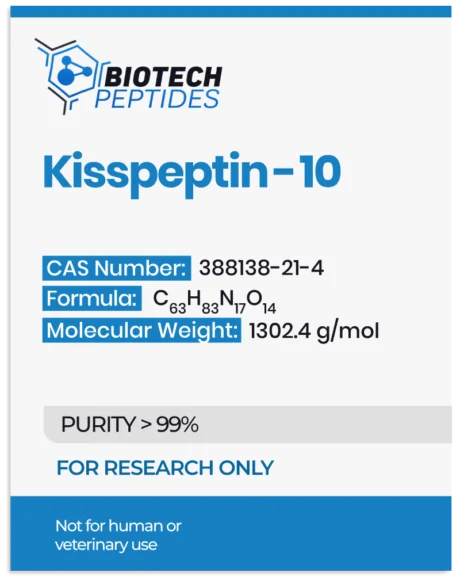
Kisspeptin-10 (10mg)
$50.00
Kisspeptin peptides are synthesised and lyophilised in the USA.
Exploring the Science Behind Reproductive Hormone Signalling
Kisspeptin-10 (10mg) is an experimental peptide fragment associated with research into the hypothalamic-pituitary-gonadal (HPG) axis, reproductive hormone regulation, puberty, fertility biology, and endocrine signalling. Kisspeptin research has become increasingly important because of the peptide’s relationship with gonadotropin-releasing hormone (GnRH), a key hormone involved in reproductive function.
Kisspeptin-10 represents one of the biologically active fragments derived from the kisspeptin family. Scientists have investigated its interactions with the kisspeptin receptor, also known as KISS1R, to better understand how reproductive signals are communicated between the brain and the endocrine system.
This article explores the science behind Kisspeptin-10 10mg, its role in reproductive biology, research applications, and frequently asked questions.
1. What Is Kisspeptin-10?
Kisspeptin-10 is a short peptide derived from the larger kisspeptin precursor protein encoded by the KISS1 gene.
Kisspeptins are signalling peptides that interact with the G protein-coupled receptor KISS1R. This signalling system is particularly important in reproductive endocrinology because it influences the secretion of GnRH from specialised neurons in the hypothalamus.
GnRH subsequently regulates the pituitary release of luteinizing hormone (LH) and follicle-stimulating hormone (FSH).
This places kisspeptin near the beginning of a major hormonal pathway responsible for reproductive development and function.
The 10mg designation refers to the stated quantity of material in a particular preparation. It describes mass and should not be interpreted as a recommended human dose or treatment protocol.
Why Kisspeptin Research Matters
Reproductive hormones operate through an intricate communication network.
Signals originating in the brain can influence the pituitary gland, which then communicates with the ovaries or testes. These organs produce sex hormones that subsequently provide feedback to the brain and pituitary.
Kisspeptin is an important part of this network.
Research into kisspeptin has helped scientists understand how the brain regulates reproductive hormone secretion and how signals related to puberty, fertility, and sex steroid feedback are coordinated.
2. The Fascinating Kisspeptin-GnRH Connection
One of the most important aspects of Kisspeptin-10 research is its relationship with GnRH neurons.
GnRH is released by specialised neurons in the hypothalamus. Its pulsatile secretion stimulates the pituitary gland to release LH and FSH.
Kisspeptin signalling can stimulate GnRH neurons through KISS1R, making the kisspeptin system an important upstream regulator of reproductive hormone signalling.
This discovery changed scientific understanding of how reproductive maturation and fertility are controlled.
Kisspeptin-10 and KISS1R
The biological effects of kisspeptin peptides are mediated primarily through KISS1R.
When kisspeptin interacts with this receptor, intracellular signaling pathways are activated within responsive cells.
Researchers study this interaction to understand how a relatively small peptide can influence a complex endocrine system.
KISS1R signaling is therefore a major focus of reproductive neuroendocrinology.
Kisspeptin-10 and LH
Luteinizing hormone (LH) is produced by the anterior pituitary gland and plays an important role in reproductive physiology.
Kisspeptin signalling can influence GnRH release, which in turn affects LH secretion.
Researchers have therefore used kisspeptin-related compounds to investigate the connections between hypothalamic signalling and pituitary hormone release.
This provides a useful experimental model for studying reproductive endocrine function.
Kisspeptin-10 and FSH
Follicle-stimulating hormone (FSH) is another pituitary hormone regulated by the reproductive endocrine axis.
FSH contributes to ovarian follicle development in females and supports aspects of sperm production in males.
Because kisspeptin signalling influences GnRH, it can also be connected indirectly to FSH regulation.
Research into Kisspeptin-10 therefore provides insights into the coordinated release of reproductive hormones.
3. Kisspeptin-10 and Puberty Research
One of the most significant discoveries in kisspeptin biology has been its role in pubertal development.
Puberty requires activation of the HPG axis.
During childhood, reproductive hormone signalling is relatively suppressed. At puberty, GnRH secretion becomes increasingly active, leading to changes in LH and FSH and eventually increased production of sex hormones.
Research indicates that kisspeptin signalling is a major component of this transition.
Scientists study kisspeptin neurons and KISS1R signalling to understand how the brain determines when reproductive maturation should begin.
Kisspeptin and Reproductive Timing
The timing of reproductive development depends on numerous biological factors.
Genetics, nutrition, energy availability, endocrine signals, and environmental factors can all influence reproductive physiology.
Kisspeptin provides one important signalling link between these systems and the reproductive axis.
This makes Kisspeptin-10 particularly valuable for researchers investigating how reproductive timing is controlled.
Kisspeptin-10 and Fertility Research
Fertility depends on coordinated communication between the brain, pituitary gland, and reproductive organs.
In females, reproductive hormone signalling is linked to follicular development, ovulation, and ovarian hormone production.
In males, the HPG axis supports testosterone production and spermatogenesis.
Because kisspeptin influences GnRH signalling, researchers have investigated the kisspeptin system as a potential way to better understand reproductive disorders and fertility-related mechanisms.
Research findings vary according to the population and experimental model, so laboratory observations should not automatically be interpreted as established treatments.
4. Kisspeptin-10 and Endocrine Research
Kisspeptin is particularly valuable in endocrine research because it sits at an important control point within the HPG axis.
Scientists have investigated kisspeptin signalling in relation to:
- Puberty
- Reproductive hormone regulation
- Fertility
- GnRH secretion
- LH and FSH regulation
- Sex steroid feedback
- Reproductive endocrinology
- Metabolic influences on reproduction
This research has helped establish kisspeptin as a major neuroendocrine signalling system.
Kisspeptin and Sex Hormones
Sex hormones such as estrogen, progesterone, and testosterone influence reproductive physiology and also participate in feedback loops involving the hypothalamus and pituitary gland.
Kisspeptin neurons appear to be sensitive to aspects of this hormonal environment.
This creates a sophisticated feedback system in which reproductive hormones can influence kisspeptin signalling, while kisspeptin influences GnRH and downstream reproductive hormones.
Understanding these feedback loops is essential to modern reproductive endocrinology.
Kisspeptin and Metabolic Signals
Reproduction is closely connected to overall energy availability.
The body must coordinate reproductive activity with nutritional and metabolic conditions. Research has therefore examined relationships between kisspeptin neurons and metabolic signals.
Scientists are investigating how factors related to energy balance can influence kisspeptin signalling and reproductive function.
This represents an important intersection between metabolism and reproductive biology.
5. Kisspeptin-10 (10mg): Research Quality and Considerations
A preparation labelled Kisspeptin-10 10mg indicates a stated quantity of ten milligrams.
The quantity alone does not establish purity, molecular identity, biological activity, safety, or clinical effectiveness.
Researchers evaluating Kisspeptin-10 materials may consider:
- Peptide identity
- Sequence confirmation
- Purity testing
- Certificate of analysis
- Batch information
- Molecular characterization
- Formulation
- Stability data
- Storage requirements
Because peptide structure is closely related to biological activity, appropriate analytical characterisation is particularly important.
Kisspeptin-10 vs. Other Kisspeptin Peptides
Kisspeptin exists in several biologically active forms.
Kisspeptin-10 is one of the shorter fragments capable of interacting with KISS1R. Other kisspeptin forms, including longer peptides, can also participate in kisspeptin signalling.
Researchers should therefore distinguish between the different molecular forms rather than treating every kisspeptin preparation as identical.
Is Kisspeptin-10 a Hormone?
Kisspeptin is generally described as a neuropeptide or signalling peptide rather than a conventional steroid hormone.
Its significance comes from its ability to regulate neuroendocrine signalling, particularly the pathway leading to GnRH secretion.
This makes it an important subject within neuroendocrinology.
Frequently Asked Questions About Kisspeptin-10 (10mg)
What is Kisspeptin-10?
Kisspeptin-10 is a biologically active peptide fragment derived from the KISS1 gene product. It has been extensively studied for its role in kisspeptin receptor signalling and reproductive endocrinology.
What does Kisspeptin-10 10mg mean?
Kisspeptin-10 10mg refers to a preparation containing a stated quantity of ten milligrams. The figure represents mass and does not establish a recommended human dose.
What receptor does Kisspeptin-10 interact with?
Kisspeptin-10 primarily interacts with KISS1R, also known as the GPR54 receptor.
How is kisspeptin related to GnRH?
Kisspeptin signalling can stimulate GnRH neurons in the hypothalamus. GnRH then influences pituitary secretion of LH and FSH, connecting kisspeptin to the broader reproductive hormone axis.
Is Kisspeptin-10 involved in puberty?
Yes. Kisspeptin signalling is strongly associated with activation of the reproductive endocrine axis during puberty. Researchers have investigated its role in the timing and initiation of reproductive maturation.
Is Kisspeptin-10 studied for fertility?
Yes. Researchers have investigated the kisspeptin system in relation to reproductive hormone regulation and fertility. However, experimental research should not automatically be interpreted as proof of a specific fertility treatment.
Does Kisspeptin affect LH and FSH?
Kisspeptin can influence GnRH signalling, which subsequently affects pituitary secretion of LH and FSH. The exact response depends on biological context and experimental conditions.
Is Kisspeptin-10 approved as a medicine?
Regulatory status depends on the specific formulation, indication, and jurisdiction. A research preparation should not automatically be considered an approved pharmaceutical product.
Is Kisspeptin-10 safe for human use?
A research preparation should not automatically be assumed to be safe or suitable for personal use. Safety depends on the specific formulation, clinical evidence, individual circumstances, and regulatory status.
What should researchers look for when evaluating Kisspeptin-10?
Researchers may examine sequence identity, purity, analytical testing, certificate of analysis, batch information, formulation, stability, and storage requirements.
The Future of Kisspeptin Research
Kisspeptin research has significantly expanded scientific understanding of reproductive neuroendocrinology.
The discovery of the kisspeptin-KISS1R system provided important insights into how the brain controls GnRH secretion and how reproductive hormone signalling is coordinated.
Future research may further investigate kisspeptin’s relationship with fertility, puberty, metabolic status, reproductive disorders, and endocrine regulation.
The field also demonstrates how relatively small signalling peptides can influence highly complex physiological systems.
Final Thoughts on Kisspeptin-10 (10mg)
Kisspeptin-10 (10mg) is an important research peptide for studying the biological pathways connecting the brain with reproductive hormone regulation.
Its relationship with KISS1R, GnRH, LH, FSH, puberty, fertility, and the HPG axis makes it a particularly valuable subject in reproductive endocrinology research.
For researchers evaluating Kisspeptin-10, the stated 10mg quantity is only one aspect of the material. Molecular identity, sequence confirmation, purity, analytical documentation, formulation, stability, and regulatory considerations are equally important.
As scientific understanding of reproductive neuroendocrinology continues to develop, Kisspeptin-10 remains an intriguing research tool for exploring one of biology’s most sophisticated communication systems: the pathway linking brain signalling, hormonal regulation, and reproductive function.
Brand
Biotech Peptides
Be the first to review “Kisspeptin-10 (10mg)”
Related products
PEPTIDES
PEPTIDES
PEPTIDES

PEPTIDES
PEPTIDES
PEPTIDES

PEPTIDES
PEPTIDES
Reviews
There are no reviews yet.