

Exploring the Science Behind Vasoactive Intestinal Peptide
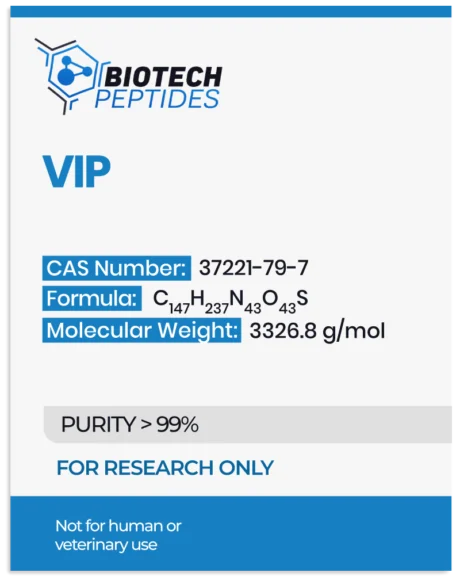
VIP (6mg), short for Vasoactive Intestinal Peptide, is a naturally occurring neuropeptide that has been extensively studied for its role in gastrointestinal, neurological, cardiovascular, and immune signalling. Because VIP interacts with several receptor systems throughout the body, it has become an important subject in peptide and biomedical research. VIP (6mg) For Sale.
For researchers searching for VIP (6mg) for sale, understanding the biology, receptor activity, and research applications of vasoactive intestinal peptide is essential. VIP is not simply associated with the digestive system. Scientific literature has explored its involvement in smooth muscle relaxation, neurotransmission, intestinal secretion, vascular signalling, and immune regulation.
This guide examines the science behind VIP 6mg, its biological characteristics, research applications, and frequently asked questions.
1. What Is VIP? Discover the Peptide Behind a Remarkable Signalling Network
Vasoactive Intestinal Peptide (VIP) is a 28-amino-acid neuropeptide originally identified in the gastrointestinal nervous system.
It is produced by neurons and other specialised cells and acts as a signalling molecule in multiple tissues.
VIP belongs to a family of peptides that includes pituitary adenylate cyclase-activating polypeptide (PACAP) and related signalling molecules.
Its biological effects are mediated primarily through G protein-coupled receptors known as VPAC1 and VPAC2. VIP can also interact with the PAC1 receptor under certain experimental conditions.
This receptor activity helps explain why VIP research extends across multiple biological systems.
The 6mg designation describes the stated quantity of material in a particular research preparation. It represents mass and should not be interpreted as a recommended dose or treatment protocol.
VIP and Neurotransmission
VIP functions as a neuropeptide within the peripheral and central nervous systems.
It can act alongside other neurotransmitters and signaling molecules to regulate physiological processes.
Researchers have investigated VIP in relation to:
- Neuronal communication
- Smooth muscle activity
- Vascular signaling
- Gastrointestinal function
- Circadian biology
- Immune regulation
This broad activity makes VIP a particularly interesting molecule for interdisciplinary research.
2. The Fascinating Biology of VIP: From the Gut to the Nervous System
The name Vasoactive Intestinal Peptide reflects two of the biological observations that originally attracted scientific attention: effects on blood vessels and intestinal physiology.
However, modern research has demonstrated that VIP’s biological activity extends well beyond the gastrointestinal tract.
VIP and Gastrointestinal Research
VIP is widely studied in gastrointestinal physiology.
Within the digestive system, VIP containing neurons participate in the regulation of intestinal smooth muscle and secretory processes.
Research has associated VIP signaling with relaxation of gastrointestinal smooth muscle and regulation of intestinal fluid and electrolyte secretion.
These properties have made VIP an important molecule for understanding the complex communication network operating throughout the gastrointestinal tract.
VIP and Vascular Signaling
The word “vasoactive” is an important part of VIP’s name.
VIP can influence vascular smooth muscle and has been investigated for its effects on blood vessel relaxation and blood flow.
This research has helped scientists better understand how neuropeptides can participate in communication between the nervous and cardiovascular systems.
Because vascular responses involve numerous signaling pathways, VIP is studied alongside other vasodilatory mediators.
VIP and Smooth Muscle
Smooth muscle exists throughout many parts of the body, including the gastrointestinal and respiratory systems.
VIP signaling has been investigated for its ability to influence smooth muscle relaxation.
Researchers study these mechanisms to understand how neuronal signals can regulate involuntary muscle activity.
This represents another example of VIP functioning as a bridge between the nervous system and peripheral tissues.
3. VIP and Immune Research: An Intriguing Neuroimmune Connection
One of the most interesting areas of modern VIP research is the relationship between the nervous and immune systems.
The nervous system and immune system are not isolated networks. They communicate continuously through hormones, neurotransmitters, cytokines, and neuropeptides.
VIP is one of the signaling molecules involved in this communication.
VIP and Immune Cells
Research has investigated VIP interactions with various immune cells and inflammatory signaling pathways.
Scientists are particularly interested in how neuropeptides can influence immune cell behavior and cytokine production.
VIP research has therefore contributed to the expanding field of neuroimmunology, which examines communication between the nervous and immune systems.
Importantly, experimental observations regarding immune signalling should not automatically be interpreted as evidence that VIP is an established treatment for inflammatory or immune-related conditions.
VIP and Inflammatory Signalling
Inflammation is a highly coordinated biological process involving numerous signalling molecules.
Researchers have studied VIP in relation to inflammatory mediators and immune cell activity.
Understanding these interactions may help scientists investigate how neural signals influence immune responses in different tissues.
The exact effects of VIP can depend on receptor expression, tissue type, concentration, and biological context.
4. VIP (6mg) For Sale: Understanding Research Quality and Applications
A preparation labeled VIP (6mg) indicates a stated quantity of six milligrams.
For legitimate laboratory research, however, quantity is only one consideration.
Researchers evaluating VIP materials may want to examine:
- Molecular identity
- Peptide purity
- Sequence confirmation
- Certificate of analysis
- Batch information
- Molecular characterization
- Formulation
- Stability data
- Storage requirements
These details can help researchers determine whether a particular preparation is appropriate for their intended laboratory work.
Why VIP Purity Matters
Peptide research often requires careful characterisation because impurities or degradation products can potentially interfere with experimental results.
A high-quality analytical profile can help researchers understand the composition of a preparation.
Depending on the research setting, analytical methods may be used to confirm molecular identity and assess purity.
The goal is reproducibility.
Reliable research requires scientists to know exactly what material is being evaluated.
VIP and Respiratory Research
VIP has also been investigated within respiratory biology.
The peptide is present in the respiratory nervous system and has been studied for its effects on airway smooth muscle and inflammatory signalling.
Researchers are interested in how neuropeptide signalling contributes to airway physiology and communication between the nervous and immune systems.
These investigations form part of a much larger effort to understand respiratory neurobiology.
VIP and Circadian Biology
An especially fascinating area of VIP research involves the circadian system.
VIP is strongly associated with neurons within the brain’s suprachiasmatic nucleus, a region that plays a central role in regulating circadian rhythms.
Researchers have investigated how VIP signalling helps synchronise cellular clocks within this neural network.
This work demonstrates that VIP’s biological role extends far beyond its original association with intestinal physiology.
5. The Future of VIP Research: A Peptide With Many Biological Connections
VIP remains an important subject across several research disciplines.
Its activity at VPAC receptors and its involvement in neural, gastrointestinal, vascular, respiratory, immune, and circadian signalling make it particularly valuable for studying biological communication.
Future research may provide additional insights into:
- Neuroimmune signaling
- Gastrointestinal physiology
- Vascular regulation
- Circadian rhythms
- Smooth muscle biology
- Respiratory signaling
- Peptide receptor pharmacology
The continued study of VIP may also help researchers better understand how the nervous system communicates with peripheral organs.
VIP vs. PACAP
VIP and PACAP are related neuropeptides and share some receptor interactions, but they are not identical.
PACAP has a particularly strong relationship with the PAC1 receptor, while VIP primarily acts through VPAC1 and VPAC2.
Although their signalling systems overlap, researchers should distinguish the two peptides when designing experiments or interpreting scientific literature.
Frequently Asked Questions About VIP (6mg)
What is VIP?
VIP stands for Vasoactive Intestinal Peptide. It is a naturally occurring 28-amino-acid neuropeptide involved in gastrointestinal, neurological, vascular, immune, respiratory, and circadian signalling.
What does VIP 6mg mean?
VIP 6mg refers to a preparation containing a stated quantity of six milligrams. The measurement describes mass and does not establish a recommended human dose.
What receptors does VIP activate?
VIP primarily interacts with the VPAC1 and VPAC2 receptors, which are G protein-coupled receptors. It can also interact with PAC1 under certain circumstances.
What is VIP studied for?
Research has examined VIP in relation to gastrointestinal physiology, smooth muscle relaxation, vascular signalling, neuroimmune communication, respiratory biology, and circadian rhythms.
Is VIP a hormone?
VIP is generally classified as a neuropeptide. It can act as a signalling molecule in the nervous system and peripheral tissues.
Does VIP occur naturally in the body?
Yes. VIP is naturally produced by neurons and other cells in humans and participates in normal physiological signalling.
Why is VIP important in gastrointestinal research?
VIP is involved in gastrointestinal neural signalling and has been studied for its effects on intestinal smooth muscle, secretion, and other digestive processes.
Is VIP involved in the immune system?
Research has investigated VIP’s interactions with immune cells and inflammatory signalling. These studies form part of the broader field of neuroimmune communication.
Is VIP approved as a medicine?
Regulatory status depends on the specific product, formulation, indication, and jurisdiction. A research preparation should not automatically be considered an approved pharmaceutical. VIP (6mg) For Sale
Is VIP (6mg) safe for human use?
A research preparation should not automatically be assumed to be safe or suitable for personal use. Safety depends on the formulation, clinical evidence, individual circumstances, and regulatory requirements.
What should researchers look for when evaluating VIP?
Researchers may examine peptide identity, sequence confirmation, purity, certificate of analysis, batch information, formulation, stability, and storage requirements.
Is VIP the same as PACAP?
No. VIP and PACAP are related neuropeptides with overlapping biological activities, but they have different receptor preferences and physiological roles.
Final Thoughts on VIP (6mg)
VIP (6mg) is a fascinating research peptide with biological connections spanning the digestive system, nervous system, cardiovascular system, respiratory system, immune system, and circadian network.
Its primary receptors, VPAC1 and VPAC2, provide researchers with important tools for investigating peptide receptor signalling and neuropeptide physiology.
For researchers interested in VIP 6mg, understanding the compound’s identity, purity, formulation, stability, and analytical documentation is essential. The stated six-milligram quantity describes the amount of material but does not establish clinical effectiveness or a recommended human application. VIP (6mg) For Sale
From gastrointestinal signalling to circadian synchronisation, VIP demonstrates how a single neuropeptide can participate in remarkably diverse biological processes. Continued research may reveal even more about the complex communication pathways connecting the nervous system with the organs and tissues throughout the body.
Brand
Biotech Peptides
Be the first to review “VIP (6mg)”
Related products
PEPTIDES

PEPTIDES
PEPTIDES
PEPTIDES
PEPTIDES

PEPTIDES
PEPTIDES
PEPTIDES
Reviews
There are no reviews yet.