
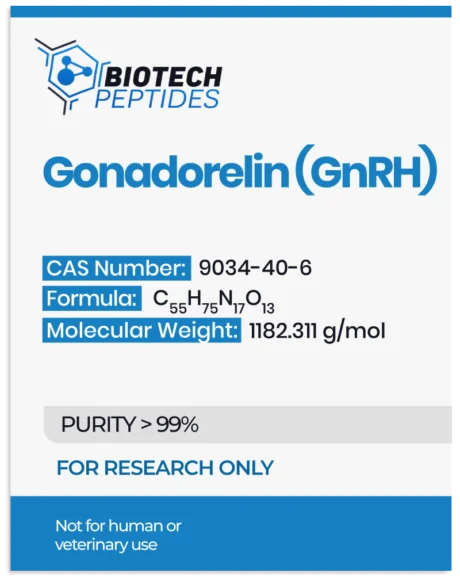
Gonadorelin (GnRH) (10mg)
$76.00
Gonadorelin (GnRH) are synthesised and lyophilised in the USA.
Exploring the Science Behind Reproductive Hormone Signalling
Gonadorelin (GnRH) (10mg) is an important peptide hormone used extensively in endocrine and reproductive biology research. Also known as gonadotropin-releasing hormone, GnRH plays a central role in regulating communication between the hypothalamus, pituitary gland, and reproductive organs.
Because GnRH sits at the beginning of the hypothalamic-pituitary-gonadal (HPG) axis, researchers study it to better understand reproductive development, fertility, puberty, hormone production, and gonadal function.
For those researching Gonadorelin 10mg, understanding its molecular biology, receptor activity, and role in endocrine signalling is essential. This guide provides an educational overview of Gonadorelin (GnRH), its research significance, and frequently asked questions.
1. What Is Gonadorelin (GnRH)? Discover the Master Signal of Reproductive Endocrinology
Gonadorelin, commonly known as GnRH, is a naturally occurring decapeptide consisting of ten amino acids.
It is produced by specialised neurons in the hypothalamus. GnRH travels through the hypothalamic portal circulation to the anterior pituitary, where it interacts with GnRH receptors on gonadotroph cells.
This interaction stimulates the production and secretion of two important reproductive hormones:
- Luteinizing hormone (LH)
- Follicle-stimulating hormone (FSH)
LH and FSH subsequently act on the ovaries or testes, influencing reproductive processes and sex hormone production.
This makes GnRH one of the most important signalling molecules in reproductive physiology.
The 10mg designation refers to the stated quantity of Gonadorelin in a particular preparation. It describes mass and should not be interpreted as a recommended human dose or treatment protocol.
Why GnRH Is So Important
The reproductive endocrine system operates through a sophisticated series of signals.
The hypothalamus communicates with the pituitary gland. The pituitary communicates with the gonads. The gonads then produce sex hormones that provide feedback to the brain and pituitary.
GnRH initiates this cascade.
Without appropriate GnRH signalling, normal reproductive hormone production and reproductive function can be disrupted.
2. The Fascinating GnRH-LH-FSH Connection
The relationship between GnRH, LH, and FSH is central to reproductive endocrinology.
GnRH is released in a pulsatile pattern rather than continuously. The frequency and amplitude of these pulses influence pituitary gonadotropin secretion.
This pulsatile signalling is one of the most fascinating aspects of GnRH biology.
Gonadorelin and LH
Luteinizing hormone is produced by the anterior pituitary gland.
In females, LH is involved in follicular development and the hormonal events surrounding ovulation. In males, LH stimulates specialised cells in the testes that produce testosterone.
Because GnRH regulates LH secretion, researchers can use the GnRH system to investigate how hypothalamic signals influence reproductive hormone production.
Gonadorelin and FSH
FSH is another gonadotropin regulated by GnRH.
In females, FSH contributes to ovarian follicle development. In males, FSH participates in the regulation of spermatogenesis through its actions on cells within the testes.
The relationship between GnRH, FSH, and LH demonstrates how a short peptide can influence a much larger endocrine network.
Why Pulsatile GnRH Matters
Continuous and pulsatile GnRH signalling can produce different biological responses.
This is an important concept in endocrine research.
The reproductive system does not simply respond to whether GnRH is present. It also responds to how GnRH is delivered over time.
Researchers therefore study pulse frequency and receptor signalling to understand how the hypothalamus controls pituitary function.
3. Gonadorelin and the Hypothalamic-Pituitary-Gonadal Axis
The HPG axis is the central regulatory network connecting the brain with reproductive organs.
Its major components include:
Hypothalamus → GnRH → Pituitary → LH/FSH → Gonads → Sex hormones
This pathway helps regulate puberty, reproductive development, gamete production, and sex hormone synthesis.
Gonadorelin occupies a crucial position at the beginning of this chain.
Gonadorelin and Puberty Research
Puberty involves the activation of the reproductive endocrine system.
As GnRH signalling increases, the pituitary begins producing greater amounts of LH and FSH. These hormones stimulate the gonads, resulting in increased production of sex hormones and the physical changes associated with reproductive maturation.
Researchers study GnRH signalling to understand the biological mechanisms underlying pubertal development.
This research is particularly important when investigating disorders involving abnormal timing of reproductive maturation.
Gonadorelin and Fertility Research
Normal fertility requires coordinated communication between the hypothalamus, pituitary gland, and gonads.
Disruptions at any point in the HPG axis can affect reproductive function.
Gonadorelin research therefore provides valuable information about the hormonal mechanisms underlying fertility.
Scientists have investigated GnRH signalling in both male and female reproductive biology, including gonadotropin secretion and gonadal function.
Importantly, research findings should not be interpreted as evidence that a research preparation is appropriate for self-treatment.
4. Gonadorelin (GnRH) (10mg): Research Applications and Quality Considerations
A preparation labelled Gonadorelin (GnRH) 10mg indicates a stated quantity of ten milligrams.
For laboratory research, however, the quantity is only one consideration.
Researchers evaluating Gonadorelin materials may examine:
- Molecular identity
- Peptide sequence
- Purity
- Certificate of analysis
- Batch information
- Molecular characterization
- Formulation
- Stability
- Storage requirements
These factors can be particularly important when conducting experiments involving receptor signalling or endocrine responses.
Understanding GnRH Receptor Signalling
GnRH produces its effects by binding to the GnRH receptor, a G protein-coupled receptor located primarily on pituitary gonadotroph cells.
Activation of this receptor initiates intracellular signalling pathways that ultimately promote the synthesis and release of LH and FSH.
Studying this receptor system helps scientists understand how extracellular peptide signals are converted into cellular responses.
Gonadorelin vs. GnRH Analogues
Gonadorelin is the naturally occurring GnRH sequence.
Researchers may also encounter GnRH agonists and antagonists, which have been chemically modified to produce different receptor behaviours.
These compounds should not be confused with Gonadorelin itself.
Some GnRH agonists can initially stimulate the GnRH receptor and, with sustained exposure, produce receptor desensitisation. GnRH antagonists work through a different mechanism by directly blocking receptor activation.
Understanding these differences is important when interpreting scientific studies.
Why Analytical Documentation Matters
Experimental peptide research depends on reproducibility.
A researcher needs confidence that the material being tested corresponds to the intended molecular compound.
Analytical documentation such as purity testing, sequence confirmation, and a certificate of analysis can provide useful information about a particular research preparation.
Product descriptions alone cannot establish clinical efficacy or safety.
5. The Future of Gonadorelin Research
More than a reproductive hormone signal, GnRH provides researchers with a powerful model for studying neuroendocrine communication.
Scientists continue to investigate how GnRH neurons are regulated and how they integrate signals related to energy availability, developmental status, sex steroids, and other physiological conditions.
Research into GnRH may contribute to a better understanding of:
- Reproductive endocrinology
- Pubertal development
- Fertility biology
- Gonadal function
- Hormone feedback systems
- Pituitary signaling
- Neuroendocrine regulation
The continuing study of GnRH demonstrates how a tiny peptide can control an extraordinarily complex biological system.
Frequently Asked Questions About Gonadorelin (GnRH) (10mg)
What is Gonadorelin?
Gonadorelin is the synthetic form of gonadotropin-releasing hormone (GnRH), a naturally occurring decapeptide produced by the hypothalamus.
What does Gonadorelin 10mg mean?
Gonadorelin 10mg refers to a preparation containing a stated quantity of ten milligrams. The measurement represents mass and does not establish a recommended dose.
What does GnRH do?
GnRH stimulates the pituitary gland to produce and release LH and FSH, which regulate important aspects of reproductive physiology.
Where is GnRH produced?
GnRH is produced by specialised neurons in the hypothalamus. These neurons release GnRH in pulses that regulate pituitary gonadotropin secretion.
What is the HPG axis?
The hypothalamic-pituitary-gonadal axis is a hormonal communication network connecting the hypothalamus, pituitary gland, and reproductive organs.
Does Gonadorelin affect testosterone?
GnRH can influence LH secretion, and LH stimulates testosterone production by specialised cells in the testes. The overall response depends on the pattern of GnRH signalling and physiological context.
Does Gonadorelin affect estrogen?
GnRH regulates LH and FSH, which influence ovarian function and sex hormone production. The relationship between GnRH and estrogen is therefore indirect and part of the broader HPG axis.
Is Gonadorelin involved in puberty?
Yes. Activation of pulsatile GnRH secretion is a central event in the initiation and progression of normal reproductive maturation.
What is the difference between Gonadorelin and GnRH?
There is essentially no difference in the underlying peptide identity. Gonadorelin is the name commonly used for the synthetic form of naturally occurring GnRH.
Is Gonadorelin the same as a GnRH agonist?
Not necessarily. Gonadorelin is the native GnRH sequence, while GnRH agonists are modified compounds designed to produce particular receptor responses.
Is Gonadorelin approved as a medicine?
Regulatory status depends on the specific formulation, indication, and country. A research preparation should not automatically be considered an approved pharmaceutical product.
Is Gonadorelin 10mg safe for human use?
A research preparation should not automatically be assumed to be safe or suitable for personal use. Safety depends on the formulation, clinical evidence, individual circumstances, and applicable regulatory requirements.
What should researchers look for when evaluating Gonadorelin?
Researchers may examine peptide identity, sequence confirmation, purity, certificate of analysis, batch information, formulation, stability, and storage requirements.
Final Thoughts on Gonadorelin (GnRH) (10mg)
Gonadorelin (GnRH) (10mg) is a fundamental research compound for understanding reproductive endocrinology and neuroendocrine signalling.
Its ability to regulate pituitary release of LH and FSH places GnRH at the centre of the HPG axis, connecting hypothalamic signalling with gonadal function.
Research into Gonadorelin has helped scientists understand the mechanisms behind puberty, reproductive hormone regulation, fertility biology, gonadal function, and endocrine feedback.
For researchers evaluating a Gonadorelin 10mg preparation, molecular identity, purity, sequence confirmation, analytical documentation, formulation, and stability are important considerations.
The remarkable biology of GnRH demonstrates that biological impact is not necessarily determined by molecular size. A peptide consisting of only ten amino acids can initiate a sophisticated hormonal cascade affecting reproductive physiology throughout the body.
As research continues, Gonadorelin remains an important molecule for exploring the complex relationship between the brain, pituitary gland, reproductive organs, and endocrine system.
Brand
Biotech Peptides
Be the first to review “Gonadorelin (GnRH) (10mg)”
Related products
PEPTIDES
PEPTIDES
PEPTIDES
PEPTIDES
PEPTIDES
PEPTIDES
PEPTIDES
PEPTIDES
Reviews
There are no reviews yet.