
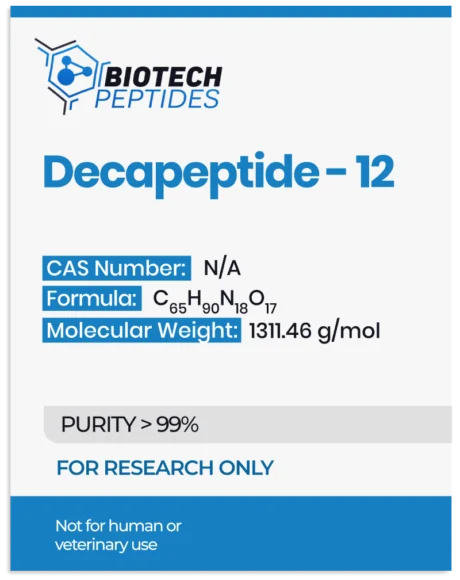
Decapeptide-12 (200mg)
Original price was: $239.00.$223.00Current price is: $223.00.
Decapeptide-12 (200mg) peptides are synthesised and lyophilised In the USA
Exploring the Science Behind an Advanced Cosmetic Peptide
Decapeptide-12 (200mg) is a synthetic peptide that has attracted interest in cosmetic science, skin biology, pigmentation research, and peptide formulation.
A decapeptide is a peptide made from ten amino acid residues. Decapeptide-12 is particularly interesting because it has been researched in connection with pathways involved in skin pigmentation and the appearance of uneven skin tone.
Modern skincare research increasingly focuses on peptides as targeted cosmetic ingredients. Rather than simply supporting the skin’s surface, researchers investigate how specific peptide sequences interact with biological processes.
With a stated quantity of 200mg, Decapeptide-12 can be evaluated as a research material for cosmetic formulation and peptide science.
Research disclaimer: Decapeptide-12 is discussed here as an experimental and cosmetic research material. Research findings should not be interpreted as proof of a medical treatment or guaranteed skin-lightening result. Cosmetic applications should follow applicable safety and regulatory requirements.
1. What Is Decapeptide-12? Discover the Peptide Behind Pigmentation Research
Decapeptide-12 is a short synthetic peptide consisting of ten amino acid residues.
The term “deca” refers to ten, while “peptide” describes a chain of amino acids connected by peptide bonds.
This relatively small molecular structure makes Decapeptide-12 an interesting subject for cosmetic and biochemical research.
Understanding Decapeptide-12
Skin pigmentation is influenced by a complex biological process known as melanogenesis.
Melanogenesis is the process through which specialized cells called melanocytes produce melanin.
Melanin contributes to the color of skin, hair, and eyes.
Researchers study melanogenesis to better understand:
- Melanin production
- Pigment distribution
- Melanocyte activity
- Cellular signaling
- Uneven skin tone
- Hyperpigmentation pathways
Decapeptide-12 has attracted interest because of research into its relationship with pigmentation pathways.
What Does Decapeptide-12 200mg Mean?
Decapeptide-12 200mg refers to a preparation containing a stated quantity of 200 milligrams.
The 200mg specification describes the amount of material.
It does not represent a recommended dosage or establish a treatment protocol.
For research purposes, the quantity used depends on the experimental design and intended application.
2. The Fascinating Science of Decapeptide-12: Peptides and Melanin Research
Melanin is one of the body’s most important natural pigments.
It helps determine skin colour and contributes to the biological response of skin to ultraviolet radiation.
Because pigmentation is controlled by multiple cellular pathways, researchers continue to investigate ways to understand melanogenesis.
Decapeptide-12 and Melanogenesis Research
Melanogenesis involves several biochemical steps.
Melanocytes produce melanin inside specialised structures called melanosomes.
The resulting pigment can then be transferred to surrounding keratinocytes.
This process is controlled by complex signalling pathways.
Research into Decapeptide-12 has focused on its potential relationship with pigmentation-related mechanisms.
Why Melanin Research Matters
Changes in melanin production can contribute to differences in skin pigmentation.
Factors such as genetics, ultraviolet exposure, hormones, inflammation, and environmental conditions can influence pigmentation.
Understanding these processes is important for cosmetic science.
Researchers can use pigmentation models to investigate how specific ingredients interact with melanocyte-related pathways.
Decapeptide-12 and Cosmetic Science
The cosmetic industry has shown increasing interest in peptides.
Different peptides may be researched for different cosmetic purposes.
Some are investigated in relation to:
- Skin hydration
- Skin texture
- Collagen pathways
- Pigmentation
- Cellular signaling
- Skin appearance
Decapeptide-12 is particularly associated with pigmentation research.
3. Decapeptide-12 Research: Exploring Skin Tone, Melanocytes, and Cosmetic Formulation
Interest in Decapeptide-12 research is closely connected to cosmetic approaches for improving the appearance of uneven pigmentation.
However, skin pigmentation is highly complex.
Decapeptide-12 and Melanocyte Research
Melanocytes are specialised cells responsible for producing melanin.
They are located primarily in the basal layer of the epidermis.
Researchers study melanocytes to understand how pigment production is regulated.
Experimental peptide research can provide insight into how particular molecular structures interact with these pathways.
Decapeptide-12 and Tyrosinase Research
Tyrosinase is an important enzyme involved in melanin production.
It catalyses key steps in the melanogenesis pathway.
Because of its role, tyrosinase is frequently studied in cosmetic pigmentation research.
Researchers may investigate whether compounds influence tyrosinase activity or related signalling pathways.
This provides one scientific context for studying pigmentation-focused peptides.
Decapeptide-12 and Uneven Skin Tone
Uneven skin tone can result from differences in melanin production and distribution.
Sun exposure, inflammation, ageing, and other factors may contribute.
Cosmetic researchers therefore investigate ingredients that may help improve the appearance of uneven pigmentation.
Decapeptide-12 is one peptide associated with this area of research.
However, cosmetic results can vary depending on formulation, concentration, skin type, and other factors.
The Importance of Formulation
A raw peptide is not the same as a finished skincare product.
Formulation can influence stability and performance.
Factors may include:
- pH
- Solubility
- Concentration
- Preservatives
- Packaging
- Temperature
- Other active ingredients
For this reason, Decapeptide-12 should be evaluated within the context of its intended formulation.
4. Decapeptide-12 (200mg): Quality, Purity, and Research Considerations
When evaluating Decapeptide-12 200mg, the amount of peptide is only one consideration.
Researchers should also examine identity, purity, analytical characterisation, and storage information.
Useful documentation may include:
- Exact peptide sequence
- Chemical identity
- Molecular weight
- Purity percentage
- Certificate of analysis
- Batch number
- Analytical testing
- Stability information
- Solubility
- Storage requirements
Why Decapeptide-12 Purity Matters
Research requires consistent materials.
Unexpected impurities may affect experimental observations.
A certificate of analysis can provide batch specific information about peptide identity and purity.
Researchers should review analytical documentation before using a material in controlled experiments.
The 200mg label alone does not confirm purity, stability, biological activity, or cosmetic effectiveness.
Decapeptide-12 Stability
Peptides can be sensitive to environmental conditions.
Temperature, moisture, light, pH, and repeated handling can influence stability.
Researchers should follow the supplier’s documented storage requirements.
Appropriate handling can help maintain material consistency.
Research Material vs. Finished Cosmetic Product
Decapeptide-12 research material should not automatically be considered a finished cosmetic ingredient.
A finished skincare product requires appropriate formulation and safety evaluation.
Applicable cosmetic regulations may also vary between markets.
Researchers and formulators should assess the complete product system rather than relying solely on the peptide itself.
5. The Future of Decapeptide-12 Research: Unlocking New Possibilities in Pigmentation Science
Skin pigmentation remains an active field of cosmetic and biological research.
Scientists continue to investigate melanocytes, melanin synthesis, pigment transport, and cellular signaling.
Peptides provide another tool for exploring these processes.
Potential Areas for Future Research
Future research may explore:
- Melanogenesis
- Melanocyte biology
- Tyrosinase pathways
- Melanin production
- Pigment distribution
- Uneven skin tone
- Peptide signaling
- Cosmetic formulation
- Peptide stability
- Skin appearance
Why Decapeptide-12 Is Scientifically Interesting
Decapeptide-12 provides researchers with a defined peptide structure for investigating pigmentation-related biology.
Its association with melanogenesis makes it particularly relevant to cosmetic research focused on skin tone.
Researchers can examine the peptide through laboratory models and formulation studies.
The Bigger Picture of Cosmetic Peptide Research
Peptide science is expanding across many areas of skincare.
Researchers are studying peptides associated with skin structure, hydration, pigmentation, cellular signaling, and other biological processes.
Decapeptide-12 represents one example of this expanding field.
As formulation technology develops, researchers may gain a better understanding of how peptides can be incorporated into cosmetic systems.
Frequently Asked Questions About Decapeptide-12 (200mg)
What is Decapeptide-12?
Decapeptide-12 is a synthetic peptide consisting of ten amino acid residues. It has attracted interest in cosmetic research involving skin pigmentation and melanogenesis.
What does Decapeptide-12 200mg mean?
It indicates a preparation containing a stated quantity of 200 milligrams. The quantity does not represent a recommended dosage.
What is a decapeptide?
A decapeptide is a peptide made from ten amino acid residues.
What is Decapeptide-12 studied for?
Decapeptide-12 is primarily associated with research into pigmentation, melanogenesis, melanocyte biology, and cosmetic skin appearance.
What is melanogenesis?
Melanogenesis is the biological process through which melanocytes produce melanin, the pigment responsible for much of the color of skin, hair, and eyes.
What are melanocytes?
Melanocytes are specialized cells that produce melanin. They are located primarily in the basal layer of the epidermis.
What is tyrosinase?
Tyrosinase is an enzyme involved in important steps of melanin production. It is widely studied in pigmentation research.
Is Decapeptide-12 a skin-lightening treatment?
Decapeptide-12 is associated with cosmetic pigmentation research. It should not be presented as a guaranteed skin-lightening treatment or a medical therapy.
Can Decapeptide-12 remove hyperpigmentation?
Research into pigmentation peptides does not guarantee that a particular product will remove hyperpigmentation. Cosmetic outcomes can vary based on many factors.
Is Decapeptide-12 suitable for skincare formulations?
Decapeptide-12 may be investigated in cosmetic formulation research. Suitability depends on the specific material, formulation, concentration, safety assessment, and applicable regulations.
Why is peptide purity important?
Purity can affect experimental consistency. Well-characterised research materials help researchers reduce unwanted variables.
What should researchers look for when evaluating Decapeptide-12 200mg?
Researchers should consider the exact peptide sequence, chemical identity, molecular weight, purity, certificate of analysis, batch information, stability, and storage requirements.
How should Decapeptide-12 be stored?
Storage requirements depend on the specific preparation. Researchers should follow the supplier’s documented storage and handling instructions.
Is Decapeptide-12 an approved medical treatment?
Decapeptide-12 should not be presented as an approved medical treatment. Cosmetic research does not automatically establish clinical effectiveness.
Is Decapeptide-12 safe for personal use?
Safety depends on the exact material and intended application. Experimental research material should not automatically be considered suitable for direct personal use.
Final Thoughts on Decapeptide-12 (200mg)
Decapeptide-12 (200mg) is an intriguing peptide associated with cosmetic science, pigmentation research, melanogenesis, melanocyte biology, and skin appearance.
Its ten-amino-acid structure provides researchers with a defined molecule for investigating complex pigmentation pathways.
Melanin production involves multiple cellular and biochemical processes. Melanocytes, tyrosinase, melanosomes, and signalling pathways all contribute to pigmentation.
This complexity makes pigmentation research an important area of modern cosmetic science.
For researchers evaluating Decapeptide-12 200mg, quality documentation should remain a priority. Peptide identity, sequence, purity, analytical testing, batch information, stability, and storage conditions can all influence research reliability.
As cosmetic peptide research continues to evolve, Decapeptide-12 provides another interesting opportunity to explore the molecular science behind skin pigmentation and cosmetic formulation.
Ten amino acids. One fascinating research molecule. A closer look at the science of pigmentation and modern cosmetic peptides.
Brand
Biotech Peptides
Be the first to review “Decapeptide-12 (200mg)”
Related products
PEPTIDES
PEPTIDES
PEPTIDES
PEPTIDES
PEPTIDES
PEPTIDES
PEPTIDES
PEPTIDES
Reviews
There are no reviews yet.