
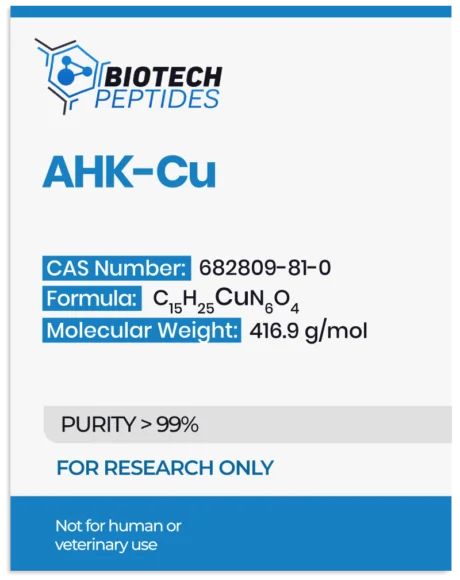
AHK-Cu (200mg)
$190.00
AHK-Cu peptides are synthesised and lyophilised in the USA.
Discover the Science Behind This Copper Peptide
AHK-Cu (200mg) is a copper-binding peptide that has attracted attention in skin biology, hair follicle research, tissue regeneration, and cellular signalling. Copper peptides are studied because copper ions can participate in important biological processes, including collagen formation, antioxidant activity, and cellular communication.
AHK-Cu is particularly interesting because of its proposed relationship with hair follicle biology and dermal cells. Researchers continue to investigate how small copper-binding peptides may interact with cells involved in skin and hair physiology.
If you are researching AHK-Cu 200mg, this guide explains what AHK-Cu is, why it is scientifically interesting, how it differs from other copper peptides, and what researchers should consider when evaluating a peptide preparation.
Research note: AHK-Cu is an experimental peptide. The information below is educational and does not establish AHK-Cu as an approved treatment or guarantee cosmetic, hair-growth, or other health benefits.
1. What Is AHK-Cu? Meet the Copper Peptide Sparking New Research
AHK-Cu is a short peptide associated with copper-binding activity. It belongs to a broader group of peptides studied for their potential role in cellular signalling, skin biology, and tissue-related research.
Copper is an essential trace element. It participates in several biological reactions and contributes to processes involving connective tissue, antioxidant enzymes, and cellular metabolism.
When copper is associated with a peptide, researchers can investigate how the resulting complex interacts with biological systems.
AHK-Cu has generated particular interest in research involving dermal fibroblasts and hair follicles.
The 200mg designation refers to the stated quantity of material in a particular preparation. It describes the amount of peptide and should not be interpreted as a recommended dose or treatment protocol.
Why Copper Peptides Matter
Copper peptides are interesting because they bring together two important components:
A peptide structure + copper-dependent biological activity
This combination provides researchers with an opportunity to investigate cellular pathways involved in skin and connective tissue biology.
Research into copper peptides has explored areas such as:
- Collagen-related processes
- Fibroblast activity
- Skin repair
- Oxidative stress
- Cellular signaling
- Hair follicle biology
- Tissue remodeling
AHK-Cu is one of the peptides being investigated within this broader field.
2. The Science of AHK-Cu: Where Peptide Biology Meets Copper Signalling
The biological activity of copper peptides is linked to the interaction between the peptide and copper ions.
Copper can participate in enzymatic reactions throughout the body. It is involved in processes related to connective tissue formation, antioxidant defence, and cellular metabolism.
AHK-Cu research seeks to understand whether this type of peptide-copper interaction can influence specific cellular responses.
AHK-Cu and Fibroblast Research
Fibroblasts are important cells found within connective tissue.
They produce components of the extracellular matrix, including collagen and other structural proteins.
Because fibroblasts contribute to skin structure and tissue repair, they are frequently used in laboratory studies investigating cosmetic and regenerative biology.
Research involving copper peptides has examined cellular activity involving fibroblasts and extracellular matrix processes.
This does not mean that AHK-Cu is proven to reverse ageing or repair human tissue. Laboratory findings require careful interpretation and further research.
AHK-Cu and Cellular Signalling
Peptides can act as biological messengers or interact with cellular pathways.
AHK-Cu is being investigated in this context because researchers are interested in how small peptide molecules may influence cell behaviour.
Understanding these pathways could contribute to broader research into skin health, tissue remodelling, and hair follicle biology.
3. AHK-Cu and Hair Research: Exploring the Biology of Hair Follicles
One of the most interesting areas associated with AHK-Cu research is hair follicle biology.
Hair follicles are complex mini-organs containing multiple cell types and signalling pathways. Their activity changes throughout the hair growth cycle.
Researchers study factors that influence follicular activity, cellular communication, and the surrounding tissue environment.
Why Hair Follicle Research Matters
The hair growth cycle consists of several phases, including:
- Anagen: the active growth phase
- Catagen: a transitional phase
- Telogen: a resting phase
Numerous molecular signals influence how follicles move through these stages.
AHK-Cu has attracted scientific interest because experimental research has examined copper peptides in relation to hair follicle cells and related biological processes.
However, research interest does not establish AHK-Cu as a clinically proven hair-loss treatment.
AHK-Cu vs. GHK-Cu
AHK-Cu and GHK-Cu are both copper-binding peptides, but they are not identical.
GHK-Cu is a naturally occurring copper peptide that has been more extensively discussed in cosmetic and skin research.
AHK-Cu is a different peptide sequence that has attracted particular interest in experimental hair follicle research.
Understanding the difference is important when evaluating scientific literature or product information.
4. AHK-Cu (200mg): Research Applications and Quality Considerations
A preparation labelled AHK-Cu 200mg contains a stated quantity of 200 milligrams.
For research purposes, quantity is only one consideration. Researchers should also evaluate the identity and quality of the material.
Important considerations can include:
- Peptide identity
- Amino acid sequence
- Purity
- Copper content or characterization
- Certificate of analysis
- Batch information
- Stability
- Formulation
- Storage requirements
These details can help researchers assess whether a preparation is appropriate for a particular laboratory application.
Why Peptide Purity Matters
Peptide research depends on reproducibility.
Unexpected impurities or degradation products can influence experimental observations. Accurate characterisation helps researchers understand exactly what they are studying.
A certificate of analysis can provide useful information about a specific batch, although documentation should be evaluated carefully.
The stated 200mg quantity alone does not establish purity, potency, biological activity, or human safety.
AHK-Cu in Skin Research
Copper peptides are frequently investigated in connection with skin biology.
Researchers may examine cellular responses involving:
- Fibroblasts
- Extracellular matrix proteins
- Collagen-related pathways
- Oxidative stress
- Cellular repair mechanisms
AHK-Cu may therefore be relevant to laboratories exploring the relationship between peptides, copper, and dermal biology.
Research Peptide Storage
Peptide stability can depend on factors such as temperature, moisture, light, formulation, and handling.
Researchers should follow the storage conditions provided with the specific preparation and its analytical documentation.
Avoid assuming that storage requirements for one copper peptide automatically apply to another.
5. The Future of AHK-Cu Research: A Small Peptide With Big Potential
The growing interest in peptide science reflects a broader effort to understand how small biological molecules influence complex cellular systems.
AHK-Cu is particularly intriguing because its research connects peptide chemistry, copper biology, skin science, and hair follicle research.
Future research may investigate:
- Hair follicle signaling
- Dermal fibroblast activity
- Copper-dependent cellular pathways
- Extracellular matrix regulation
- Oxidative stress
- Skin biology
- Tissue remodeling
- Peptide-receptor interactions
More research is needed to establish the biological effects, pharmacological properties, and potential applications of AHK-Cu.
Why AHK-Cu Continues to Attract Attention
The appeal of AHK-Cu comes from its relatively simple molecular structure and its potential relevance to several areas of biological research.
Scientists are increasingly interested in how peptides interact with cells at a molecular level.
Rather than viewing peptides simply as isolated ingredients, modern research examines their relationships with receptors, enzymes, signalling pathways, and cellular environments.
AHK-Cu provides another interesting molecule for exploring these relationships.
Frequently Asked Questions About AHK-Cu (200mg)
What is AHK-Cu?
AHK-Cu is a short copper-binding peptide studied in experimental research involving skin biology, hair follicles, fibroblasts, and cellular signalling.
What does AHK-Cu 200mg mean?
AHK-Cu 200mg indicates a preparation containing a stated amount of 200 milligrams. This refers to the quantity and is not a recommended dosage.
What is AHK-Cu used for in research?
Research has explored AHK-Cu and related copper peptides in areas including hair follicle biology, dermal cells, cellular signalling, and tissue-related processes.
Is AHK-Cu a copper peptide?
Yes. AHK-Cu is a peptide associated with copper-binding activity.
What is copper’s role in the body?
Copper is an essential trace element involved in several biological processes, including enzymatic reactions, connective tissue formation, antioxidant defence, and cellular metabolism.
Is AHK-Cu the same as GHK-Cu?
No. Both are copper-binding peptides, but they have different peptide sequences and research profiles.
Is AHK-Cu studied for hair growth?
AHK-Cu has attracted interest in experimental research involving hair follicles. However, this should not be interpreted as proof that it is an established hair-growth treatment in humans.
Is AHK-Cu studied for skin?
Yes. Copper peptide research includes investigations into fibroblasts, extracellular matrix processes, collagen-related biology, and cellular responses relevant to skin.
Does AHK-Cu contain copper?
The name AHK-Cu indicates a copper-associated peptide complex. The exact composition and characterisation should be confirmed through the analytical documentation for the specific preparation.
Is AHK-Cu an anti-ageing peptide?
AHK-Cu is investigated within areas of research related to skin and cellular biology. However, describing it as a proven anti-ageing treatment would go beyond the available evidence.
Is AHK-Cu approved as a medicine?
AHK-Cu should not automatically be considered an approved pharmaceutical treatment. Regulatory status depends on the specific product, formulation, intended use, and jurisdiction.
Is AHK-Cu safe for human use?
An experimental peptide should not automatically be assumed to be safe or suitable for personal use. Human safety requires appropriate evidence, formulation, and regulatory evaluation.
What should researchers look for when buying AHK-Cu 200mg?
Researchers should consider peptide identity, sequence, purity, copper characterisation, certificate of analysis, batch information, stability, formulation, and storage requirements.
Final Thoughts on AHK-Cu (200mg)
AHK-Cu (200mg) is an intriguing copper-binding peptide that has generated interest in hair follicle research, skin biology, fibroblast activity, cellular signalling, and tissue science.
Its appeal comes from the combination of a short peptide structure and copper-associated biological activity. Researchers are particularly interested in understanding how copper peptides interact with cells and whether they influence pathways involved in extracellular matrix regulation and follicular biology.
For anyone researching AHK-Cu 200mg, it is important to look beyond the product name and stated quantity. Peptide identity, purity, analytical characterisation, copper content, batch information, formulation, and stability all matter when evaluating research materials.
Although early research provides interesting avenues for further investigation, AHK-Cu should not be presented as a guaranteed solution for hair loss, wrinkles, ageing, or other medical conditions.
As peptide research continues to advance, AHK-Cu remains an interesting molecule for scientists exploring one compelling question: how can small copper-binding peptides influence the complex biological processes that maintain healthy cells, skin, and hair follicles?
Brand
Biotech Peptides
Be the first to review “AHK-Cu (200mg)” Cancel reply
Related products
PEPTIDES
PEPTIDES
PEPTIDES
PEPTIDES
PEPTIDES
PEPTIDES
PEPTIDES
PEPTIDES
Reviews
There are no reviews yet.