
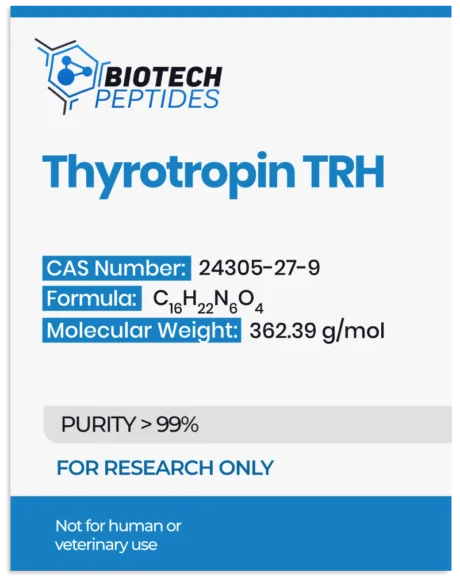
TRH Thyrotropin (Protirelin) (25mg)
$90.00
TRH Thyrotropin (Protirelin) peptides are synthesised and lyophilised in the USA.
TRH Thyrotropin (Protirelin): Exploring the Science of a Powerful Thyroid Signalling Peptide
TRH Thyrotropin (Protirelin), commonly known as thyrotropin-releasing hormone (TRH) or protirelin, is a naturally occurring hypothalamic peptide with a central role in endocrine signalling. It is best known for stimulating the pituitary gland to release thyroid-stimulating hormone (TSH), thereby connecting the hypothalamus with the thyroid gland.
Beyond thyroid regulation, TRH has also been investigated in neuroscience, metabolism, thermoregulation, and neuroendocrine research. Its relatively small molecular structure makes it an interesting model for studying how peptide hormones can initiate complex physiological responses.
For researchers exploring TRH, Thyrotropin, or Protirelin, understanding its biological function, receptor activity, and research applications provides valuable context. This guide examines the science behind TRH and answers common questions about this important research peptide.
1. What Is TRH (Thyrotropin-Releasing Hormone)? Discover the Peptide That Helps Control Thyroid Signalling
TRH, short for thyrotropin-releasing hormone, is a tripeptide produced primarily by specialised neurons in the hypothalamus.
TRH travels from the hypothalamus to the anterior pituitary gland, where it interacts with TRH receptors on pituitary cells. This stimulates the release of thyroid-stimulating hormone, or TSH.
TSH subsequently acts on the thyroid gland, encouraging the production and release of thyroid hormones.
The basic pathway can be summarised as:
Hypothalamus → TRH → Pituitary → TSH → Thyroid → Thyroid hormones
This pathway is a fundamental component of the hypothalamic pituitary thyroid (HPT) axis.
Understanding Protirelin
Protirelin is the synthetic form of thyrotropin-releasing hormone.
It has been used in medical and scientific contexts to investigate pituitary and thyroid function, making it particularly relevant to endocrine research.
2. The Fascinating TRH-TSH Connection: How a Tiny Peptide Influences the Thyroid
The relationship between TRH and TSH is one of the most important aspects of thyroid physiology.
The hypothalamus continuously monitors and coordinates numerous physiological signals. When appropriate, TRH is released and reaches the anterior pituitary.
There, TRH binds to its receptor and stimulates pituitary thyrotroph cells.
The resulting release of TSH provides the next signal in the pathway.
TRH and Thyroid Hormones
TSH acts on the thyroid gland, stimulating production of the primary thyroid hormones thyroxine (T4) and triiodothyronine (T3).
These hormones have widespread effects throughout the body, influencing processes such as energy metabolism, thermogenesis, cardiovascular function, and development.
Why Endocrine Researchers Study TRH
Studying TRH provides researchers with a way to investigate the earliest stages of thyroid hormone regulation.
Rather than examining only thyroid gland activity, scientists can study the complete signalling pathway from the hypothalamus to the pituitary and ultimately to the thyroid.
This makes TRH particularly valuable in neuroendocrinology and endocrine physiology research.
3. TRH Beyond the Thyroid: Exploring Its Role in the Brain and Nervous System
Although TRH was originally characterised because of its role in thyroid regulation, research has demonstrated that TRH is also widely distributed throughout the central nervous system.
This has led scientists to investigate TRH in relation to several neurological and physiological processes.
TRH and Neuroendocrine Signalling
TRH is an excellent example of how the nervous and endocrine systems communicate.
The hypothalamus is part of the brain, yet it controls several major endocrine pathways.
TRH demonstrates this connection particularly clearly.
A neural signal originating in the hypothalamus can trigger a hormonal response from the pituitary, ultimately affecting an organ located in the neck.
This brain-to-gland communication is a major subject of neuroendocrine research.
TRH and Thermoregulation
Researchers have also investigated TRH in relation to thermoregulation, the body’s ability to maintain an appropriate internal temperature.
Thyroid hormones influence metabolic activity and heat production, while TRH itself is involved in central nervous system signalling.
Scientists therefore study TRH as part of the broader network connecting metabolism, temperature regulation, and endocrine activity.
4. TRH Thyrotropin (Protirelin): Research Applications and Scientific Considerations
TRH and protirelin have a long history of scientific interest.
Researchers may investigate TRH in areas including:
- Thyroid physiology
- Pituitary function
- TSH secretion
- Neuroendocrinology
- HPT axis signalling
- Thermoregulation
- Metabolic regulation
- Central nervous system biology
- Hormonal feedback mechanisms
Its well-defined position within the HPT axis makes TRH particularly useful for studying endocrine signalling.
TRH Receptor Signalling
TRH produces its biological effects by interacting with TRH receptors, which belong to the G protein-coupled receptor family.
Receptor activation triggers intracellular signalling pathways that can ultimately promote the release of TSH from pituitary cells.
Studying these mechanisms allows researchers to examine how peptide hormones communicate with cells and translate extracellular signals into physiological responses.
Research Quality Matters
When working with peptide research materials, the stated quantity alone does not establish quality or biological activity.
Researchers may consider:
- Molecular identity
- Peptide sequence
- Purity
- Certificate of analysis
- Batch information
- Analytical characterization
- Formulation
- Stability
- Storage requirements
Appropriate characterisation is especially important when studying receptor activity or endocrine responses.
5. The Future of TRH Research: A Small Peptide With a Huge Biological Role
TRH demonstrates how a molecule containing only three amino acids can participate in an extraordinarily complex physiological system.
The HPT axis is tightly regulated and involves multiple layers of feedback between the hypothalamus, pituitary gland, and thyroid.
Continued TRH research may provide additional insights into:
- Thyroid hormone regulation
- Pituitary physiology
- Neuroendocrine communication
- Metabolic signaling
- Thermoregulation
- Central nervous system function
- Hormonal feedback mechanisms
Researchers may also continue exploring how TRH signalling interacts with other neurotransmitters, hormones, and metabolic pathways.
Understanding these relationships can help scientists build a more complete picture of endocrine regulation.
TRH vs. TSH: Understanding the Difference
TRH and TSH are sometimes confused because they are both involved in thyroid regulation, but they are very different molecules.
TRH is a hypothalamic releasing hormone that signals the pituitary.
TSH is a pituitary glycoprotein hormone that signals the thyroid gland.
The sequence is therefore:
TRH stimulates TSH release, and TSH stimulates thyroid hormone production.
This distinction is essential when discussing thyroid research.
Frequently Asked Questions About TRH Thyrotropin (Protirelin)
What is TRH?
TRH stands for thyrotropin-releasing hormone. It is a small hypothalamic peptide that stimulates the pituitary gland to release thyroid-stimulating hormone.
What is Protirelin?
Protirelin is the synthetic form of thyrotropin-releasing hormone, or TRH.
What does TRH do?
TRH primarily stimulates the pituitary gland to release TSH. It also has functions within the central nervous system and has been investigated in several areas of neuroendocrine research.
What is the HPT axis?
The hypothalamic pituitary thyroid axis is the endocrine pathway connecting the hypothalamus, pituitary gland, and thyroid gland. TRH is an important signalling molecule at the beginning of this pathway.
Does TRH affect TSH?
Yes. TRH binds to receptors on pituitary thyrotroph cells and stimulates the secretion of TSH.
What does TSH do?
TSH acts on the thyroid gland and stimulates the production and release of thyroid hormones, primarily T4 and T3.
Is TRH the same as TSH?
No. TRH is produced primarily by the hypothalamus, while TSH is produced by the anterior pituitary gland. TRH stimulates TSH secretion.
Is TRH a hormone?
Yes. TRH is a peptide hormone and neuroendocrine signalling molecule.
Is Protirelin approved as a medicine?
Protirelin has had medical and diagnostic uses in some jurisdictions, but regulatory status depends on the specific formulation, indication, and country. A research preparation should not automatically be considered an approved pharmaceutical product.
Is TRH safe for human use?
A research preparation should not automatically be assumed to be safe or appropriate for personal use. Human administration requires appropriate medical oversight, clinical evidence, and compliance with applicable regulatory requirements.
What should researchers look for when evaluating TRH?
Researchers may consider molecular identity, sequence confirmation, purity, certificate of analysis, batch information, analytical characterisation, formulation, stability, and storage requirements.
Final Thoughts on TRH Thyrotropin (Protirelin)
TRH Thyrotropin (Protirelin) is a fascinating peptide at the centre of thyroid and neuroendocrine research. Although it is exceptionally small, TRH plays a critical role in the signalling pathway connecting the hypothalamus, pituitary gland, and thyroid.
Its primary function involves stimulating TSH release, which subsequently influences thyroid hormone production. At the same time, TRH’s presence throughout the nervous system has encouraged research into thermoregulation, metabolism, and broader neuroendocrine signalling.
For researchers exploring TRH or Protirelin, understanding molecular identity, purity, analytical characterisation, formulation, and stability is important when evaluating research materials.
Brand
Biotech Peptides
Be the first to review “TRH Thyrotropin (Protirelin) (25mg)”
Related products
PEPTIDES
PEPTIDES
PEPTIDES
PEPTIDES

PEPTIDES
PEPTIDES
PEPTIDES
PEPTIDES
Reviews
There are no reviews yet.