
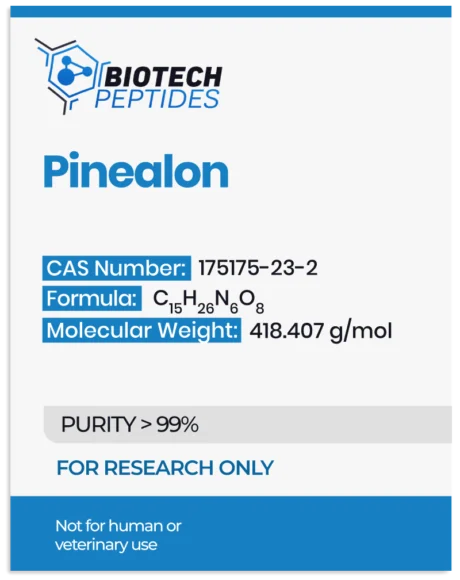
Pinealon (20mg)
$66.00
Pinealon peptides are synthesised and lyophilised in the USA.
Pinealon (20mg): Exploring the Science of a Fascinating Research Peptide
Pinealon (20mg) is an experimental peptide that has attracted interest in research involving neurobiology, cellular ageing, oxidative stress, gene expression, and cognitive function. Often discussed within the broader field of peptide and gerontology research, Pinealon is being investigated for its potential influence on cellular processes associated with ageing and neurological function.
Unlike conventional nutritional supplements, Pinealon is a small research peptide whose biological properties are studied at the molecular and cellular level. Researchers interested in Pinealon 20mg may examine its relationship with gene regulation, cellular stress responses, and mechanisms involved in healthy cellular function.
This guide provides an educational overview of Pinealon, its scientific background, potential research applications, and frequently asked questions.
1. What Is Pinealon? Discover the Peptide at the Intersection of Ageing and Neuroscience
Pinealon is a short synthetic peptide that has been studied primarily in connection with the pineal gland, cellular ageing, and neurological research.
It is generally described as a tripeptide, with research interest centred on its possible effects on gene expression and cellular regulation.
The pineal gland is a small endocrine structure in the brain best known for its role in producing melatonin, a hormone involved in circadian rhythm regulation. Research involving Pinealon has explored whether short peptides associated with pineal biology may have broader cellular effects.
The 20mg designation refers to the stated quantity of material in a particular research preparation. It represents mass and should not be interpreted as a recommended human dose or treatment protocol.
Why Researchers Are Interested in Pinealon
Ageing involves many interconnected biological processes.
Researchers study changes in:
- Gene expression
- Oxidative stress
- Cellular communication
- Mitochondrial function
- DNA regulation
- Neurodegeneration
- Cellular repair mechanisms
Pinealon has attracted attention because preliminary research has explored whether short peptides can influence some of these pathways.
This places Pinealon within an interesting area of research connecting peptide biology and gerontology.
2. The Fascinating Science Behind Pinealon and Cellular Regulation
One of the most interesting aspects of Pinealon research is its proposed relationship with gene expression.
Gene expression determines how information encoded in DNA is translated into functional cellular products. Changes in gene expression occur naturally throughout life and can be influenced by age, environment, hormones, stress, and cellular conditions.
Scientists have investigated whether certain short peptides can influence these processes.
Pinealon has been studied within this context.
Pinealon and Gene Expression
Research into Pinealon has examined its possible influence on gene expression patterns associated with cellular ageing.
The underlying concept is fascinating: rather than simply supplying a nutrient or acting as a conventional hormone, a peptide could potentially influence cellular regulatory processes.
However, these mechanisms remain an area of scientific investigation.
Laboratory observations should not be interpreted as proof that Pinealon can reverse ageing or produce specific health outcomes in humans.
Pinealon and Oxidative Stress
Oxidative stress occurs when reactive oxygen species and related molecules exceed the cell’s ability to regulate them effectively.
Oxidative stress is studied extensively in ageing research because it can affect proteins, lipids, DNA, and cellular structures.
Researchers have investigated Pinealon in relation to oxidative stress and cellular antioxidant systems.
This work forms part of a broader effort to understand how small signalling molecules may influence cellular responses to age-related stress.
3. Pinealon and Brain Research: Exploring Cognitive and Neurobiological Pathways
Pinealon has also generated interest in neuroscience research.
The brain is highly sensitive to metabolic changes, oxidative stress, and alterations in cellular signalling. Consequently, researchers are investigating numerous molecular pathways that may contribute to healthy neuronal function.
Pinealon research has explored its possible relationship with neuronal processes and age-related changes in the nervous system.
Pinealon and Cognitive Research
Because of its connection to neurological research, Pinealon is sometimes discussed in relation to memory and cognitive function.
Researchers are interested in understanding whether changes in cellular regulation and oxidative stress can influence neuronal performance.
However, it is important to distinguish between research into biological pathways associated with cognition and evidence demonstrating that an experimental peptide improves cognitive performance in humans.
Clinical claims require appropriately designed human studies.
Pinealon and Neuronal Ageing
Neuronal ageing is a complex process involving multiple biological systems.
Scientists study mitochondrial function, oxidative stress, protein homeostasis, inflammation, and changes in gene expression to understand how neurons respond to ageing.
Pinealon provides researchers with another experimental molecule for exploring these mechanisms.
The goal is to better understand how cellular regulation changes over time and how peptide signalling may interact with these processes.
4. Pinealon (20mg): Research Quality, Preparation, and Scientific Considerations
A preparation labelled Pinealon 20mg indicates a stated quantity of twenty milligrams.
For laboratory research, however, quantity alone does not establish molecular quality or biological activity.
Researchers evaluating Pinealon materials may consider:
- Molecular identity
- Peptide sequence
- Purity
- Certificate of analysis
- Batch information
- Analytical characterization
- Formulation
- Stability
- Storage requirements
These factors can be particularly important when conducting experiments designed to measure subtle cellular effects.
Why Peptide Purity Matters
Research reproducibility depends on knowing precisely what is being tested.
Impurities, degradation products, or incorrect molecular identity can potentially affect experimental outcomes.
For this reason, researchers may use analytical testing to verify peptide identity and assess purity.
A product description or stated milligram quantity alone cannot establish biological activity, clinical effectiveness, or human safety.
Pinealon and the Pineal Gland
The name Pinealon is associated with the pineal gland, an endocrine structure located in the brain.
The pineal gland is strongly associated with circadian biology because it produces melatonin in response to signals related to the body’s biological clock.
However, Pinealon should not be confused with melatonin.
Melatonin is a hormone, while Pinealon is an experimental peptide studied for different biological properties.
This distinction is important when researching peptide products associated with pineal biology.
5. The Future of Pinealon Research: Where Peptide Biology Meets Gerontology
The scientific interest surrounding Pinealon reflects a larger trend in modern ageing research.
Scientists increasingly recognise that ageing is not controlled by a single pathway. Instead, it involves interconnected changes in metabolism, gene expression, mitochondrial function, cellular stress responses, and tissue communication.
Small signalling peptides are being investigated as potential tools for studying these mechanisms.
Pinealon is one such research peptide.
Future investigations may explore its relationship with:
- Cellular aging
- Gene regulation
- Oxidative stress
- Neuronal function
- Cognitive biology
- Cellular resilience
- Pineal biology
- Age-related molecular changes
As research progresses, better controlled studies will be necessary to determine which observed effects are reproducible and whether laboratory findings have meaningful relevance to human physiology.
Frequently Asked Questions About Pinealon (20mg)
What is Pinealon?
Pinealon is a short synthetic peptide investigated in research involving cellular aging, gene expression, oxidative stress, and neurobiology.
What does Pinealon 20mg mean?
Pinealon 20mg refers to a preparation containing a stated quantity of twenty milligrams. The number indicates mass and does not represent a recommended human dose.
Why is Pinealon associated with the pineal gland?
The name Pinealon reflects its historical association with research involving pineal biology. However, Pinealon should not be confused with melatonin, the hormone produced by the pineal gland.
Is Pinealon a hormone?
Pinealon is generally described as an experimental peptide rather than a conventional endocrine hormone.
What is Pinealon studied for?
Research has investigated Pinealon in relation to cellular ageing, gene expression, oxidative stress, neurological function, and age-related biological processes.
Is Pinealon an anti-ageing peptide?
Pinealon is researched within the broader field of ageing and gerontology, but this does not establish it as a proven anti-ageing treatment or longevity therapy.
Does Pinealon improve memory?
Pinealon has attracted interest in cognitive and neurological research, but there is insufficient evidence to describe it as a proven human memory-enhancing treatment.
Is Pinealon related to melatonin?
Pinealon and melatonin are different molecules. Melatonin is a hormone involved in circadian rhythm regulation, while Pinealon is an experimental peptide investigated for other biological effects.
What is oxidative stress?
Oxidative stress occurs when reactive molecules can exceed the body’s ability to regulate them. It is an important subject in research involving ageing, cellular damage, and neurobiology.
Is Pinealon approved as a medicine?
Regulatory status depends on the specific formulation and jurisdiction. An experimental research preparation should not automatically be considered an approved pharmaceutical product.
Is Pinealon 20mg safe for human use?
A research preparation should not automatically be assumed to be safe or appropriate for personal use. Human safety requires appropriate clinical evidence and regulatory evaluation.
What should researchers look for when evaluating Pinealon?
Researchers may examine molecular identity, sequence confirmation, purity, certificate of analysis, batch information, analytical characterisation, formulation, stability, and storage requirements.
Final Thoughts on Pinealon (20mg)
Pinealon (20mg) is an intriguing experimental peptide positioned at the intersection of peptide biology, neuroscience, cellular ageing, and gerontology research.
Its scientific interest comes from investigations into gene expression, oxidative stress, cellular regulation, and age-related neurological processes. The peptide also provides researchers with an opportunity to explore how small signalling molecules may interact with complex cellular systems.
For researchers evaluating Pinealon 20mg, the stated quantity is only one consideration. Molecular identity, purity, analytical testing, sequence confirmation, formulation, stability, and batch documentation are important factors when assessing research materials.
Although Pinealon continues to attract attention within longevity and peptide research communities, experimental findings should be separated from established clinical evidence. Claims concerning anti-ageing, cognitive enhancement, or longevity require rigorous human research before they can be considered scientifically established.
As research into cellular ageing continues to evolve, Pinealon remains an interesting molecule for scientists investigating a fundamental question: how can changes at the molecular level influence the way cells respond to stress and ageing?
Brand
Biotech Peptides
Be the first to review “Pinealon (20mg)”
Related products
PEPTIDES

PEPTIDES
PEPTIDES
PEPTIDES
PEPTIDES

PEPTIDES

PEPTIDES
PEPTIDES
Reviews
There are no reviews yet.