
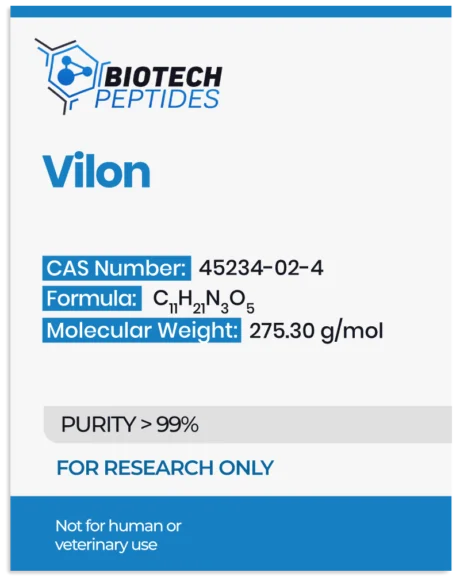
Vilon (20mg)


Original price was: $65.00.$60.00Current price is: $60.00.
Vilon peptides are synthesised and lyophilised In the USA
Exploring the Science Behind This Experimental Peptide Bioregulator
Vilon (20mg) is an experimental peptide bioregulator studied in connection with immune system biology, cellular signalling, thymus research, and age-related biological processes. Buy Vilon Peptides Online
Vilon is commonly described as a short peptide associated with research into thymic and immune-related biology. The thymus plays an important role in the development and maturation of immune cells, making thymus-related peptides an interesting area of laboratory research.
Peptide bioregulators are small peptide sequences that scientists investigate for their potential relationships with tissue-specific cellular processes.
As interest in peptide science continues to grow, Vilon 20mg has become a subject of interest for researchers exploring cellular communication, immune biology, and biological ageing.
Research disclaimer: Vilon is an experimental research peptide. Research interest does not establish Vilon as an approved treatment for immune disorders, aging, or other medical conditions. This content is provided for educational and laboratory research purposes.
1. What Is Vilon? Discover the Experimental Peptide Linked to Thymus Research
Vilon is a short peptide bioregulator associated with experimental research involving thymic and immune system biology.
The thymus is a specialised organ located in the upper chest. It plays an important role in the development of T lymphocytes, commonly called T cells.
T cells are essential components of adaptive immunity.
Because thymic activity is closely connected with immune cell development, researchers have long been interested in understanding the molecular signals involved in thymus function.
Understanding Vilon Peptide Research
Vilon is studied within the broader field of peptide bioregulators.
These compounds are investigated because short peptide sequences may participate in biological signaling.
Research may examine their potential relationships with:
- Cellular communication
- Tissue-specific signalling
- Gene expression
- Immune system biology
- Cellular differentiation
- Age related biological changes
Vilon provides an experimental model for investigating these questions.
What Does Vilon 20mg Mean?
Vilon 20mg refers to a preparation containing a stated quantity of 20 milligrams.
The 20mg designation describes the amount of research material.
It does not establish a recommended dose or treatment protocol.
Laboratory research requirements depend on the experimental model, methodology, and research objectives.
2. The Fascinating World of Vilon and Thymic Biology
The thymus is one of the most interesting organs in immunology.
It is particularly active during childhood and adolescence, when T cell development is especially important.
Thymic activity changes with age, making the organ an important subject of research into immune system development and aging.
Vilon and Immune System Research
The immune system relies on highly coordinated cellular communication.
T cells must develop and mature through carefully regulated processes.
Researchers investigate the molecular signals involved in these pathways.
Peptide research provides one approach to studying cellular communication within immune biology.
Vilon and T Cell Biology
T cells play an important role in adaptive immunity.
Different types of T cells perform different functions.
These include helper T cells, cytotoxic T cells, and regulatory T cells.
The thymus provides an important environment for T cell development.
Research into thymus associated peptides may therefore contribute to a broader understanding of immune cell biology.
Why Thymus Research Matters
The thymus changes throughout the lifespan.
Its structure and activity can decline with age.
This process is known as thymic involution.
Researchers study thymic involution because it is associated with changes in immune system function. Buy Vilon Peptides Online
Vilon is part of the broader research interest in thymus-related peptide signalling.
3. Vilon Research: Exploring Immune Signalling, Cellular Function, and Ageing Biology
Interest in Vilon peptide research extends beyond basic thymus biology.
Scientists are also interested in how immune function changes throughout life.
Vilon and Cellular Signalling
Cells communicate through a wide range of biochemical signals.
These signals influence cell growth, differentiation, metabolism, and immune activity.
Researchers investigate whether short peptide sequences may interact with these biological processes.
Vilon is studied within this larger framework.
Vilon and Immune Ageing Research
The immune system changes as people age.
This phenomenon is sometimes called immunosenescence.
Researchers study how ageing affects immune cell production, cellular communication, and immune responses.
The thymus plays an important role in this discussion because thymic activity changes significantly with age.
Vilon therefore attracts interest within experimental research into thymic biology and ageing.
Vilon and Gene Expression
Peptide research can also involve studying changes in gene expression.
Gene expression determines how cells produce proteins and perform specialised functions.
Researchers may investigate whether experimental peptides are associated with changes in cellular gene activity.
Such research can provide insights into biological signalling.
However, laboratory observations do not automatically establish clinical effectiveness.
4. Vilon (20mg): Quality, Purity, and Research Considerations
When evaluating Vilon 20mg, the stated quantity is only one part of the equation.
Researchers should also consider the identity and quality of the peptide material.
Useful documentation may include:
- Peptide sequence
- Molecular identity
- Molecular weight
- Purity
- Certificate of analysis
- Batch information
- Analytical testing
- Stability information
- Solubility
- Storage requirements
Why Vilon Purity Matters
Research requires consistent materials.
Unexpected impurities or degradation products can introduce unwanted variables.
A certificate of analysis can provide useful batch-specific information about peptide identity and purity.
However, a product label stating Vilon 20mg does not independently confirm purity, biological activity, effectiveness, or safety.
Vilon Stability
Peptides may be sensitive to temperature, moisture, light, pH, and repeated handling.
The exact stability profile depends on the formulation and preparation.
Researchers should follow the supplier’s documented storage and handling instructions.
Good laboratory practices can help maintain material consistency.
Vilon Research Material vs. Medical Product
Vilon should be accurately described as an experimental peptide bioregulator.
Research compounds are not automatically approved pharmaceutical products.
A compound can be studied in laboratory environments without being authorised for diagnosing, treating, curing, or preventing disease.
This distinction is particularly important when discussing immune-related peptides.
5. The Future of Vilon Research: Unlocking New Questions in Immune and Thymic Biology
Research into the thymus continues to provide important insights into immune system development and ageing.
Scientists are studying how thymic tissue communicates with immune cells and how these relationships change over time.
Experimental peptides may provide additional tools for investigating these mechanisms.
Potential Areas for Future Research
Future studies may explore:
- Thymic biology
- T cell development
- Immune cell differentiation
- Cellular signaling
- Gene expression
- Immune aging
- Thymic involution
- Tissue-specific peptide signaling
- Cellular communication
- Peptide bioregulator biology
Why Vilon Is Scientifically Interesting
Vilon is interesting because it sits within the intersection of peptide science, thymus research, and immune biology.
The thymus is essential to the development of adaptive immune cells.
Understanding the molecular signals associated with thymic tissue may help researchers better understand immune system development.
The Bigger Picture of Peptide Bioregulators
Peptide bioregulators represent a broad area of experimental research.
Scientists investigate whether short peptide sequences can provide insight into tissue-specific cellular communication.
Vilon offers one example of this research approach.
As molecular biology develops, researchers may gain a clearer understanding of how small peptides interact with complex biological systems.
Frequently Asked Questions About Vilon (20mg)
What is Vilon?
Vilon is an experimental peptide bioregulator associated with research into thymic biology, immune system signalling, cellular communication, and biological aging.
What does Vilon 20mg mean?
Vilon 20mg indicates a preparation containing a stated quantity of 20 milligrams. The amount refers to the material quantity and does not represent a recommended dosage.
What is Vilon studied for?
Vilon is associated with experimental research involving thymus biology, immune signalling, cellular function, T cell development, and age-related biological processes. Buy Vilon Peptides Online
Is Vilon an immune system medication?
No. Vilon should not automatically be described as an approved medication for immune system conditions.
Can Vilon treat immune disorders?
Experimental research does not establish Vilon as a proven treatment for immune disorders or other medical conditions.
What is the thymus?
The thymus is a specialised immune organ involved in the development and maturation of T cells.
What are T cells?
T cells are immune cells that play important roles in adaptive immunity, including immune regulation and responses to foreign substances.
What is thymic involution?
Thymic involution is the gradual reduction in thymic size and activity that occurs with age. Buy Vilon Peptides Online. It is an important area of immunology and ageing research.
Is Vilon an anti-ageing peptide?
Vilon may be discussed in research involving thymic biology and biological ageing. However, it should not be marketed as a proven anti-ageing treatment.
Is Vilon a peptide?
Yes. Vilon is described as an experimental peptide bioregulator.
What is a peptide bioregulator?
A peptide bioregulator is a short peptide studied for its possible relationship with cellular communication and tissue-specific biological processes.
What should researchers look for when evaluating Vilon 20mg?
Important factors include peptide identity, sequence, purity, molecular weight, certificate of analysis, batch information, analytical testing, stability, and storage requirements.
Why is Vilon purity important?
Purity can influence experimental consistency. Well-characterised research materials can help reduce unwanted variables during laboratory studies.
How should Vilon be stored?
Storage requirements depend on the specific preparation. Researchers should follow the supplier’s documented storage and handling instructions.
Is Vilon approved for human use?
Experimental research material should not automatically be considered an approved pharmaceutical product. Regulatory status depends on the specific product and jurisdiction.
Is Vilon safe for personal use?
Safety cannot be assumed from laboratory research. Buy Vilon Peptides Online. Experimental research materials should not automatically be considered suitable for personal use or self-administration.
Final Thoughts on Vilon (20mg)
Vilon (20mg) is an intriguing experimental peptide associated with research into thymic biology, immune signalling, T cell development, cellular communication, and biological ageing.
The thymus plays a central role in the development of adaptive immune cells. Its changing activity throughout life makes it an important subject for researchers studying immune function and ageing.
Vilon provides an experimental model for exploring the potential relationships between short peptide sequences and tissue-specific biological processes.
For researchers evaluating Vilon 20mg, quality documentation should remain a priority. Peptide identity, sequence, purity, analytical testing, batch information, stability, and storage requirements can all influence research reliability.
As peptide science continues to evolve, compounds such as Vilon may help researchers ask new questions about the molecular communication underlying immune and thymic biology.
A small peptide. A remarkable organ. A fascinating field of research into the molecular foundations of immune biology.
Brand
Biotech Peptides
Be the first to review “Vilon (20mg)”
Related products
PEPTIDES
PEPTIDES
PEPTIDES
PEPTIDES
PEPTIDES

PEPTIDES

PEPTIDES
PEPTIDES
Reviews
There are no reviews yet.