

Exploring the Science Behind This Experimental Liver Peptide
Livagen (20mg) is an experimental peptide bioregulator associated with research into liver biology, cellular signalling, tissue regulation, and age-related biological processes.
Livagen is commonly described as a short peptide bioregulator studied in connection with liver tissue. Interest in Livagen comes from the broader field of peptide research, where scientists investigate how small peptide sequences may interact with tissue-specific cellular processes.
The liver performs hundreds of important biological functions. It contributes to metabolism, nutrient processing, protein synthesis, and the body’s natural biochemical regulation. Because of its complexity, liver biology remains a major area of scientific research.
Experimental peptides such as Livagen provide researchers with additional tools for exploring these biological mechanisms.
Research disclaimer: Livagen is an experimental research peptide. It should not be presented as an approved treatment for liver disease, liver damage, detoxification, or aging. This content is intended for educational and laboratory research purposes.
1. What Is Livagen? Discover the Experimental Peptide Behind Liver Research
Livagen is a short peptide bioregulator associated with experimental research involving the liver.
Peptide bioregulators are small peptide sequences that researchers investigate for their potential relationship with tissue specific biological processes.
Livagen is particularly interesting because its research focus is linked to hepatic tissue.
Understanding Liver Tissue Research
The liver is one of the body’s most metabolically active organs.
It participates in numerous processes, including:
- Nutrient metabolism
- Protein production
- Bile production
- Lipid metabolism
- Carbohydrate regulation
- Biochemical processing
- Cellular detoxification pathways
Because the liver performs so many functions, researchers study its cellular biology from many different perspectives.
These include gene expression, cellular signaling, metabolism, tissue maintenance, and regeneration.
What Does Livagen 20mg Mean?
Livagen 20mg refers to a preparation containing a stated quantity of 20 milligrams.
The 20mg designation describes the amount of research material.
It does not represent a recommended dosage or establish a treatment protocol.
The quantity required for laboratory work depends on the specific experimental design.
2. The Fascinating World of Livagen and Liver Biology
The liver has a remarkable ability to maintain and regenerate its tissue.
This makes liver biology especially interesting to researchers.
Scientists investigate how liver cells respond to stress, injury, metabolic changes, and environmental factors.
Livagen and Hepatic Cellular Signaling
Cells communicate using complex networks of proteins, peptides, receptors, and other signaling molecules.
These interactions help regulate cellular behavior.
Researchers studying Livagen are interested in the broader concept of peptide mediated tissue regulation.
Experimental peptide research can help scientists investigate how short sequences may interact with cellular processes.
Why Liver Signalling Matters
Hepatocytes are the primary functional cells of the liver.
They perform many of the organ’s metabolic functions.
Other cell types also contribute to liver biology, including:
- Kupffer cells
- Hepatic stellate cells
- Sinusoidal endothelial cells
- Cholangiocytes
Communication between these cells helps maintain liver tissue.
Understanding this communication is a major part of modern hepatic research.
Livagen and Tissue-Specific Peptides
One interesting concept in peptide bioregulator research is tissue specificity.
Different tissues have different biological environments.
Researchers therefore investigate whether particular peptides may be associated with particular organs or cellular systems.
Livagen is studied within this broader scientific framework.
3. Livagen Research: Exploring Cellular Function, Regeneration, and Biological Regulation
Interest in Livagen peptide research is closely connected with the study of liver tissue.
Researchers continue to explore how liver cells maintain their structure and function.
Livagen and Liver Regeneration Research
The liver has a unique regenerative capacity.
After certain types of tissue loss or injury, liver cells can proliferate and help restore tissue mass.
Scientists study the signaling pathways responsible for this process.
Research areas may include:
- Hepatocyte proliferation
- Cellular differentiation
- Growth signaling
- Tissue remodeling
- Extracellular matrix biology
- Gene regulation
Experimental peptides may be investigated as part of this larger research field.
However, laboratory research should not be confused with proven clinical treatment.
Livagen and Cellular Stress
Liver cells are exposed to many metabolic processes.
This creates a complex cellular environment.
Researchers investigate how hepatocytes respond to oxidative stress, metabolic changes, inflammation, and other biological challenges.
Peptide signaling is one area of interest within this research.
Livagen and Aging Research
Age-related changes can affect cellular metabolism and tissue function.
Researchers study how different organs respond to biological aging.
The liver is an important area of investigation because metabolism changes throughout the lifespan.
Livagen may therefore appear in discussions surrounding tissue-specific peptide bioregulator research.
However, this does not establish Livagen as an anti-ageing treatment.
4. Livagen (20mg): Quality, Purity, and Research Considerations
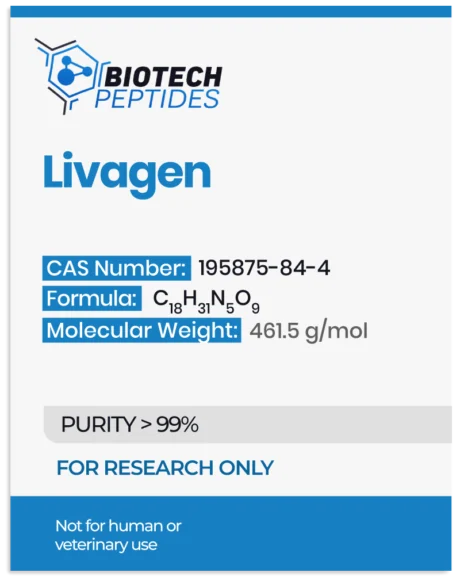
When evaluating Livagen 20mg, the stated quantity is only one factor.
Researchers should also examine the identity and quality of the material.
Useful documentation may include:
- Peptide sequence
- Molecular identity
- Molecular weight
- Purity
- Certificate of analysis
- Batch information
- Analytical testing
- Stability data
- Solubility
- Storage requirements
Why Livagen Purity Matters
Purity is important for laboratory research.
Unwanted impurities or degradation products can introduce variables into an experiment.
A certificate of analysis can provide useful batch specific information.
Researchers should review available analytical documentation rather than relying solely on the product name.
A 20mg label alone does not confirm purity, biological activity, effectiveness, or safety.
Livagen Stability
Peptides can be sensitive to environmental conditions.
Temperature, moisture, light, pH, and repeated handling may affect stability.
Researchers should follow the documented storage instructions supplied with the specific preparation.
Proper storage can help maintain consistency during research.
Livagen Research Material vs. Medical Product
Livagen should be accurately described as an experimental peptide bioregulator.
A research compound is not automatically an approved medicine.
Clinical use requires appropriate evidence, regulatory review, quality standards, and safety evaluation.
This distinction is important when discussing experimental liver related peptides.
5. The Future of Livagen Research: Unlocking New Questions in Liver Biology
Liver research continues to advance rapidly.
Scientists are investigating the molecular mechanisms responsible for liver metabolism, regeneration, cellular communication, and tissue maintenance.
Experimental peptides such as Livagen provide another potential research model for studying these processes.
Potential Areas for Future Research
Future studies may explore:
- Liver cell biology
- Hepatocyte signaling
- Tissue regeneration
- Cellular stress
- Gene expression
- Metabolic regulation
- Extracellular matrix biology
- Cellular aging
- Peptide signaling
- Tissue specific bioregulation
Why Livagen Is Scientifically Interesting
Livagen represents an approach to peptide research that focuses on tissue-specific biological questions.
The liver provides an especially interesting model because of its complex metabolic functions and regenerative properties.
Researchers can use experimental systems to investigate how cellular signalling contributes to these processes.
The Bigger Picture of Peptide Bioregulators
Peptide bioregulators are part of a wider area of molecular research.
Short peptides can provide scientists with defined molecular structures for investigating cellular interactions.
By studying these interactions, researchers can learn more about tissue organisation and cellular regulation.
Livagen is one experimental example within this broader field.
Frequently Asked Questions About Livagen (20mg)
What is Livagen?
Livagen is an experimental peptide bioregulator associated with research into liver tissue, cellular signaling, tissue regulation, and hepatic biology.
What does Livagen 20mg mean?
Livagen 20mg indicates a preparation containing a stated quantity of 20 milligrams. The quantity does not represent a recommended dosage.
What is Livagen studied for?
Livagen is associated with experimental research involving liver biology, cellular regulation, tissue maintenance, regeneration research, and related biological processes.
Is Livagen a liver medication?
No. Livagen should not automatically be described as an approved medication for liver conditions.
Can Livagen treat liver disease?
Experimental research does not establish Livagen as a proven treatment for liver disease, liver injury, or other medical conditions.
Why is liver peptide research important?
The liver performs many essential biological functions. Studying peptide signalling may help researchers better understand how liver cells communicate, respond to stress, and maintain tissue function.
Is Livagen a peptide?
Yes. Livagen is described as an experimental peptide bioregulator.
What is a peptide bioregulator?
A peptide bioregulator is a short peptide studied for its potential relationship with cellular signalling and tissue-specific biological processes.
What is the liver’s role in the body?
The liver participates in metabolism, protein synthesis, bile production, nutrient processing, and many biochemical pathways.
What is liver regeneration?
Liver regeneration refers to the organ’s remarkable ability to restore tissue mass through controlled cellular processes following certain types of tissue loss or injury.
Is Livagen an anti-aging peptide?
Livagen may be discussed in the context of peptide bioregulator and cellular aging research. However, it should not be marketed as a proven anti-aging treatment.
What should researchers look for when evaluating Livagen 20mg?
Important factors include peptide identity, sequence, purity, molecular weight, certificate of analysis, batch information, analytical testing, stability, and storage requirements.
Why does Livagen purity matter?
Purity can influence laboratory results. Well-characterised research material helps researchers reduce unwanted variables during experiments.
How should Livagen be stored?
Storage requirements depend on the specific preparation. Researchers should follow the supplier’s documented storage and handling instructions.
Is Livagen approved for human use?
Experimental research material should not automatically be considered an approved pharmaceutical product. Regulatory status depends on the specific product and jurisdiction.
Is Livagen safe for personal use?
Safety cannot be assumed from experimental research. Research materials should not automatically be considered suitable for personal use or self-administration.
Final Thoughts on Livagen (20mg)
Livagen (20mg) is an intriguing experimental peptide bioregulator associated with liver biology, cellular signalling, tissue regulation, regeneration research, and peptide science.
The liver is one of the body’s most complex organs. Its ability to regulate metabolism and maintain tissue function makes it an important subject for molecular and cellular research.
Livagen provides researchers with another experimental model for exploring tissue-specific peptide biology.
When evaluating Livagen 20mg, researchers should look beyond the stated quantity. Peptide identity, sequence, purity, analytical documentation, batch information, stability, and storage conditions are important considerations.
As peptide research continues to develop, experimental compounds such as Livagen may help scientists investigate the complex signalling systems that influence tissue function and cellular regulation.
A small peptide connected to a fascinating organ. Livagen opens another window into the complex world of liver biology and experimental peptide research.
Brand
Biotech Peptides
Be the first to review “Livagen (20mg)”
Related products
PEPTIDES
PEPTIDES
PEPTIDES
PEPTIDES
PEPTIDES
PEPTIDES
PEPTIDES

PEPTIDES
Reviews
There are no reviews yet.