
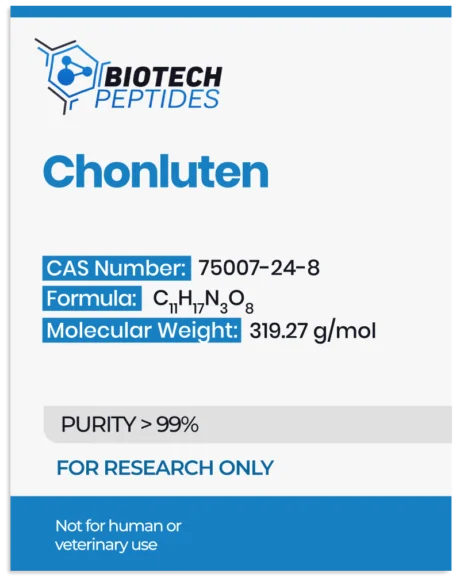
Chonluten (T-34) (20mg)

$60.00
Chonluten (T-34) peptides are synthesised and lyophilised In the USA
Exploring the Science Behind This Experimental Peptide Bioregulator
Chonluten (T-34) (20mg) is an experimental peptide bioregulator studied in connection with respiratory biology, lung tissue, cellular signalling, and peptide research.
Also known as T-34, Chonluten belongs to a group of short peptides investigated for their potential relationship with tissue-specific biological processes. Its research interest is linked to the respiratory system, making it a subject of interest in experimental studies focused on lung tissue and cellular regulation.
The respiratory system is highly specialised. The lungs must exchange gases efficiently while maintaining a complex protective barrier. This requires constant communication between epithelial cells, immune cells, connective tissue, and other components.
Research into peptide bioregulators such as Chonluten aims to better understand these biological processes.
If you are researching Chonluten 20mg, this guide explores what it is, why respiratory peptide research matters, potential research areas, and the quality factors worth considering when evaluating this experimental material.
Research disclaimer: Chonluten is an experimental peptide bioregulator. Research interest does not establish it as an approved medicine or treatment for respiratory disease. This content is intended for educational and research purposes.
1. What Is Chonluten? Meet the Experimental Peptide Known as T-34
Chonluten, also referred to as T-34, is a short peptide bioregulator associated with experimental research into the respiratory system.
Peptide bioregulators are small peptide sequences studied for their possible role in cellular communication and tissue-specific regulation.
Chonluten is particularly interesting because its research focus is associated with lung and respiratory tissue.
Understanding Tissue-Specific Peptide Research
Different organs contain different types of cells.
These cells have specialized functions and respond to different biological signals.
Researchers have therefore explored whether specific peptides may be associated with tissue-specific signalling.
Respiratory peptide research can involve areas such as:
- Lung cell biology
- Epithelial tissue research
- Cellular signaling
- Tissue maintenance
- Immune responses
- Regenerative biology
Chonluten fits within this broader research field.
What Does Chonluten (T-34) 20mg Mean?
The term Chonluten (T-34) 20mg refers to a preparation containing a stated quantity of 20 milligrams.
The 20mg amount describes the quantity of material.
It does not represent a recommended dosage, treatment schedule, or therapeutic strength.
For laboratory research, the appropriate amount depends on the experimental design and research objectives.
2. The Fascinating World of Lungs and Respiratory Biology
The lungs are among the body’s most important organs.
They provide the surface where oxygen and carbon dioxide are exchanged.
At the same time, lung tissue must protect itself from environmental particles, microorganisms, and other external factors.
This creates a complex biological environment.
Why Lung Tissue Research Matters
Healthy lung function depends on several types of cells working together.
These include epithelial cells, immune cells, endothelial cells, fibroblasts, and other specialised cells.
Communication between these cells helps maintain tissue structure and function.
Researchers study signaling pathways involved in:
- Cellular growth
- Tissue maintenance
- Differentiation
- Immune activity
- Barrier function
- Cellular stress
Experimental peptide research provides another way to investigate these processes.
Cholesterol and Cellular Signalling
One reason peptide bioregulators attract scientific interest is their potential relationship with cellular signalling.
Cells communicate using many types of molecules.
These signals can influence gene expression, protein activity, metabolism, and tissue behaviour.
Chonluten is studied within the broader context of understanding how short peptides may interact with tissue-specific biological processes.
The Importance of Respiratory Tissue
The respiratory tract contains several protective barriers.
The airway lining plays an important role in maintaining the internal environment of the lungs.
Researchers therefore investigate how respiratory tissues respond to environmental stress and biological challenges.
Chonluten research contributes to this broader scientific discussion.
3. Chonluten Research: Exploring Lung Tissue, Cellular Function, and Biological Regulation
Interest in Chonluten peptide research comes from the broader study of tissue specific peptide bioregulators.
Scientists continue to investigate how short peptides may interact with cellular processes.
Chonluten and Lung Biology
Lung biology involves numerous interconnected systems.
Researchers examine how cells communicate and maintain tissue structure.
This includes research into:
- Respiratory epithelial cells
- Connective tissue
- Cellular signaling
- Tissue regeneration
- Immune responses
- Oxidative stress
- Cellular aging
Chonluten provides an experimental molecule for researchers interested in these areas.
Chonluten and Respiratory Tissue Research
The respiratory system is constantly exposed to the outside environment.
Airborne particles and environmental factors can interact with airway tissues.
This makes respiratory tissue an important area for studying cellular defense mechanisms.
Researchers may investigate how experimental compounds interact with lung-related cellular pathways.
However, laboratory observations must be interpreted carefully.
A finding in a cell or animal model does not automatically demonstrate a clinical benefit in humans.
Chronolumen and Cellular Ageing
Cellular ageing is another important field of biological research.
As cells age, their metabolism, signalling, and ability to maintain tissue structure can change.
Researchers investigate these processes across many organs, including the lungs.
Peptide bioregulators are sometimes studied as part of broader research into age related cellular changes.
This does not mean that Chonluten should be marketed as an anti-aging treatment.
It remains an experimental research compound.
4. Chonluten (T-34) (20mg): Quality, Purity, and Research Considerations
When evaluating Chonluten (T-34) 20mg, the stated quantity is only one consideration.
Researchers should also examine the quality and identity of the material.
Useful documentation may include:
- Peptide identity
- Amino acid sequence
- Molecular characterization
- Purity
- Certificate of analysis
- Batch information
- Stability
- Solubility
- Storage requirements
These details can support reliable laboratory research.
Why Chonluten Purity Matters
Purity is important when studying biological pathways.
Unexpected impurities can introduce unwanted variables into an experiment.
A certificate of analysis can provide useful batch-specific information about the material.
Researchers should review analytical documentation rather than relying only on a product description.
A 20mg label alone does not establish purity, biological activity, effectiveness, or safety.
Chonluten Stability
Peptides can be sensitive to environmental conditions.
Temperature, moisture, light, pH, and repeated handling can affect stability depending on the preparation.
Researchers should follow the manufacturer’s documented storage and handling recommendations.
Proper storage can help maintain material consistency during research.
Chonluten Research Material vs. Medicine
Chonluten should be accurately described as an experimental peptide bioregulator.
Research materials are not automatically pharmaceutical products.
A compound may be investigated in laboratories without being approved for diagnosis, treatment, or prevention of disease.
This distinction is especially important when discussing respiratory research.
5. The Future of Chonluten Research: Unlocking New Questions in Respiratory Biology
Respiratory science continues to evolve.
Researchers are studying lung tissue from multiple perspectives, including molecular signalling, cellular aging, regeneration, immune responses, and tissue maintenance.
Experimental peptide bioregulators offer another research avenue.
Potential Areas for Future Research
Future studies may explore:
- Lung tissue biology
- Respiratory epithelial cells
- Cellular signaling
- Tissue regeneration
- Cellular stress
- Immune signaling
- Oxidative stress
- Age related tissue changes
- Peptide interactions
- Respiratory system biology
Why Chonluten Is Scientifically Interesting
Chonluten is interesting because it represents the concept of tissue-focused peptide research.
Instead of studying peptides only as general biological molecules, researchers can investigate whether specific sequences have relationships with particular tissues.
This approach can help scientists ask more focused questions about cellular regulation.
The Bigger Picture of Peptide Bioregulators
Peptide bioregulators are part of a larger field of molecular biology.
Short peptide sequences can provide researchers with relatively precise molecular structures for laboratory investigation.
By studying their interactions with cells and tissues, scientists can learn more about biological regulation.
Chonluten represents one experimental example within this developing field.
Frequently Asked Questions About Chonluten (T-34) (20mg)
What is Chonluten?
Chonluten, also known as T-34, is an experimental peptide bioregulator associated with research into respiratory and lung tissue biology.
What does Chonluten (T-34) 20mg mean?
It indicates a preparation containing a stated quantity of 20 milligrams. The 20mg amount describes the material quantity and does not represent a recommended dosage.
What is T-34?
T-34 is another name used for Chonluten in peptide bioregulator research.
What is Chonluten studied for?
Chonluten is associated with experimental research involving respiratory tissue, lung biology, cellular signalling, tissue maintenance, and related biological processes.
Is Chonluten a respiratory medicine?
No. Chonluten should not automatically be described as an approved respiratory medicine or treatment.
Can Chonluten treat lung disease?
Experimental research does not establish Chonluten as a proven treatment for lung disease or other respiratory conditions.
Why is lung peptide research important?
Lung tissue contains many specialised cells that must communicate to maintain the respiratory system. Studying peptide signalling may help researchers understand these cellular processes.
Is Chonluten a peptide?
Yes. Chonluten is described as an experimental peptide bioregulator.
What areas of respiratory biology are studied by researchers?
Research may involve epithelial cells, tissue maintenance, immune responses, cellular signaling, regeneration, oxidative stress, and age related changes.
Does Chonluten have anti-ageing properties?
Chonluten may be discussed in the context of peptide bioregulators and cellular aging research. However, it should not be marketed as a proven anti-ageing treatment.
What should researchers look for when evaluating Chonluten 20mg?
Important factors include peptide identity, sequence, purity, molecular characterisation, certificate of analysis, batch information, stability, and storage requirements.
Why is peptide purity important?
High quality research materials can help reduce unwanted variables and improve the reliability of laboratory experiments.
How should Chonluten be stored?
Storage requirements depend on the specific preparation. Researchers should follow the supplier’s documented storage and handling instructions.
Is Chonluten approved for human use?
Experimental research material should not automatically be considered an approved pharmaceutical product. Regulatory status depends on the specific product and jurisdiction.
Is Chonluten safe for personal use?
Safety cannot be assumed from experimental research. A research peptide should not automatically be considered suitable for personal use or self-administration.
Final Thoughts on Chonluten (T-34) (20mg)
Chonluten (T-34) (20mg) is an intriguing experimental peptide bioregulator associated with respiratory biology, lung tissue research, cellular signaling, and tissue-specific peptide science.
The respiratory system depends on complex interactions between epithelial cells, immune cells, connective tissue, and other specialized components. Understanding these interactions is an important part of modern lung research.
Chonluten provides researchers with another experimental molecule for investigating the biological processes associated with respiratory tissues.
When evaluating Chonluten 20mg, researchers should look beyond the quantity on the label. Peptide identity, sequence, purity, analytical documentation, batch information, stability, and storage conditions all deserve careful attention.
As peptide science continues to develop, tissue-focused research may provide new insights into how specialized organs communicate and maintain their biological functions.
One short peptide. One fascinating research direction. A closer look at the molecular biology of respiratory tissue.
Brand
Biotech Peptides
Be the first to review “Chonluten (T-34) (20mg)”
Related products
PEPTIDES
PEPTIDES
PEPTIDES
PEPTIDES
PEPTIDES
PEPTIDES
PEPTIDES
PEPTIDES
Reviews
There are no reviews yet.