
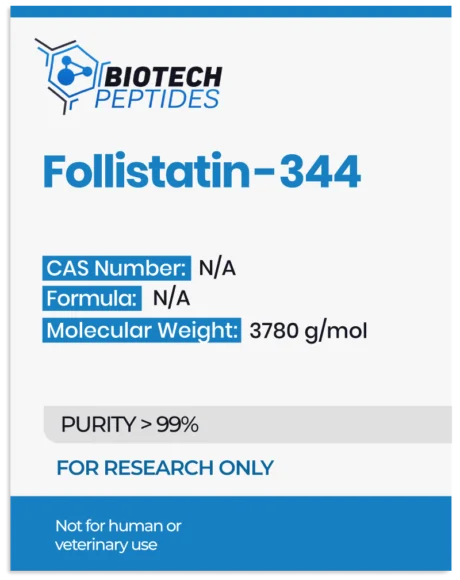
Follistatin-344 (1mg)
$160.00
Follistatin-344 peptides are synthesised and lyophilised in the USA.
Follistatin-344 (1mg): Exploring the Science Behind a Powerful Research Protein
Follistatin-344 (1mg) is an experimental research protein that has attracted significant interest in studies involving myostatin, activin signalling, muscle biology, and cellular growth pathways.
Follistatin is a naturally occurring glycoprotein involved in the regulation of several members of the transforming growth factor beta (TGF-β) superfamily. Researchers are particularly interested in its interaction with myostatin and activins, two signalling molecules that can influence muscle and tissue biology.
Follistatin-344 is therefore an important subject in molecular biology and protein research.
If you are researching Follistatin-344 1mg, understanding its molecular characteristics, biological targets, and research applications is essential. This guide provides an easy-to-read overview of the science behind this fascinating research compound.
Research disclaimer: Follistatin-344 is an experimental research material. It should not be presented as an approved treatment, dietary supplement, or guaranteed muscle-building product. Human use should only be considered within appropriate medical and regulatory frameworks.
1. What Is Follistatin-344? Meet the Protein at the Centre of Myostatin Research
Follistatin is a naturally occurring protein that binds to and regulates several signaling molecules.
It is best known for its ability to interact with activins and myostatin.
Follistatin-344 refers to a particular form associated with the follistatin protein family. The number relates to the precursor protein’s amino acid length rather than representing a recommended quantity for use.
This distinction is important when researching Follistatin-344.
The 1mg designation refers to the stated amount of material in a particular preparation. It does not indicate a recommended dose or treatment protocol.
Why Follistatin Matters
Follistatin is involved in complex biological signaling.
Its interactions with members of the TGF-β superfamily have made it an important research subject in areas such as:
- Muscle biology
- Activin signaling
- Myostatin research
- Cell differentiation
- Tissue development
- Reproductive biology
- Molecular endocrinology
Because these pathways affect multiple biological processes, researchers continue to investigate how follistatin interacts with different signaling molecules.
2. The Fascinating Science of Follistatin-344 and Myostatin
One of the most interesting aspects of Follistatin-344 research is its relationship with myostatin.
Myostatin is a protein belonging to the TGF-β superfamily. It is also known as growth differentiation factor 8, or GDF-8.
Myostatin is strongly associated with the regulation of skeletal muscle development and growth.
How Does Follistatin Interact With Myostatin?
Follistatin can bind to certain signaling proteins outside the cell.
This interaction can influence whether those signaling molecules are available to interact with their receptors.
Because myostatin participates in pathways that regulate muscle biology, researchers have investigated the relationship between follistatin and myostatin as part of broader studies of muscle development.
This does not mean that Follistatin-344 is a proven muscle-building treatment.
Instead, it highlights why the molecule is scientifically interesting.
Follistatin and Activin
Follistatin does not interact exclusively with myostatin.
It can also bind members of the activin family.
Activins participate in numerous biological processes, including:
- Cell growth
- Differentiation
- Reproductive function
- Tissue development
- Hormonal regulation
This broad activity makes follistatin research more complex than simply studying muscle growth.
3. Follistatin-344 Research: Unlocking New Questions in Muscle and Cellular Biology
The relationship between follistatin and muscle biology has made Follistatin-344 an interesting research subject.
Scientists use experimental models to investigate how changes in myostatin and activin signaling may influence skeletal muscle.
Follistatin and Skeletal Muscle
Skeletal muscle is regulated by numerous molecular pathways.
Myostatin is one of the proteins involved in this regulatory network.
Researchers have studied whether modifying myostatin-related signaling can alter muscle development in experimental models.
Follistatin is relevant because it can interact with myostatin and related proteins.
However, findings from animal or laboratory studies should not automatically be interpreted as evidence of equivalent effects in humans.
Beyond Muscle Research
Follistatin biology extends beyond skeletal muscle.
Because activins and related signaling molecules participate in many physiological processes, follistatin has been investigated in several areas of biological research.
These areas include:
- Reproductive biology
- Endocrine signaling
- Cell differentiation
- Tissue development
- Fibrosis research
- Muscle physiology
- Growth-factor signaling
This broad biological activity makes careful experimental design especially important.
4. Follistatin-344 (1mg): Research Quality, Characterization, and Storage
When evaluating Follistatin-344 1mg, the stated quantity is only one part of the picture.
Protein research requires careful attention to molecular identity and quality.
Researchers may examine:
- Protein identity
- Amino acid sequence
- Purity
- Molecular weight
- Folding and structural integrity
- Certificate of analysis
- Batch information
- Aggregation
- Stability
- Storage conditions
These factors can influence experimental reproducibility.
Why Protein Purity Matters
Purity is particularly important when studying biologically active proteins.
Contaminants, degradation products, or improperly folded material can affect experimental observations.
A certificate of analysis can provide information about a specific batch.
Researchers should review analytical documentation rather than relying solely on a product label.
Follistatin-344 Storage Considerations
Proteins can be sensitive to environmental conditions.
Temperature, moisture, repeated handling, and formulation can influence stability.
Researchers should always follow the storage and handling instructions supplied with the specific preparation.
Avoid assuming that storage requirements for one protein automatically apply to another.
Why Characterisation Is Important
A stated quantity of 1mg does not establish biological activity, purity, or suitability for a particular experiment.
Proper characterization helps researchers understand what they are working with.
This is particularly important for proteins involved in complex signaling pathways.
5. The Future of Follistatin Research: A Deeper Look at Growth-Factor Signaling
Follistatin-344 research sits within a much larger field of molecular biology.
Scientists continue to investigate how growth factors communicate with cells and how these signals regulate tissue development and function.
The relationship between follistatin, myostatin, and activins offers an especially interesting research model.
Future research may explore:
- Myostatin signaling
- Activin regulation
- Skeletal muscle biology
- Cellular differentiation
- Tissue development
- Growth-factor interactions
- Protein structure
- Receptor signaling
- Therapeutic target discovery
Why Follistatin-344 Continues to Attract Attention
The scientific interest surrounding Follistatin-344 comes from its ability to interact with important signaling proteins.
Rather than acting through a single pathway, follistatin is connected to a broader network of biological signals.
That makes it valuable for researchers studying how cells communicate and how tissues respond to changes in extracellular signaling.
As protein research advances, better characterisation of these interactions may help scientists understand the complex relationship between growth factors and tissue biology.
Frequently Asked Questions About Follistatin-344 (1mg)
What is Follistatin-344?
Follistatin-344 is an experimental form associated with the follistatin protein family. It is studied for its interactions with signaling proteins such as myostatin and activins.
What does Follistatin-344 1mg mean?
Follistatin-344 1mg refers to a preparation containing a stated amount of one milligram. The quantity is a mass measurement and should not be interpreted as a recommended dose.
What is Follistatin?
Follistatin is a naturally occurring glycoprotein involved in regulating several members of the TGF-β superfamily, including activins and myostatin.
What is myostatin?
Myostatin, also called growth differentiation factor 8 or GDF-8, is a signaling protein associated with the regulation of skeletal muscle development and growth.
How is Follistatin related to myostatin?
Follistatin can bind myostatin and other related signaling proteins. This interaction is one of the main reasons researchers study follistatin in muscle biology.
Is Follistatin-344 a peptide?
Follistatin is a glycoprotein rather than a simple short peptide. Follistatin-344 therefore should not be described as an ordinary peptide such as a short synthetic peptide.
Is Follistatin-344 used in muscle research?
Yes. Its relationship with myostatin and other growth-factor pathways makes it relevant to experimental research involving skeletal muscle biology.
Does Follistatin-344 increase muscle mass?
Experimental research has investigated follistatin and muscle-related signalling. However, research findings do not establish Follistatin-344 as a proven or approved muscle-building treatment for humans.
What is activin?
Activins are signalling proteins belonging to the TGF-β superfamily. They participate in several biological processes, including cell differentiation, tissue development, and reproductive biology.
Why is Follistatin important in activin research?
Follistatin can bind activins and influence their availability for receptor interaction. This makes it an important tool for studying activin-related signalling.
What should researchers look for when evaluating Follistatin-344 1mg?
Researchers should consider protein identity, sequence, purity, molecular characterisation, certificate of analysis, batch information, stability, and appropriate storage conditions.
Is Follistatin-344 approved as a medicine?
Follistatin-344 should not automatically be considered an approved pharmaceutical treatment. Experimental research materials and regulated medicines are subject to different standards.
Is Follistatin-344 safe for personal use?
An experimental biologically active protein should not automatically be assumed to be safe for personal use. Safety depends on the specific material, formulation, route of exposure, and available evidence.
Final Thoughts on Follistatin-344 (1mg)
Follistatin-344 (1mg) is an intriguing research protein with an important place in studies of myostatin, activin signalling, skeletal muscle biology, and growth-factor regulation.
Its scientific importance comes from its ability to interact with several members of the TGF-β superfamily. This makes follistatin a useful subject for researchers exploring how biological signals regulate muscle, cells, and tissues.
When evaluating Follistatin-344 1mg, researchers should look beyond the stated quantity. Protein identity, purity, structural integrity, analytical characterisation, batch information, and storage conditions are all important.
The growing body of research surrounding follistatin also demonstrates how interconnected biological signalling can be. A single regulatory protein can interact with multiple pathways, creating complex effects throughout different tissues.
For researchers interested in Follistatin-344, this molecule offers an opportunity to explore some of the most interesting questions in modern growth-factor biology.
Follistatin-344 is more than a research protein. It is a window into the complex signalling networks that help regulate muscle, cell, and tissue development.
Brand
Biotech Peptides
Be the first to review “Follistatin-344 (1mg)”
Related products
PEPTIDES
PEPTIDES
PEPTIDES
PEPTIDES
PEPTIDES

PEPTIDES
PEPTIDES
PEPTIDES
Reviews
There are no reviews yet.