
Exploring the Science Behind an Experimental p53 Research Peptide
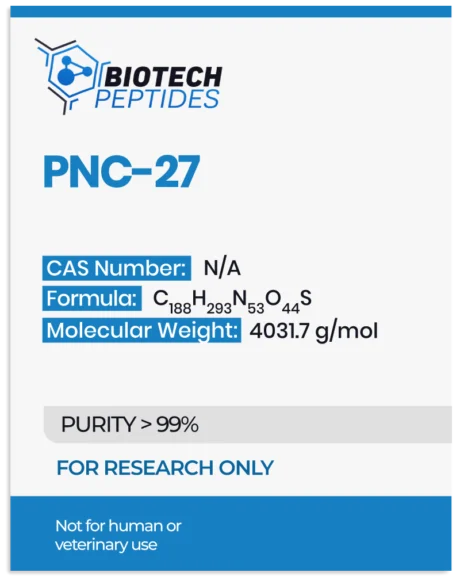
PNC-27 (5mg) is an experimental peptide that has attracted attention in cancer biology, p53 research, MDM2 signalling, apoptosis studies, and molecular biology. PNC-27 For Sale
PNC-27 was developed as a research peptide designed to investigate interactions involving MDM2, a regulatory protein associated with the tumour suppressor protein p53. This relationship makes PNC-27 an interesting subject for researchers studying cellular stress, programmed cell death, and cancer-related molecular pathways.
The p53 pathway is one of the most widely studied systems in cancer biology. It helps cells respond to DNA damage and other forms of cellular stress. When this pathway becomes disrupted, abnormal cell growth can occur.
Researchers have therefore explored compounds that interact with the p53-MDM2 pathway, including experimental peptides such as PNC-27.
If you are researching PNC-27 5mg, this guide explains what it is, how it relates to MDM2 and p53, its research significance, and the key quality factors to consider when evaluating an experimental peptide.
Research disclaimer: PNC-27 is an experimental research peptide. Research findings do not establish PNC-27 as an approved cancer treatment or a substitute for professional medical care.
1. What Is PNC-27? Meet the Experimental Peptide at the Heart of p53 Research
PNC-27 is a synthetic peptide investigated for its interaction with MDM2, a protein that regulates the activity and stability of p53.
The peptide was developed as a research tool to investigate how disrupting certain protein interactions may influence cellular behaviour.
Its scientific interest comes from its connection with a major pathway in cancer research.
Understanding p53
The p53 protein is often called a tumour suppressor because it can help prevent damaged cells from continuing to divide.
When cells experience certain forms of stress, p53 can become activated.
Depending on the circumstances, p53 can influence processes such as:
- Cell cycle regulation
- DNA damage responses
- DNA repair
- Cellular senescence
- Apoptosis
Because of these functions, p53 has become a central focus of molecular cancer research.
What Is MDM2?
MDM2, or mouse double minute 2 homolog, is an important negative regulator of p53.
MDM2 can bind to p53 and regulate its activity and stability.
This creates a complex biological relationship.
When MDM2 activity is altered, p53 signalling can also change.
Researchers study this interaction to better understand how cells control tumour suppressor pathways.
What Does PNC-27 5mg Mean?
PNC-27 5mg refers to a preparation containing a stated amount of five milligrams.
The 5mg designation describes the quantity of material. It does not indicate a recommended dose, treatment schedule, or therapeutic strength.
2. The Fascinating PNC-27, MDM2, and p53 Connection
The relationship between PNC-27 and the MDM2-p53 pathway is central to its research interest.
MDM2 normally interacts with p53 and helps regulate the protein.
This interaction can influence how much active p53 is available inside cells.
PNC-27 has been investigated because of its ability to interact with MDM2-related processes. PNC-27 For Sale
Why the p53-MDM2 Interaction Matters
The p53 pathway plays an important role in maintaining cellular integrity.
If DNA damage occurs, p53 can help cells respond appropriately.
Possible responses include stopping cell division or initiating programmed cell death.
In many cancers, however, p53 signalling can become disrupted.
This can happen through mutations in p53 itself or through changes in proteins that regulate the pathway.
MDM2 is therefore an important target of scientific investigation.
PNC-27 and Protein Interactions
One important area of PNC-27 research involves protein-protein interactions.
Proteins rarely operate alone.
They communicate and regulate one another through highly specific molecular interactions.
By studying peptides that interact with these proteins, scientists can learn more about how cellular signalling works.
PNC-27 provides one experimental model for investigating these relationships.
3. PNC-27 Research: Exploring Apoptosis and Cellular Biology
One of the most interesting areas of PNC-27 research involves apoptosis, commonly known as programmed cell death.
Apoptosis is a natural biological process.
It allows the body to remove damaged, unnecessary, or abnormal cells in a controlled manner.
Why Apoptosis Matters
Healthy tissues require a balance between cell growth and cell death.
Too much cell growth can contribute to abnormal tissue development.
Too much cell death can also cause problems.
Cancer research therefore focuses heavily on understanding how cells regulate apoptosis.
Researchers have investigated whether PNC-27 can influence cellular pathways associated with programmed cell death in experimental models.
These findings are scientifically interesting but should not be interpreted as evidence that PNC-27 is an effective cancer therapy in humans.
PNC-27 and Cancer Biology
The p53-MDM2 pathway is highly relevant to cancer research.
Scientists continue to investigate how abnormal regulation of this pathway may contribute to uncontrolled cellular growth.
PNC-27 is one of many experimental molecules studied in this field.
Research may involve:
- Tumor suppressor pathways
- Protein interactions
- Apoptosis
- Cell cycle regulation
- Cancer cell biology
- Molecular signaling
- Cellular stress responses
These studies can help researchers understand fundamental biological mechanisms.
Why Laboratory Results Need Careful Interpretation
Experimental cancer research often begins with cell-based or molecular studies.
A compound may demonstrate an interesting effect in a laboratory model.
That does not automatically mean it will produce the same effect in humans.
Researchers must consider factors such as delivery, stability, metabolism, toxicity, tissue distribution, and biological complexity. PNC-27 For Sale
This distinction is particularly important with experimental peptides.
4. PNC-27 (5mg): Quality, Purity, and Research Considerations
When evaluating PNC-27 5mg, the stated quantity is only one consideration.
Researchers should also examine the quality and identity of the peptide.
Important information may include:
- Peptide sequence
- Molecular identity
- Purity
- Molecular weight
- Certificate of analysis
- Batch information
- Analytical testing
- Stability
- Solubility
- Storage requirements
These details can help support reliable experimental work.
Why PNC-27 Purity Matters
Peptide purity can affect research results.
Impurities or degradation products may produce unexpected effects or interfere with analytical testing.
Researchers should therefore review available quality documentation for the specific batch.
A certificate of analysis can provide useful information about identity and purity.
However, a label stating PNC-27 5mg does not independently establish purity, biological activity, effectiveness, or safety.
PNC-27 Stability
Synthetic peptides may be sensitive to environmental conditions.
Temperature, moisture, light, pH, and repeated handling can affect stability depending on the formulation.
Researchers should follow the storage and handling specifications provided for the particular material.
Proper storage helps maintain consistency during laboratory work.
Research Material vs. Approved Medicine
This distinction is especially important with PNC-27.
An experimental research peptide is not automatically a pharmaceutical product.
Research materials may be used to investigate biological mechanisms without being approved for diagnosis, treatment, or prevention of disease. PNC-27 For Sale
PNC-27 should therefore be described accurately as an experimental research peptide.
5. The Future of PNC-27 Research: Unlocking New Questions in Cancer Biology
The p53-MDM2 pathway remains an important area of molecular research.
Scientists continue to investigate how cells respond to DNA damage, cellular stress, and abnormal growth signals.
Experimental molecules such as PNC-27 can help researchers explore these complex interactions.
Future research may investigate:
- MDM2 regulation
- p53 signaling
- Protein-protein interactions
- Apoptosis
- Cell cycle control
- Cellular stress responses
- Tumour suppressor biology
- Peptide structure
- Peptide stability
- Targeted molecular research
Why PNC-27 Continues to Attract Scientific Interest
PNC-27 is interesting because it focuses on a highly studied biological interaction.
The relationship between MDM2 and p53 demonstrates how one protein can strongly influence the activity of another.
Understanding these interactions can help researchers investigate the molecular mechanisms behind abnormal cell growth.
PNC-27 therefore represents one small part of a much larger field of cancer biology.
The Bigger Picture
Modern cancer research increasingly focuses on molecular pathways rather than viewing cancer as a single disease. PNC-27 For Sale
Different cancers can involve different genetic changes and signalling mechanisms.
The p53 pathway is one important part of this complex picture.
Research into experimental peptides such as PNC-27 may contribute to a deeper understanding of these molecular relationships.
Frequently Asked Questions About PNC-27 (5mg)
What is PNC-27?
PNC-27 is an experimental synthetic peptide studied in connection with MDM2, p53 signalling, apoptosis, and cancer cell biology.
What does PNC-27 5mg mean?
PNC-27 5mg indicates a preparation containing a stated quantity of five milligrams. It is a measurement of material and does not represent a recommended dosage.
What is p53?
p53 is a tumour suppressor protein that helps cells respond to DNA damage and cellular stress. It can influence cell cycle control, DNA repair, senescence, and apoptosis.
What is MDM2?
MDM2 is a regulatory protein that can bind to p53 and influence its stability and activity. The MDM2-p53 interaction is an important subject in cancer research.
How is PNC-27 related to MDM2?
PNC-27 has been investigated for its interaction with MDM2 and its potential effects on pathways involving p53. These interactions are primarily of interest in experimental molecular research.
Is PNC-27 a cancer treatment?
PNC-27 is an experimental research peptide. It should not be described as an approved cancer treatment or as a replacement for established cancer therapies.
Does PNC-27 kill cancer cells?
Some experimental studies have investigated PNC-27 in relation to cellular death pathways. Laboratory findings do not establish that PNC-27 is an effective or safe cancer treatment in humans.
What is apoptosis?
Apoptosis is programmed cell death. It is a natural process that helps organisms remove damaged or unnecessary cells.
Why is p53 important in cancer research?
p53 can help prevent damaged cells from dividing uncontrollably. Alterations in the p53 pathway are therefore important subjects in cancer biology.
Is PNC-27 a peptide?
Yes. PNC-27 is a synthetic peptide designed for experimental research involving protein interactions and cellular signalling. PNC-27 For Sale
What should researchers look for when evaluating PNC-27 5mg?
Researchers should consider peptide identity, sequence, purity, molecular characterisation, certificate of analysis, batch information, stability, and storage requirements.
Is PNC-27 approved for human use?
PNC-27 should not automatically be considered an approved pharmaceutical product. Experimental research materials and regulated medicines are subject to different standards.
Is PNC-27 safe for personal use?
Safety cannot be assumed from laboratory research. An experimental peptide should not automatically be considered suitable for personal use or self-administration.
Final Thoughts on PNC-27 (5mg)
PNC-27 (5mg) is an intriguing experimental peptide at the intersection of p53 research, MDM2 signalling, apoptosis, and molecular cancer biology.
Its scientific interest comes from the important relationship between MDM2 and p53. Researchers study this pathway because it plays a major role in cellular stress responses and tumour suppressor biology.
PNC-27 research provides an opportunity to investigate protein interactions and cellular signalling in controlled experimental settings. However, laboratory findings should always be interpreted carefully and should not be presented as proof of a human cancer treatment.
When evaluating PNC-27 5mg, researchers should look beyond the stated quantity. Peptide identity, sequence, purity, analytical testing, stability, batch information, and storage conditions are all important.
As molecular research continues to advance, understanding the interactions between proteins such as MDM2 and p53 may provide valuable insight into cellular regulation and cancer biology.
One experimental peptide. One critical cellular pathway. A fascinating area of research into how cells control growth, stress, and programmed cell death.
Brand
Biotech Peptides
Be the first to review “PNC-27 (5mg)”
Related products
PEPTIDES

PEPTIDES

PEPTIDES
PEPTIDES

PEPTIDES
PEPTIDES

PEPTIDES

PEPTIDES
Reviews
There are no reviews yet.