
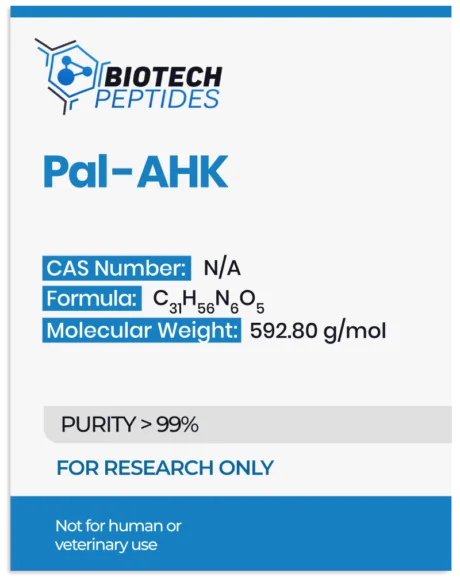
Pal-AHK (200mg)
Original price was: $192.00.$178.00Current price is: $178.00.
Pal-AHK peptides are synthesised and lyophilised In the USA
Discover the Science Behind an Advanced Cosmetic Lipopeptide
Pal-AHK (200mg) is a synthetic lipopeptide that has attracted interest in cosmetic science, skin biology, peptide chemistry, and hair and scalp research. Pal-AHK Peptides.
Pal-AHK combines the short peptide AHK with a palmitoyl group. This lipid component gives the molecule properties that make it interesting for researchers studying peptide-based cosmetic ingredients.
AHK is a tripeptide composed of alanine, histidine, and lysine. When linked to palmitic acid, the resulting molecule is known as Pal-AHK or Palmitoyl Tripeptide-1. However, peptide naming can vary between commercial materials, so researchers should always confirm the exact sequence and chemical identity before use.
The 200mg quantity provides a defined amount of material for cosmetic formulation research and laboratory investigation.
Research disclaimer: Pal-AHK is discussed here as an experimental and cosmetic research material. Pal-AHK Peptides. This content does not establish the peptide as a medical treatment or guarantee hair, skin, or cosmetic results. Researchers and formulators should verify product identity, specifications, and applicable regulatory requirements.
1. What Is Pal-AHK? Explore the Peptide-Lipid Combination Behind the Research
Pal-AHK is a lipopeptide formed by combining the AHK peptide sequence with a palmitoyl group.
Lipopeptides are interesting because they bring together two different chemical characteristics.
The peptide portion contains amino acids, while the lipid portion can influence molecular interactions and formulation behaviour.
Understanding AHK
AHK is a short tripeptide consisting of:
- Alanine
- Histidine
- Lysine
Short peptides like AHK are studied because even small changes in amino acid sequence can influence molecular properties.
The addition of a palmitoyl group creates a modified peptide with different characteristics from the unmodified AHK sequence.
What Does Pal-AHK 200mg Mean?
Pal-AHK 200mg refers to a preparation containing a stated quantity of 200 milligrams.
The 200mg specification describes the amount of research material.
It does not represent a recommended dosage or establish a therapeutic protocol.
For laboratory and cosmetic formulation research, the appropriate quantity depends on the experimental design.
Why Are Lipopeptides Interesting?
Lipopeptides are studied across several areas of science.
Researchers may investigate them in relation to:
- Skin biology
- Hair and scalp research
- Cellular signaling
- Peptide chemistry
- Formulation science
- Molecular interactions
- Cosmetic ingredient development
Pal-AHK fits within this broader field of peptide research.
2. The Fascinating Science of Pal-AHK: Where Peptide Chemistry Meets Cosmetic Research
The combination of a peptide sequence and a lipid group creates an interesting molecular structure.
This structure can affect characteristics such as solubility, formulation compatibility, and interactions with other molecules.
Pal-AHK and Skin Research
Skin is a complex biological system.
Its structure depends on cells, proteins, lipids, extracellular matrix components, and signalling molecules.
Cosmetic researchers investigate peptides because certain sequences may interact with biological pathways involved in skin structure and appearance.
Pal-AHK provides an example of a modified peptide that can be evaluated in this context.
Pal-AHK and Hair Research
Peptide-based cosmetic research also extends to hair and scalp science.
Hair follicles are complex structures influenced by cellular signalling and interactions between different types of cells.
Researchers investigate various peptides and lipopeptides to better understand their potential roles in cosmetic hair and scalp formulations.
Pal-AHK may therefore be of interest within experimental hair research.
However, laboratory interest should not be interpreted as proof that Pal-AHK promotes hair growth or treats hair loss.
The Importance of Lipid Modification
Adding a lipid group to a peptide can change its physicochemical properties.
This can influence how the molecule behaves in a formulation.
The lipid portion may also affect interactions with other lipids and biological structures.
For researchers, this makes Pal-AHK an interesting example of how chemical modification can alter peptide behaviour.
3. Pal-AHK Research: Exploring Skin, Hair, and Advanced Peptide Formulations
Interest in Pal-AHK research comes from the broader development of peptide-based cosmetic ingredients.
Researchers are increasingly studying modified peptides to understand how their structures affect biological and formulation properties.
Pal-AHK and Skin Appearance
Healthy-looking skin depends on multiple factors.
These include hydration, extracellular matrix structure, collagen organisation, environmental exposure, and cellular activity.
Cosmetic peptide research explores whether specific peptide structures can interact with pathways associated with skin appearance.
Pal-AHK can be investigated as part of this wider research area.
Pal-AHK and Extracellular Matrix Research
The extracellular matrix provides structural support around cells.
It contains proteins and other molecules that help maintain tissue organisation.
Researchers study extracellular matrix biology to understand processes involving collagen, elastin, and other structural components.
Peptides and lipopeptides are sometimes investigated within these pathways.
This makes Pal-AHK relevant to research involving skin structure and cosmetic formulation.
Pal-AHK and Hair Follicle Research
Hair follicles contain multiple cell types and signalling pathways.
Researchers continue to investigate the molecular mechanisms that influence follicle biology.
Peptide-based ingredients have attracted attention in cosmetic hair research because of their potential interactions with cellular pathways.
Pal-AHK may be explored in laboratory or formulation studies related to hair and scalp biology.
It is important to distinguish research interest from proven clinical performance.
Pal-AHK in Cosmetic Formulation
A peptide’s behaviour can change significantly depending on the formulation.
Researchers may evaluate factors such as:
- pH
- Solubility
- Concentration
- Compatibility
- Temperature
- Packaging
- Preservatives
- Other active ingredients
These factors can influence stability and product performance.
4. Pal-AHK (200mg): Quality, Purity, and Research Considerations
When evaluating Pal-AHK 200mg, the stated quantity is only one part of the equation.
Researchers should also consider chemical identity, purity, analytical characterisation, and stability.
Useful documentation may include:
- Exact peptide sequence
- Lipid component
- Chemical identity
- Molecular weight
- Purity
- Certificate of analysis
- Batch information
- Analytical testing
- Stability information
- Solubility
- Storage requirements
Why Pal-AHK Purity Matters
Purity is important for reproducible laboratory research.
Unexpected impurities can introduce unwanted variables into experimental results.
A certificate of analysis can provide batch-specific information about identity and purity.
However, a 200mg label alone does not confirm purity, stability, biological activity, or cosmetic performance.
Pal-AHK Stability
Peptide materials can be affected by environmental conditions.
Temperature, moisture, light, pH, and repeated handling can influence stability.
The lipid component may also affect formulation behaviour.
Researchers should follow the specific storage and handling instructions supplied with the material.
Verifying the Exact Peptide Identity
Peptide names can sometimes vary between commercial sources.
This is particularly important for modified peptides and lipopeptides.
Researchers should confirm the exact amino acid sequence, lipid attachment, chemical structure, and analytical specifications. Pal-AHK Peptides.
Accurate identification helps support reliable experimental work.
5. The Future of Pal-AHK Research: Unlocking New Possibilities in Cosmetic Peptide Science
Cosmetic peptide research continues to expand.
Scientists are studying how short peptides and modified peptides can interact with biological systems and how they can be incorporated into advanced formulations.
Pal-AHK represents one interesting example of this field.
Potential Areas for Future Research
Future research may explore:
- Pal-AHK stability
- Peptide-lipid interactions
- Skin biology
- Hair follicle biology
- Scalp research
- Extracellular matrix pathways
- Cellular signaling
- Cosmetic delivery systems
- Formulation compatibility
- Peptide chemistry
Why Pal-AHK Is Scientifically Interesting
Pal-AHK demonstrates how a small peptide can be chemically modified with a lipid group.
This type of modification provides researchers with an opportunity to study how molecular structure influences formulation and biological interactions.
Its potential relevance to skin and hair cosmetic research makes it an interesting subject for continued investigation.
The Bigger Picture of Cosmetic Lipopeptides
The development of lipopeptides reflects the growing sophistication of cosmetic ingredient science.
Researchers are no longer limited to studying simple peptide sequences.
Chemical modifications can create molecules with different physicochemical properties.
Pal-AHK provides another example of this approach.
As peptide chemistry and cosmetic formulation continue to develop, modified peptides may remain an important area of research.
Frequently Asked Questions About Pal-AHK (200mg)
What is Pal-AHK?
Pal-AHK is a synthetic lipopeptide based on the AHK peptide sequence and a palmitoyl group. It is associated with cosmetic and peptide research.
What is AHK?
AHK is a short tripeptide composed of alanine, histidine, and lysine.
What does Pal-AHK 200mg mean?
It refers to a preparation containing a stated quantity of 200 milligrams. The amount describes the quantity of material and does not represent a recommended dosage.
What is a lipopeptide?
A lipopeptide is a molecule containing a peptide component linked to a lipid component. This combination can give the molecule distinctive chemical properties.
Why is Pal-AHK interesting in cosmetic science?
Researchers are interested in Pal-AHK because its peptide and lipid components provide a structure that can be studied in skin biology, hair research, peptide chemistry, and cosmetic formulation.
Is Pal-AHK related to skincare research?
Pal-AHK may be investigated in cosmetic research involving skin biology, extracellular matrix processes, cellular signalling, and skin appearance.
Is Pal-AHK studied for hair research?
Peptide-based cosmetic research includes hair and scalp biology. Pal-AHK may be investigated as part of this broader field, but research interest does not establish it as a proven hair growth treatment.
Can Pal-AHK promote hair growth?
There is not sufficient evidence to present Pal-AHK as a proven hair growth treatment. It is more appropriate to describe it as an experimental research peptide.
What is the purpose of the palmitoyl group?
A palmitoyl group is a lipid modification that can change the physicochemical properties of a peptide. Pal-AHK Peptides. Researchers can study how this modification affects molecular interactions and formulation behaviour.
What should researchers look for when evaluating Pal-AHK 200mg?
Researchers should review the exact peptide sequence, lipid component, chemical identity, molecular weight, purity, certificate of analysis, batch information, stability, and storage requirements.
Why is Pal-AHK purity important?
Purity can influence experimental consistency. Well-characterised research material helps reduce unwanted variables in laboratory studies.
How should Pal-AHK be stored?
Storage requirements depend on the specific preparation. Researchers should follow the supplier’s documented storage and handling instructions.
Can Pal-AHK be used directly on the skin?
A research peptide should not automatically be considered suitable for direct skin application. Pal-AHK Peptides. A finished cosmetic formulation requires appropriate safety assessment, formulation, testing, and regulatory compliance.
Is Pal-AHK an anti-ageing treatment?
Pal-AHK may be discussed in cosmetic research involving skin biology and appearance. It should not be marketed as a proven medical anti-ageing treatment.
Is Pal-AHK approved as a medical treatment?
Research interest does not establish a compound as an approved medical treatment. Regulatory status depends on the specific product and jurisdiction.
Is Pal-AHK safe for personal use?
Safety depends on the exact material, concentration, formulation, route of exposure, and intended application. Pal-AHK Peptides. Experimental research material should not automatically be considered suitable for personal use.
Final Thoughts on Pal-AHK (200mg)
Pal-AHK (200mg) is an interesting molecule within the expanding field of cosmetic peptide and lipopeptide research.
By combining the AHK peptide sequence with a palmitoyl group, Pal-AHK provides researchers with a distinctive molecular structure for studying peptide chemistry, lipid interactions, skin biology, hair research, and cosmetic formulation.
Its potential relevance to skin and scalp research makes it an intriguing subject for continued investigation. Pal-AHK Peptides. However, experimental research should always be distinguished from proven clinical benefits.
For researchers evaluating Pal-AHK 200mg, accurate characterisation is essential. The exact peptide sequence, lipid component, chemical identity, purity, analytical testing, batch information, stability, and storage requirements should all be considered.
As cosmetic science continues to evolve, lipopeptides such as Pal-AHK demonstrate how molecular modification can create new opportunities for research into advanced skincare and cosmetic formulations.
A unique peptide-lipid structure. A fascinating field of research. A closer look at the future of advanced cosmetic peptide science.
Brand
Biotech Peptides
Be the first to review “Pal-AHK (200mg)”
Related products
PEPTIDES
PEPTIDES
PEPTIDES
PEPTIDES
PEPTIDES
PEPTIDES
PEPTIDES
PEPTIDES
Reviews
There are no reviews yet.