
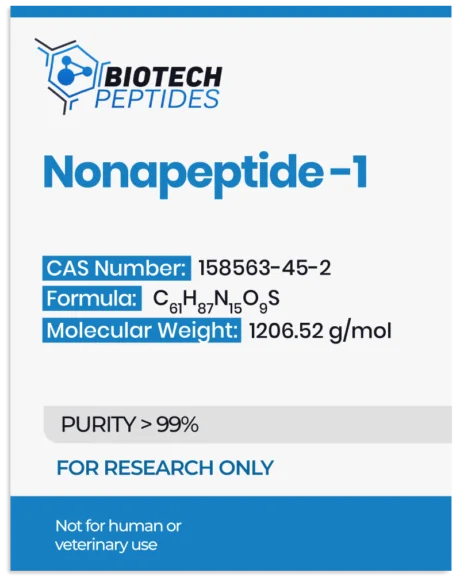
Nonapeptide-1 (200mg)
Original price was: $228.00.$216.00Current price is: $216.00.
Nonapeptide-1 peptides are synthesised and lyophilised In the USA
Discover the Science Behind This Advanced Cosmetic Peptide
Nonapeptide-1 (200mg) is a synthetic peptide that has attracted interest in cosmetic science, skin pigmentation research, melanogenesis, and peptide formulation.
Nonapeptide-1 is also known as Melanostatine 5 and is widely studied in cosmetic research focused on the appearance of uneven skin tone and pigmentation.
As the name suggests, a nonapeptide contains nine amino acid residues. Its specific sequence gives the molecule properties that make it interesting for researchers exploring skin biology and cellular signalling.
Modern skincare research increasingly focuses on targeted peptide ingredients. Rather than simply working at the surface of the skin, researchers investigate how individual peptide sequences may interact with biological pathways involved in pigmentation.
With a stated quantity of 200mg, Nonapeptide-1 provides a defined amount of material for laboratory and cosmetic formulation research.
Research disclaimer: Nonapeptide-1 is discussed as a cosmetic and research peptide. Research findings should not be interpreted as proof of a medical treatment or guaranteed skin-lightening result. Finished cosmetic products should be appropriately formulated and assessed for safety and regulatory compliance.
1. What Is Nonapeptide-1? Discover the Peptide Behind Modern Pigmentation Research
Nonapeptide-1 is a synthetic peptide consisting of nine amino acid residues.
It is commonly associated with the name Melanostatine 5 in cosmetic ingredient research.
The peptide has attracted attention because of research into the biological pathways responsible for melanin production.
Understanding Nonapeptide-1
Skin pigmentation is controlled by a complex biological process called melanogenesis.
Melanogenesis occurs primarily in specialised cells called melanocytes.
These cells produce melanin, the pigment responsible for much of the colour of the skin, hair, and eyes.
Researchers study melanogenesis to understand how pigmentation develops and changes.
Areas of interest include:
- Melanin synthesis
- Melanocyte activity
- Pigment signaling
- Tyrosinase activity
- Skin tone
- Uneven pigmentation
- Cosmetic ingredient interactions
Nonapeptide-1 is particularly interesting because of its association with signalling pathways involved in melanogenesis.
What Does Nonapeptide-1 200mg Mean?
Nonapeptide-1 200mg refers to a preparation containing a stated quantity of 200 milligrams.
The 200mg specification describes the amount of material.
It does not represent a recommended dosage or treatment protocol.
For research applications, the required quantity depends on the experimental design and intended use.
2. The Fascinating Science of Nonapeptide-1: Exploring Melanin and Cellular Signaling
Melanin production is a carefully regulated biological process.
It involves communication between melanocytes and surrounding skin cells.
Understanding these signalling pathways is important for researchers studying pigmentation.
Nonapeptide-1 and Melanogenesis Research
Nonapeptide-1 has been studied in relation to melanogenesis and pigmentation signalling.
Research into this peptide is particularly relevant to cosmetic science because excessive or uneven pigmentation is a common cosmetic concern.
Scientists can use cellular and biochemical models to investigate how peptide ingredients interact with pigmentation pathways.
Nonapeptide-1 and Melanocyte Biology
Melanocytes are specialised cells located primarily within the basal layer of the epidermis.
Their primary role is to produce melanin.
Melanin is stored within structures called melanosomes before being transferred to surrounding keratinocytes.
This complex process determines how pigment is distributed throughout the skin.
Nonapeptide-1 provides researchers with another molecule for investigating this biological system.
The Role of Cellular Signalling
Cellular signalling allows cells to respond to changes in their environment.
In pigmentation biology, signalling molecules can influence melanocyte activity and melanin production.
Research into Nonapeptide-1 has focused on how peptide signalling may interact with these processes.
Understanding these mechanisms may help scientists develop more targeted cosmetic formulations.
3. Nonapeptide-1 Research: Exploring Uneven Skin Tone and Cosmetic Formulation
Interest in Nonapeptide-1 research has grown alongside the wider use of peptides in skincare.
Cosmetic scientists are exploring how specific peptide sequences can be incorporated into products designed to improve the appearance of skin.
Nonapeptide-1 and Uneven Skin Tone
Uneven skin tone can develop for many reasons.
Sun exposure, inflammation, hormonal changes, aging, and other environmental factors can influence pigmentation.
Because pigmentation involves multiple biological pathways, cosmetic research continues to investigate ingredients that may help improve the appearance of uneven skin.
Nonapeptide-1 is one peptide associated with this research.
Nonapeptide-1 and Tyrosinase Research
Tyrosinase is an important enzyme involved in melanin synthesis.
It catalyzes key reactions in the melanogenesis pathway.
For this reason, tyrosinase is widely studied in pigmentation research.
Researchers can examine how cosmetic ingredients interact with tyrosinase and other components of the melanin production pathway.
Nonapeptide-1 and Cosmetic Science
Modern cosmetic formulations may combine multiple active ingredients.
These ingredients can work through different mechanisms or target different aspects of skin appearance.
Nonapeptide-1 can be investigated as part of this broader formulation research.
However, the behavior of a peptide depends on the complete formulation.
Factors such as pH, concentration, stability, packaging, and other ingredients can influence performance.
Why Formulation Matters
A raw peptide material is not the same as a finished skincare product.
A cosmetic formulation may contain:
- Humectants
- Emollients
- Preservatives
- Solvents
- Stabilizers
- Other active ingredients
These components can influence peptide stability and compatibility.
4. Nonapeptide-1 (200mg): Quality, Purity, and Research Considerations
When evaluating Nonapeptide-1 200mg, researchers should look beyond the stated quantity.
Material quality and analytical characterisation are equally important.
Useful documentation may include:
- Exact peptide sequence
- Chemical identity
- Molecular weight
- Purity
- Certificate of analysis
- Batch number
- Analytical testing
- Stability information
- Solubility
- Storage requirements
Why Nonapeptide-1 Purity Matters
Purity can influence research consistency.
Unexpected impurities may introduce unwanted variables into laboratory studies.
A certificate of analysis can provide useful batch-specific information about identity and purity.
However, the 200mg specification alone does not establish purity, stability, biological activity, or cosmetic effectiveness.
Nonapeptide-1 Stability
Peptides can be affected by environmental conditions.
Temperature, moisture, light, pH, and repeated handling can influence stability.
Researchers should follow the supplier’s specific storage and handling instructions.
Proper storage can help maintain consistency throughout a research project.
Research Material vs. Finished Cosmetic
Nonapeptide-1 research material should not automatically be considered a finished skincare ingredient.
Finished cosmetic products require appropriate formulation, safety evaluation, quality control, and compliance with relevant regulations.
Researchers and formulators should evaluate the complete product rather than relying only on the peptide itself.
5. The Future of Nonapeptide-1 Research: Unlocking New Possibilities in Pigmentation Science
Pigmentation remains an active area of cosmetic and biological research.
Scientists continue to investigate how melanocytes produce melanin and how cellular signals influence pigment production.
Peptides such as Nonapeptide-1 provide researchers with additional tools for exploring these pathways.
Potential Areas for Future Research
Future studies may investigate:
- Melanogenesis
- Melanocyte biology
- Tyrosinase pathways
- Melanin synthesis
- Cellular signaling
- Uneven pigmentation
- Skin tone appearance
- Peptide stability
- Cosmetic formulation
- Ingredient compatibility
Why Nonapeptide-1 Is Scientifically Interesting
Nonapeptide-1 provides a defined molecular structure for investigating pigmentation-related pathways.
Its association with melanogenesis makes it particularly relevant to cosmetic science focused on uneven skin tone.
Researchers can examine its properties through controlled laboratory models and formulation studies.
The Bigger Picture of Cosmetic Peptide Research
Nonapeptide-1 is part of a growing family of cosmetic peptides.
Different peptides are investigated for different purposes.
Some are studied in relation to collagen and extracellular matrix pathways.
Others are researched for hydration, skin texture, pigmentation, or cellular signalling.
This diversity makes peptides an important part of modern cosmetic science.
Frequently Asked Questions About Nonapeptide-1 (200mg)
What is Nonapeptide-1?
Nonapeptide-1 is a synthetic peptide consisting of nine amino acid residues. It is also associated with the name Melanostatine 5 and is studied in cosmetic pigmentation research.
What does Nonapeptide-1 200mg mean?
It indicates a preparation containing a stated quantity of 200 milligrams. The amount describes the quantity of material and does not represent a recommended dosage.
Why is Nonapeptide-1 called a nonapeptide?
The term “nonapeptide” refers to a peptide containing nine amino acid residues.
What is Nonapeptide-1 studied for?
Nonapeptide-1 is primarily studied in relation to melanogenesis, melanocyte biology, pigmentation pathways, and cosmetic skin appearance.
What is melanogenesis?
Melanogenesis is the biological process through which melanocytes produce melanin.
What are melanocytes?
Melanocytes are specialised cells responsible for producing melanin. They are found primarily in the basal layer of the epidermis.
What is Melanostatine 5?
Melanostatine 5 is a name commonly associated with Nonapeptide-1 in cosmetic peptide research.
Is Nonapeptide-1 a skin-lightening treatment?
Nonapeptide-1 is associated with cosmetic pigmentation research. It should not be presented as a guaranteed skin-lightening treatment or a medical therapy.
Can Nonapeptide-1 remove hyperpigmentation?
Research into pigmentation peptides does not guarantee that a specific preparation will remove hyperpigmentation. Results can vary depending on the formulation and individual factors.
What is tyrosinase?
Tyrosinase is an enzyme involved in important steps of melanin production. It is widely studied in pigmentation research.
Why is Nonapeptide-1 interesting in cosmetic science?
Its association with pigmentation signalling makes it an interesting molecule for researchers studying uneven skin tone and melanogenesis.
What should researchers look for when evaluating Nonapeptide-1 200mg?
Important factors include peptide sequence, chemical identity, molecular weight, purity, certificate of analysis, batch information, stability, and storage requirements.
Why is peptide purity important?
Purity can affect experimental consistency. Well-characterised research materials can help researchers reduce unwanted variables.
How should Nonapeptide-1 be stored?
Storage requirements depend on the specific preparation. Researchers should follow the supplier’s documented storage and handling instructions.
Can Nonapeptide-1 be used directly on the skin?
A research peptide should not automatically be considered suitable for direct skin application. Finished cosmetic products require appropriate formulation and safety assessment.
Is Nonapeptide-1 approved as a medical treatment?
Nonapeptide-1 should not be presented as an approved medical treatment. Cosmetic research does not automatically establish clinical effectiveness.
Is Nonapeptide-1 safe for personal use?
Safety depends on the exact material, concentration, formulation, and intended application. Experimental research material should not automatically be considered suitable for personal use.
Final Thoughts on Nonapeptide-1 (200mg)
Nonapeptide-1 (200mg) is an intriguing molecule within the expanding field of cosmetic peptide and pigmentation research.
Its nine-amino-acid structure provides researchers with a defined peptide for investigating complex biological pathways associated with melanogenesis and skin pigmentation.
The study of melanin production involves melanocytes, tyrosinase, cellular signalling, melanosomes, and several interconnected biochemical processes.
For researchers evaluating Nonapeptide-1 200mg, quality documentation should remain a priority. Exact peptide identity, sequence, purity, analytical testing, batch information, stability, and storage conditions can all contribute to reliable research.
As cosmetic science continues to advance, Nonapeptide-1 offers an interesting subject for exploring the molecular processes behind pigmentation and the development of modern peptide-based skincare formulations.
Nine amino acids. A fascinating pigmentation pathway. A closer look at the science behind modern cosmetic peptides.
Brand
Biotech Peptides
Be the first to review “Nonapeptide-1 (200mg)”
Related products
PEPTIDES
PEPTIDES
PEPTIDES
PEPTIDES

PEPTIDES
PEPTIDES
PEPTIDES
PEPTIDES
Reviews
There are no reviews yet.